HCP-Young Adult Study
English
United States, Ashburn
The Human Connectome Project
数据描述
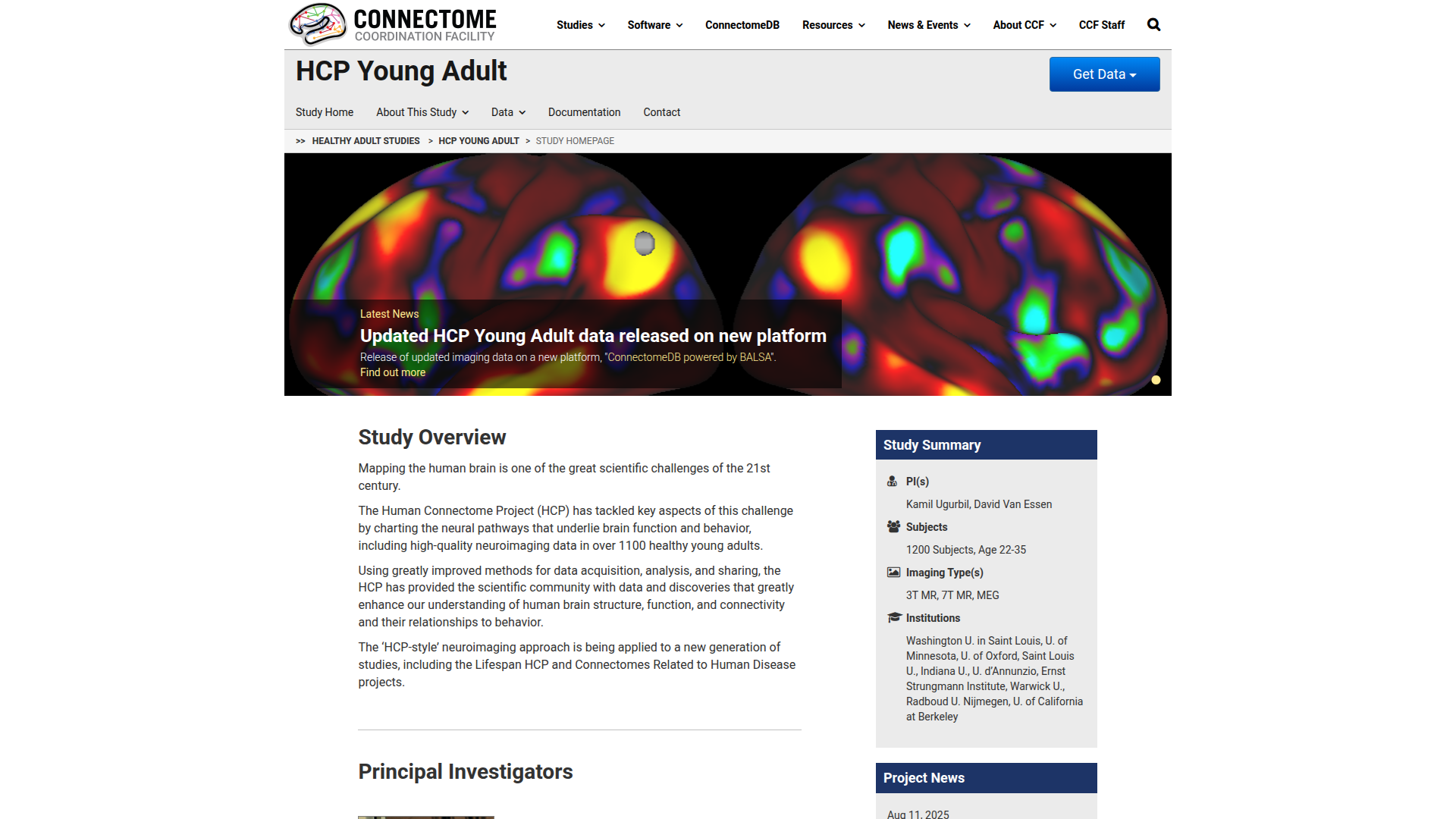
The Human Connectome Project (HCP) Young Adult dataset is a large-scale neuroimaging and phenotypic resource designed to map brain structure, function, and connectivity and relate them to behavior in healthy adults aged 22–35. It includes high-quality 3T MRI data for many participants, with subsets containing 7T MRI and MEG, plus diffusion and functional MRI measures processed with updated pipelines (e.g., spatial/temporal ICA and bias-field correction) and standardized packaging aligned with Lifespan HCP releases. Processed imaging is available for over 1000 subjects, unprocessed imaging for all imaged subjects, and non-imaging phenotypic data for 1206 participants, including retest data for some individuals.
www.humanconnectome.org
IP: 216.70.114.87
加载中...
相关论文
26Vicarious body maps bridge vision and touch in the human brain
Nicholas Hedger•Thomas Naselaris•Kendrick Kay•Tomas Knapen
Nature
2025
•2025/11/26
•00 p.1-9
Our sensory systems work together to generate a cohesive experience of the world around us. Watching others being touched activates brain areas representing our own sense of touch: the visual system recruits touch-related computations to simulate bodily consequences of visual inputs1. One long-stand...
Extrastriate cortexSensory processing
10.1038/S41586-025-09796-0
ISSN:0028-0836
BrainParc: unified lifespan brain parcellation from structural magnetic resonance images
Jiameng Liu•Feihong Liu•Kaicong Sun•Zhiming Cui•Tianyang Sun等 16 人
Nature Computational Science
2026
•2026/3/11
•00 p.1-15
Accurate brain parcellation from structural MRI across the human lifespan is essential for advancing neuroimaging and neuroscience studies. However, existing methods often struggle to generalize owing to intensity and contrast variations across brain maturation, aging and differences in MRI acquisit...
Brain imagingComputational neuroscienceMagnetic resonance imaging
10.1038/S43588-026-00963-5
ISSN:2662-8457
A network correspondence toolbox for quantitative evaluation of novel neuroimaging results
Ru Kong•R. Nathan Spreng•Aihuiping Xue•Richard F. Betzel•Jessica R. Cohen等 22 人
Nature Communications
2025
•2025/3/25
•Vol.16 No.1 p.1-16
The brain can be decomposed into large-scale functional networks, but the specific spatial topographies of these networks and the names used to describe them vary across studies. Such discordance has hampered interpretation and convergence of research findings across the field. We have developed the...
Cognitive neuroscienceNeural circuits
10.1038/S41467-025-58176-9
ISSN:2041-1723
Geometry of neural dynamics along the cortical attractor landscape reflects changes in attention
Hayoung Song•Ruiqi Chen•Thomas L. Botch•Todd S. Braver•Monica D. Rosenberg等 7 人
Nature Communications
2026
•2026/2/12
•Vol.17 No.1 p.26730
Large-scale brain activity reflects changes in attention. To understand how, we tested a hypothesis that the geometry of neural dynamics on the cortical attractor landscape, or movement along its “hills and valleys”, reflects attentional states. A dynamical systems model separating intrinsic dynamic...
AttentionDynamical systems
10.1038/S41467-026-69041-8
ISSN:2041-1723
A stable and replicable neural signature of lifespan adversity in the adult brain
Nathalie E. Holz•Mariam Zabihi•Seyed Mostafa Kia•Maximillian Monninger•Pascal-M. Aggensteiner等 33 人
Nature Neuroscience
2023
•2023/8/21
•00 p.1-10
Environmental adversities constitute potent risk factors for psychiatric disorders. Evidence suggests the brain adapts to adversity, possibly in an adversity-type and region-specific manner. However, the long-term effects of adversity on brain structure and the association of individual neurobiologi...
Predictive markersStress and resilience
10.1038/S41593-023-01410-8
ISSN:1097-6256
White matter micro- and macrostructure brain charts for the human lifespan
Michael E. Kim•Chenyu Gao•Karthik Ramadass•Nancy R. Newlin•Praitayini Kanakaraj等 30 人
Nature
2026
•2026/5/13
•00 p.1-11
The human brain relies on a complex network of connections to function, with white matter acting as the primary communication highway between different brain regions1,2. Disruptions in these critical communication pathways are linked to several neurological, psychiatric and developmental disorders3,...
Brain imagingData processing
10.1038/S41586-026-10454-2
ISSN:0028-0836
Unraveling the link between CNVs, cognition and individual neuroimaging deviation scores from a population-based reference cohort
Charlotte Fraza•Ida E. Sønderby•Rune Boen•Yingjie Shi•Christian F. Beckmann等 6 人
Nature Mental Health
2024
•2024/11/1
•00 p.1-13
Copy number variations (CNVs) are genetic variants that can have a substantial influence on neurodevelopment, neuropsychiatric traits and morphometric brain changes, yet their impact at the individual level remains unknown. Common case–control approaches for analyzing CNVs suffer from limitations; t...
NeuroscienceRisk factors
10.1038/S44220-024-00322-1
ISSN:2731-6076
Brainprints: identifying individuals from magnetoencephalograms
Wu Shenghao•Ramdas Aaditya•Wehbe Leila
Communications Biology
2022
•2022/8/22
•Vol.5 No.1 p.1-12
Magnetoencephalography (MEG) is used to study a wide variety of cognitive processes. Increasingly, researchers are adopting principles of open science and releasing their MEG data. While essential for reproducibility, sharing MEG data has unforeseen privacy risks. Individual differences may make a p...
Cognitive neuroscienceComputational neuroscience
10.1038/S42003-022-03727-9
ISSN:2399-3642
Regional, circuit and network heterogeneity of brain abnormalities in psychiatric disorders
Ashlea Segal•Linden Parkes•Kevin Aquino•Seyed Mostafa Kia•Thomas Wolfers等 24 人
Nature Neuroscience
2023
•2023/8/14
•00 p.1-17
The substantial individual heterogeneity that characterizes people with mental illness is often ignored by classical case–control research, which relies on group mean comparisons. Here we present a comprehensive, multiscale characterization of the heterogeneity of gray matter volume (GMV) difference...
NeurosciencePsychiatric disordersPsychology
10.1038/S41593-023-01404-6
ISSN:1097-6256
Functional brain networks reflect spatial and temporal autocorrelation
Shinn Maxwell•Hu Amber•Turner Laurel•Noble Stephanie•Preller Katrin H.等 16 人
Nature Neuroscience
2023
•2023/4/24
•00 p.1-12
High-throughput experimental methods in neuroscience have led to an explosion of techniques for measuring complex interactions and multi-dimensional patterns. However, whether sophisticated measures of emergent phenomena can be traced back to simpler, low-dimensional statistics is largely unknown. T...
Cognitive neuroscienceComputational neuroscienceFunctional magnetic resonance imaging
10.1038/S41593-023-01299-3
ISSN:1097-6256
A lifespan-generalizable skull-stripping model for magnetic resonance images that leverages prior knowledge from brain atlases
Limei Wang•Yue Sun•Jakob Seidlitz•Richard A. I. Bethlehem•Aaron Alexander-Bloch等 10 人
Nature Biomedical Engineering
2025
•2025/1/8
•00 p.1-16
In magnetic resonance imaging of the brain, an imaging-preprocessing step removes the skull and other non-brain tissue from the images. But methods for such a skull-stripping process often struggle with large data heterogeneity across medical sites and with dynamic changes in tissue contrast across ...
Image processingMachine learning
10.1038/S41551-024-01337-W
ISSN:2157-846X
A mosaic of whole-body representations on the human precentral gyrus
Darrel R. Deo•Elizaveta V. Okorokova•Anna L. Pritchard•Nick V. Hahn•Nicholas S. Card等 28 人
Nature
2026
•2026/6/17
•00 p.1-8
Understanding how the body is represented in the motor cortex is key to understanding how the brain controls movement. Although the motor cortex has been mapped in animal models at a fine scale1–10, characterization in humans remains primarily limited to low-resolution recording11–16 and stimulation...
Brain–machine interfaceMotor cortex
10.1038/S41586-026-10653-X
ISSN:0028-0836
Time-resolved structure-function coupling in brain networks
Liu Zhen-Qi•Vázquez-Rodríguez Bertha•Spreng R. Nathan•Bernhardt Boris C.•Betzel Richard F.等 6 人
Communications Biology
2022
•2022/6/2
•Vol.5 No.1 p.1-10
The relationship between structural and functional connectivity in the brain is a key question in systems neuroscience. Modern accounts assume a single global structure-function relationship that persists over time. Here we study structure-function coupling from a dynamic perspective, and show that ...
Dynamical systemsNetwork models
10.1038/S42003-022-03466-X
ISSN:2399-3642
Structural-functional brain network coupling during cognitive demand reveals intelligence-relevant communication strategies
Johanna L. Popp•Jonas A. Thiele•Joshua Faskowitz•Caio Seguin•Olaf Sporns等 6 人
Communications Biology
2025
•2025/6/4
•Vol.8 No.1 p.1-13
Intelligence is a broad mental capability influencing human performance across tasks. Individual differences in intelligence have been linked to characteristics of structural and functional brain networks. Here, we consider their alignment, the structural-functional brain network coupling (SC-FC cou...
IntelligenceProblem solving
10.1038/S42003-025-08231-4
ISSN:2399-3642
Critical scaling of whole-brain resting-state dynamics
Adrián Ponce-Alvarez•Morten L. Kringelbach•Gustavo Deco
Communications Biology
2023
•2023/6/10
•Vol.6 No.1 p.1-11
Scale invariance is a characteristic of neural activity. How this property emerges from neural interactions remains a fundamental question. Here, we studied the relation between scale-invariant brain dynamics and structural connectivity by analyzing human resting-state (rs-) fMRI signals, together w...
Network modelsNeural circuits
10.1038/S42003-023-05001-Y
ISSN:2399-3642
Predicting categorical and continuous Alzheimer’s disease outcomes from a single MRI scan
Daren Ma•Christabelle Pabalan•Abhejit Rajagopal•Akanksha Akanksha•Yannet Interian等 7 人
Nature Aging
2026
•2026/5/18
•Vol.6 No.5 p.1121-1137
Deep learning (DL) has shown success in predicting Alzheimer’s disease (AD) diagnosis, yet continuous measures such as cognitive assessment remain critical for richer prognosis, trajectory tracking and clinical trial enrichment. Current neurocognitive batteries are time-consuming, and the few DL mod...
Alzheimer's diseaseCognitive ageing
10.1038/S43587-026-01121-2
ISSN:2662-8465
Connectome-constrained ligand-receptor interaction analysis for understanding brain network communication
Zongchang Du•Congying Chu•Weiyang Shi•Na Luo•Yuheng Lu等 10 人
Nature Communications
2025
•2025/9/2
•Vol.16 No.1 p.1-17
Both diffusion magnetic resonance imaging and transcriptomic technologies have provided unprecedented opportunities to dissect brain network communication, offering insights from structural connectivity and signaling molecules separately. However, incorporating these complementary modalities for cha...
Cognitive neuroscienceComputational modelsData integrationNetwork models
10.1038/S41467-025-63204-9
ISSN:2041-1723
Normative modeling of MEG brain oscillations across the human lifespan
Mohammad Zamanzadeh•Ymke Verduyn•Augustijn de Boer•Tomas Ros•Thomas Wolfers等 10 人
Communications Biology
2026
•2026/3/17
0Normative modeling provides a principled framework for quantifying individual deviations from typical brain development and is increasingly used to study heterogeneity in neuropsychiatric conditions. While widely applied to structural phenotypes, functional normative models remain underdeveloped. He...
MagnetoencephalographyNeural ageing
10.1038/S42003-026-09825-2
ISSN:2399-3642
The network architecture of general intelligence in the human connectome
Ramsey R. Wilcox•Babak Hemmatian•Lav R. Varshney•Aron K. Barbey
Nature Communications
2026
•2026/1/26
•Vol.17 No.1 p.20270
Advances in network neuroscience challenge the view that general intelligence (g) emerges from a primary brain region or network. Network Neuroscience Theory (NNT) proposes that g arises from coordinated activity across the brain’s global network architecture. We tested predictions from NNT in 831 h...
Human behaviourIntelligence
10.1038/S41467-026-68698-5
ISSN:2041-1723
Eigenmode-based approach reveals a decline in brain structure–function liberality across the human lifespan
Yaqian Yang•Shaoting Tang•Xin Wang•Yi Zhen•Yi Zheng等 8 人
Communications Biology
2023
•2023/11/7
•Vol.6 No.1 p.1-16
While brain function is supported and constrained by the underlying structure, the connectome-based link estimated by current approaches is either relatively moderate or accompanied by high model complexity, with the essential principles underlying structure-function coupling remaining elusive. Here...
Cognitive ageingNetwork models
10.1038/S42003-023-05497-4
ISSN:2399-3642
ReX: an integrative tool for quantifying and optimizing measurement reliability for the study of individual differences
Ting Xu•Gregory Kiar•Jae Wook Cho•Eric W. Bridgeford•Aki Nikolaidis等 7 人
Nature Methods
2023
•2023/6/1
•00 p.1-4
Characterizing multifaceted individual differences in brain function using neuroimaging is central to biomarker discovery in neuroscience. We provide an integrative toolbox, Reliability eXplorer (ReX), to facilitate the examination of individual variation and reliability as well as the effective dir...
NeuroscienceSoftware
10.1038/S41592-023-01901-3
ISSN:1548-7091
Measurement characteristics and genome-wide correlates of lifetime brain atrophy estimated from a single MRI
Anna E. Fürtjes•Isabelle F. Foote•Charley Xia•Gail Davies•Joanna Moodie等 24 人
Nature Communications
2025
•2025/7/21
•Vol.16 No.1 p.1-15
As a cardinal marker of brain ageing, lifetime brain atrophy obtained from a cross-sectional magnetic resonance image promises to boost statistical power to uncover novel genetic mechanisms of neurodegeneration. By analysing five young and old adult cohorts, we perform the most definitive study on l...
Medical geneticsNeural ageing
10.1038/S41467-025-61978-6
ISSN:2041-1723
Modeling macroscopic brain dynamics with brain-inspired computing architecture
Zhong Zheng•Jing Wei•Yaru Xu•Chenhua Li•Tianying Lu等 10 人
Nature Communications
2025
•2025/10/24
•Vol.16 No.1 p.1-22
Understanding the brain requires modeling large-scale neural dynamics, where coarse-grained modeling of macroscopic brain behaviors is a powerful paradigm for linking brain structure to function with empirical data. However, the model inversion process remains computationally intensive and time-cons...
EngineeringMathematics and computing
10.1038/S41467-025-64470-3
ISSN:2041-1723
Transcriptomic profiles link corticostriatal microarchitecture to genetics of neurodevelopment and neuropsychiatric risks
Sheng Hu•Yanming Wang•Xiaoxiao Wang•Yang Ji•Chuanfu Li等 6 人
Translational Psychiatry
2025
•2025/2/11
•Vol.15 No.1 p.1-10
Many studies on macroscale organization have focused on only the cerebral cortex or striatum, leaving a large gap in the microstructural gradient of corticostriatal covariance. Here, we partitioned the striatum into seven distinct parcels and computed the microstructural covariance between each parc...
GeneticsNeurosciencePhysiology
10.1038/S41398-025-03260-3
ISSN:2158-3188
Contributions of network structure, chemoarchitecture and diagnostic categories to transitions between cognitive topographies
Andrea I. Luppi•S. Parker Singleton•Justine Y. Hansen•Keith W. Jamison•Danilo Bzdok等 8 人
Nature Biomedical Engineering
2024
•2024/8/5
•00 p.1-20
The mechanisms linking the brain’s network structure to cognitively relevant activation patterns remain largely unknown. Here, by leveraging principles of network control, we show how the architecture of the human connectome shapes transitions between 123 experimentally defined cognitive activation ...
Biomedical engineeringCognitive neuroscienceComputational neuroscience
10.1038/S41551-024-01242-2
ISSN:2157-846X
How measurement noise limits the accuracy of brain-behaviour predictions
Martin Gell•Simon B. Eickhoff•Amir Omidvarnia•Vincent Küppers•Kaustubh R. Patil等 8 人
Nature Communications
2024
•2024/12/12
•Vol.15 No.1 p.1-12
Major efforts in human neuroimaging strive to understand individual differences and find biomarkers for clinical applications by predicting behavioural phenotypes from brain imaging data. To identify generalisable and replicable brain-behaviour prediction models, sufficient measurement reliability i...
Human behaviourMachine learningNeuroscience
10.1038/S41467-024-54022-6
ISSN:2041-1723