Multimodal profiling of 500,000 memory T cells from a tuberculosis cohort
Aparna Nathan
2021
2021/5/24
United States, Cabin John
Harvard Medical School, Brigham and Women's Hospital
数据描述
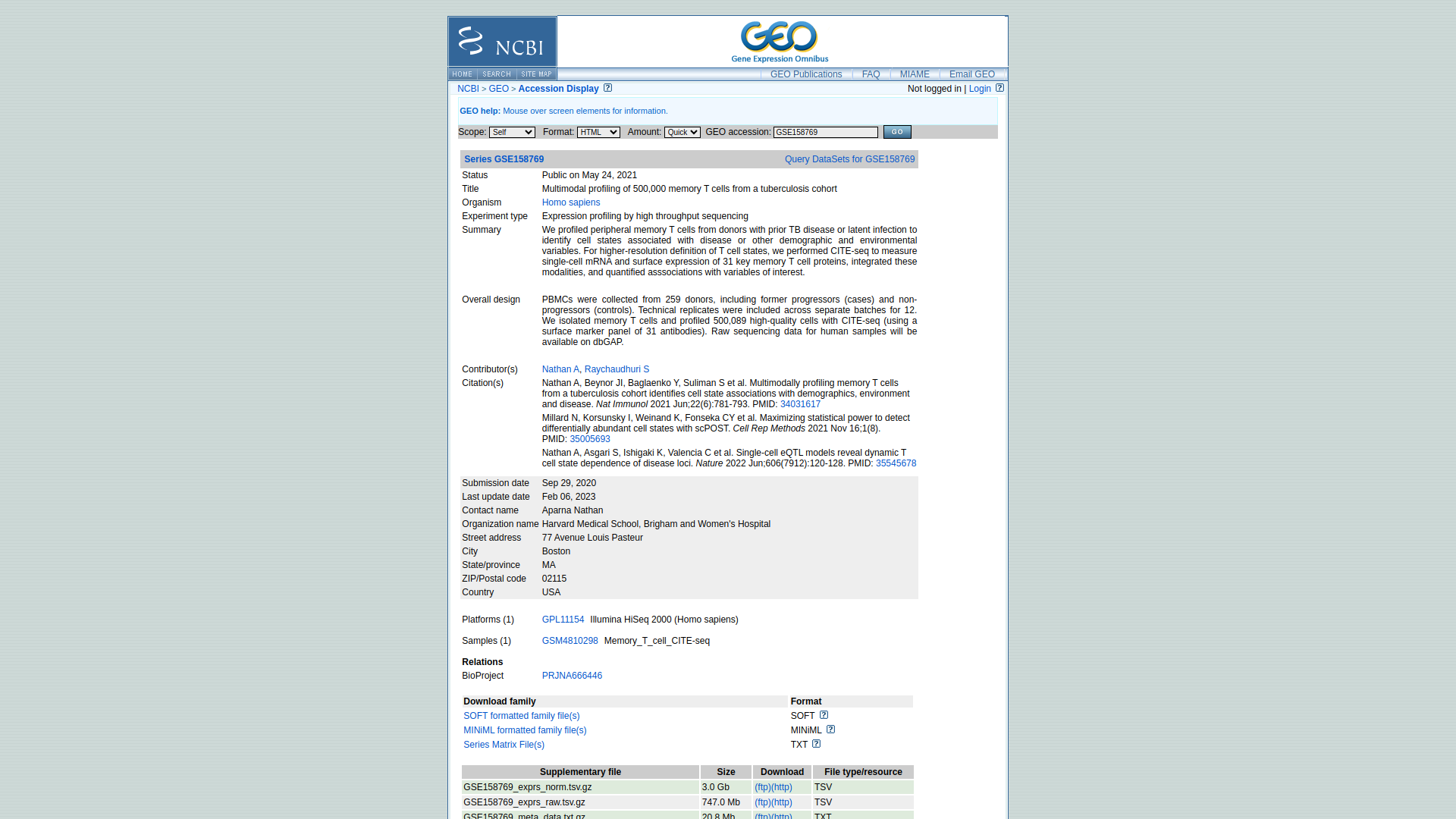
We profiled peripheral memory T cells from donors with prior TB disease or latent infection to identify cell states associated with disease or other demographic and environmental variables. For higher-resolution definition of T cell states, we performed CITE-seq to measure single-cell mRNA and surface expression of 31 key memory T cell proteins, integrated these modalities, and quantified asssociations with variables of interest.
关键词
1Homo sapiens
www.ncbi.nlm.nih.gov
IP: 130.14.29.110
加载中...
相关论文
8A statistical framework for differential pseudotime analysis with multiple single-cell RNA-seq samples
Wenpin Hou•Zhicheng Ji•Zeyu Chen•E. John Wherry•Stephanie C. Hicks等 6 人
Nature Communications
2023
•2023/11/10
•Vol.14 No.1 p.1-21
Pseudotime analysis with single-cell RNA-sequencing (scRNA-seq) data has been widely used to study dynamic gene regulatory programs along continuous biological processes. While many methods have been developed to infer the pseudotemporal trajectories of cells within a biological sample, it remains a...
Data processingMathematics and computingSoftwareStatistical methodsTranscriptomics
10.1038/S41467-023-42841-Y
ISSN:2041-1723
Multimodally profiling memory T cells from a tuberculosis cohort identifies cell state associations with demographics, environment and disease
Aparna Nathan•Jessica I. Beynor•Yuriy Baglaenko•Sara Suliman•Kazuyoshi Ishigaki等 19 人
Nature Immunology
2021
•2021/5/24
•Vol.22 No.6 p.781-793
Multimodal T cell profiling can enable more precise characterization of elusive cell states underlying disease. Here, we integrated single-cell RNA and surface protein data from 500,089 memory T cells to define 31 cell states from 259 individuals in a Peruvian tuberculosis (TB) progression cohort. A...
ImmunogeneticsSequencingT cellsTranslational immunologyTuberculosis
10.1038/S41590-021-00933-1
ISSN:1529-2908
FLASH-MM: fast and scalable single-cell differential expression analysis using linear mixed-effects models
Changjiang Xu•Delaram Pouyabahar•Veronique Voisin•Hamed Heydari•Gary D. Bader
Nature Communications
2026
•2026/2/5
•Vol.17 No.1 p.23840
Single-cell RNA sequencing (scRNA-seq) enables detailed comparisons of gene expression across cells and conditions. Single-cell differential expression analysis faces challenges like sample correlation, individual variation, and scalability. We develop a fast and scalable linear mixed-effects model ...
SoftwareStatistical methods
10.1038/S41467-026-69063-2
ISSN:2041-1723
Single-cell eQTL models reveal dynamic T cell state dependence of disease loci
Nathan Aparna•Asgari Samira•Ishigaki Kazuyoshi•Valencia Cristian•Amariuta Tiffany等 14 人
Nature
2022
•2022/5/11
•00 p.1-9
Non-coding genetic variants may cause disease by modulating gene expression. However, identifying these expression quantitative trait loci (eQTLs) is complicated by differences in gene regulation across fluid functional cell states within cell types. These states—for example, neurotransmitter-driven...
Gene regulationQuantitative trait lociStatistical methodsT cellsTranscriptomics
10.1038/S41586-022-04713-1
ISSN:0028-0836
Continual integration of single-cell multimodal data with MIRACLE
Jiahao Zhou•Jing Wang•Shuofeng Hu•Tongtong Kan•Chao Feng等 13 人
Nature Computational Science
2026
•2026/7/31
•00 p.1-17
Single-cell sequencing has transformed our understanding of cellular heterogeneity, enabling the construction of multi-omics atlases through data integration. However, conventional atlas updates require full reintegration of all datasets, creating scalability challenges that limit the timeliness and...
BioinformaticsData integrationMachine learning
10.1038/S43588-026-01030-9
ISSN:2662-8457
Repertoire analyses reveal T cell antigen receptor sequence features that influence T cell fate
Lagattuta Kaitlyn A.•Kang Joyce B.•Nathan Aparna•Pauken Kristen E.•Jonsson Anna Helena等 9 人
Nature Immunology
2022
•2022/2/17
•00 p.1-12
T cells acquire a regulatory phenotype when their T cell antigen receptors (TCRs) experience an intermediate- to high-affinity interaction with a self-peptide presented via the major histocompatibility complex (MHC). Using TCRβ sequences from flow-sorted human cells, we identified TCR features that ...
Immune toleranceVDJ recombination
10.1038/S41590-022-01129-X
ISSN:1529-2908
Polygenic enrichment distinguishes disease associations of individual cells in single-cell RNA-seq data
Zhang Martin Jinye•Hou Kangcheng•Dey Kushal K.•Sakaue Saori•Jagadeesh Karthik A.等 15 人
Nature Genetics
2022
•2022/9/1
•Vol.54 No.10 p.1572-1580
Single-cell RNA sequencing (scRNA-seq) provides unique insights into the pathology and cellular origin of disease. We introduce single-cell disease relevance score (scDRS), an approach that links scRNA-seq with polygenic disease risk at single-cell resolution, independent of annotated cell types. sc...
Gene expressionGenome-wide association studiesSoftware
10.1038/S41588-022-01167-Z
ISSN:1061-4036
Reproducible single-cell annotation of programs underlying T cell subsets, activation states and functions
Dylan Kotliar•Michelle Curtis•Ryan Agnew•Kathryn Weinand•Aparna Nathan等 11 人
Nature Methods
2025
•2025/9/3
•00 p.1-17
T cells recognize antigens and induce specialized gene expression programs (GEPs), enabling functions like proliferation, cytotoxicity and cytokine production. Traditionally, different T cell classes are thought to exhibit mutually exclusive responses, including TH1, TH2 and TH17 programs. However, ...
Adaptive immunityComputational biology and bioinformaticsSequencingSystems biology
10.1038/S41592-025-02793-1
ISSN:1548-7091