ARP@VST: a multi-band (g, r, i, H𝛼) imaging survey of the peculiar galaxies in the ARP catalog, visible from the ESO Cerro Paranal Observatory
English
Science Users Information
数据描述
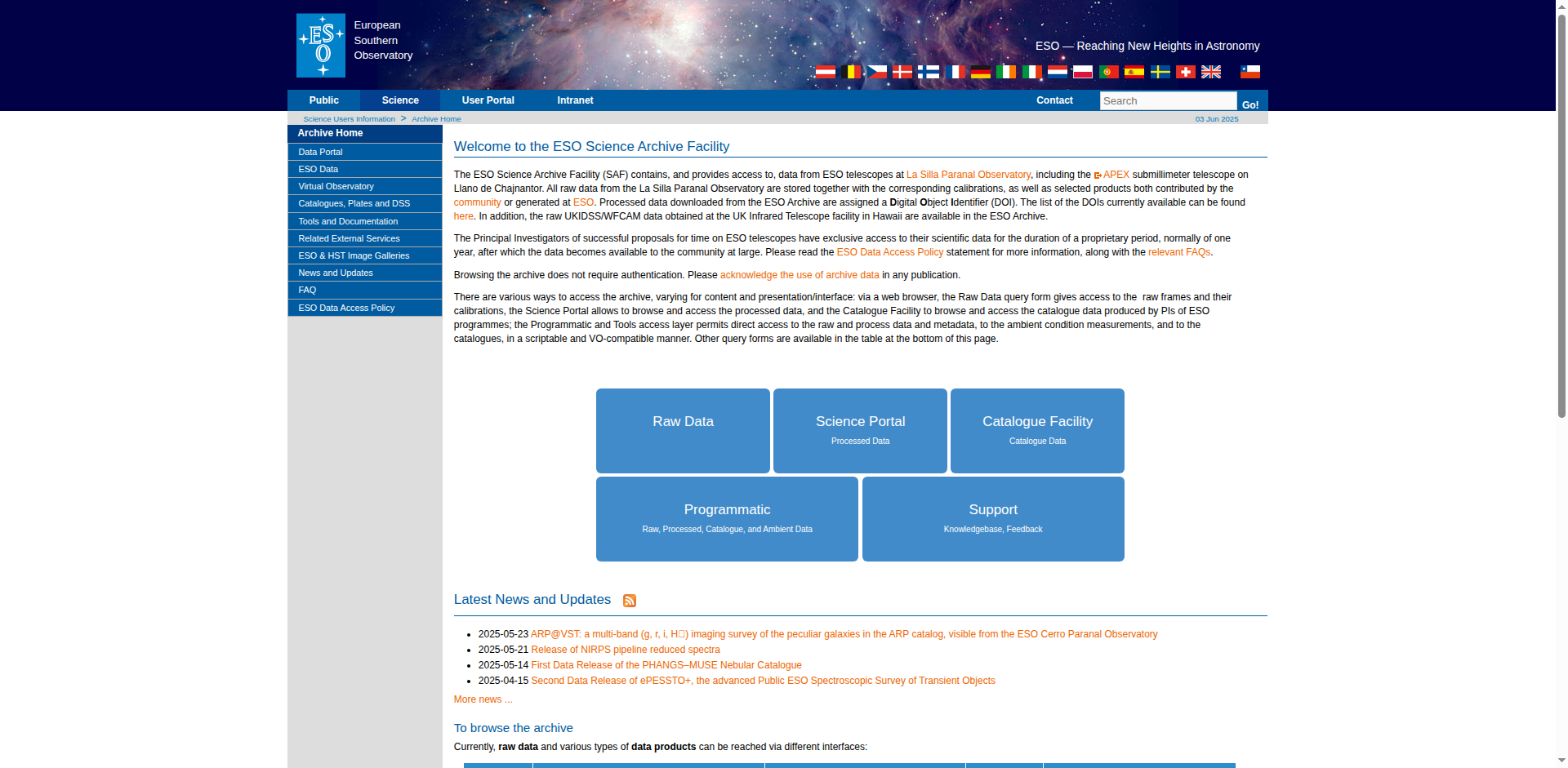
The ESO Science Archive Facility (SAF) contains, and provides access to, data from ESO telescopes at La Silla Paranal Observatory, including the APEX submillimeter telescope on Llano de Chajnantor. All raw data from the La Silla Paranal Observatory are stored together with the corresponding calibrations, as well as selected products both contributed by the community or generated at ESO. In addition, the raw UKIDSS/WFCAM data obtained at the UK Infrared Telescope facility in Hawaii are available in the ESO Archive.
archive.eso.org
IP: 134.171.46.246
加载中...
相关论文
4Compact dusty starbursts at cosmic noon linked to high-energy neutrinos
Yuji Urata•Kuiyun Huang•Bunyo Hatsukade•Mansi Kasliwal•Shigeo S. Kimura等 10 人
Nature Astronomy
2026
•2026/6/17
•00 p.1-14
The origin of high-energy astrophysical neutrinos remains unresolved, and secure electromagnetic counterparts to individual events are rare despite rapid follow-up. Dusty star-forming galaxies (DSFGs) at cosmic noon (z ≈ 1–4) are natural cosmic-ray calorimeters, yet observational links between DSFGs...
Astrophysical dustGalaxies and clustersHigh-energy astrophysicsParticle astrophysics
10.1038/S41550-026-02884-9
ISSN:2397-3366
Quasar radiation transforms the gas in a merging companion galaxy
Sergei Balashev•Pasquier Noterdaeme•Neeraj Gupta•Jens-Kristian Krogager•Françoise Combes等 10 人
Nature
2025
•2025/5/21
•Vol.641 No.8065 p.1137-1141
Quasars, powered by gas accretion onto supermassive black holes1,2, rank among the most energetic objects in the Universe3,4. Although they are thought to be ignited by galaxy mergers5–11 and affect the surrounding gas12–15, observational constraints on both processes remain scarce16–18. Here we des...
Galaxies and clustersInterstellar medium
10.1038/S41586-025-08966-4
ISSN:0028-0836
High nitrogen and carbon isotopic ratios in the interstellar comet 3I/ATLAS
C. Opitom•J. Manfroid•D. Hutsemékers•E. Jehin•M. M. Knight等 16 人
Nature Astronomy
2026
•2026/7/6
•00 p.1-10
Interstellar objects provide a unique opportunity to deepen our understanding of planetary formation by enabling detailed study of material formed around other stars. Their ices contain precious clues about the environment and conditions prevailing in their home system. As fractionation processes ca...
Asteroids, comets and Kuiper beltPlanetary science
10.1038/S41550-026-02921-7
ISSN:2397-3366
Calcium in a supernova remnant as a fingerprint of a sub-Chandrasekhar-mass explosion
Priyam Das•Ivo R. Seitenzahl•Ashley J. Ruiter•Friedrich K. Röpke•Rüdiger Pakmor等 15 人
Nature Astronomy
2025
•2025/7/2
•00 p.1-10
Type Ia supernovae play a fundamental role as cosmological probes of dark energy and produce more than half of the iron in our Galaxy. Despite their central importance, a comprehensive understanding of their progenitor systems and triggering mechanism is still a long-standing fundamental problem. He...
Stellar evolutionTime-domain astronomy
10.1038/S41550-025-02589-5
ISSN:2397-3366