Two Micron All Sky Survey (2MASS)
English
United States, Pasadena
NASA

数据描述

Two Micron All Sky Survey (2MASS)

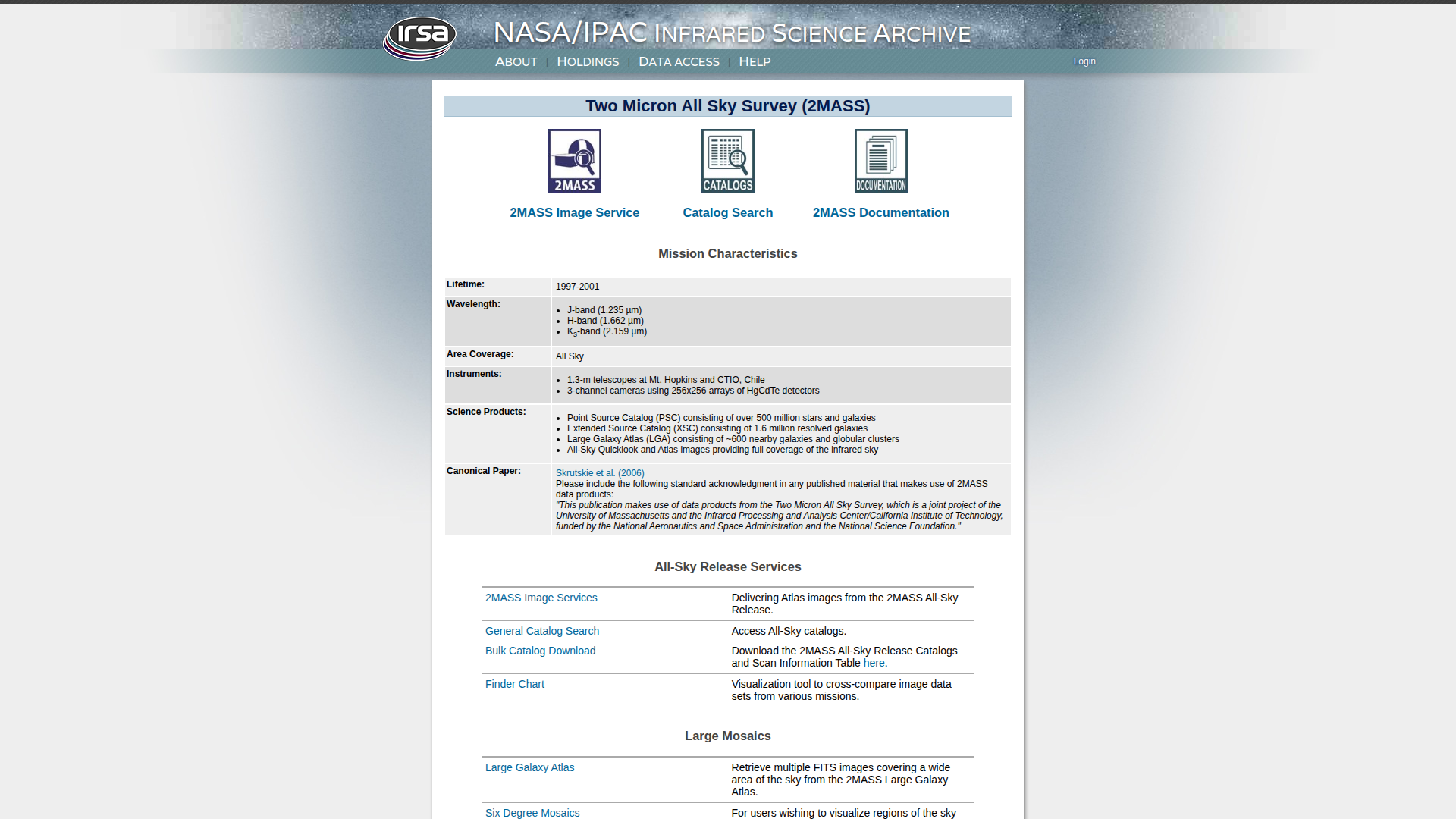
The Two Micron All Sky Survey (2MASS), conducted from 1997 to 2001, utilized a network of 1.3-meter telescopes equipped with HgCdTe detectors to capture images across three infrared bands: J-band (1.235 µm), H-band (1.662 µm), and Ks-band (2.159 µm). Covering the entire sky, it produced a comprehensive dataset including the Point Source Catalog with over 500 million detections of stars and galaxies, the Extended Source Catalog featuring 1.6 million resolved galaxies, and the Large Galaxy Atlas containing detailed images of approximately 600 nearby galaxies. The survey also provided All-Sky Quicklook and Atlas images, along with tools like Finder Charts and Six-Degree Mosaics for analyzing large sky regions. The data products have been widely used in astronomical research and require acknowledgment in published works.

irsa.ipac.caltech.edu
IP: 134.4.54.87
访问数据源
加载中...

相关论文

2

Discovery of quasar variability and early accretion disk signatures at cosmic dawn

Gene C. K. LeungAnna-Christina EilersChristos PanagiotouJulien WolfKishalay De15
Nature Astronomy
2026
2026/6/8
00 p.1-8
In the nearby universe, quasars are well known to exhibit variability in their brightness over time, offering a powerful tool to probe the physics of accretion onto the supermassive black hole (SMBH) and directly measure the mass of the SMBH. However, detecting variability in early quasars remains c...
Astrophysical disksEarly universeGalaxies and clustersTime-domain astronomy
10.1038/S41550-026-02897-4
ISSN:2397-3366

Galaxy and black hole co-evolution in dark matter haloes not captured by cosmological simulations

Hassen M. YesufConnor Bottrell
Nature Astronomy
2026
2026/2/25
00 p.1-16
Star formation in galaxies is governed by internal and environmental processes, yet their relative roles are not well understood. In particular, uncertainties in measurements of active galactic nuclei (AGN) host galaxies, combined with modelling limitations, obfuscate the impact of supermassive blac...
Astronomy and astrophysics
10.1038/S41550-026-02792-Y
ISSN:2397-3366