Constraining the Formation Mechanisms of Wide-Orbit Planets: The Case of Fomalhaut b
English
Germany, Garching
QSO

数据描述

Constraining the Formation Mechanisms of Wide-Orbit Planets: The Case of Fomalhaut b

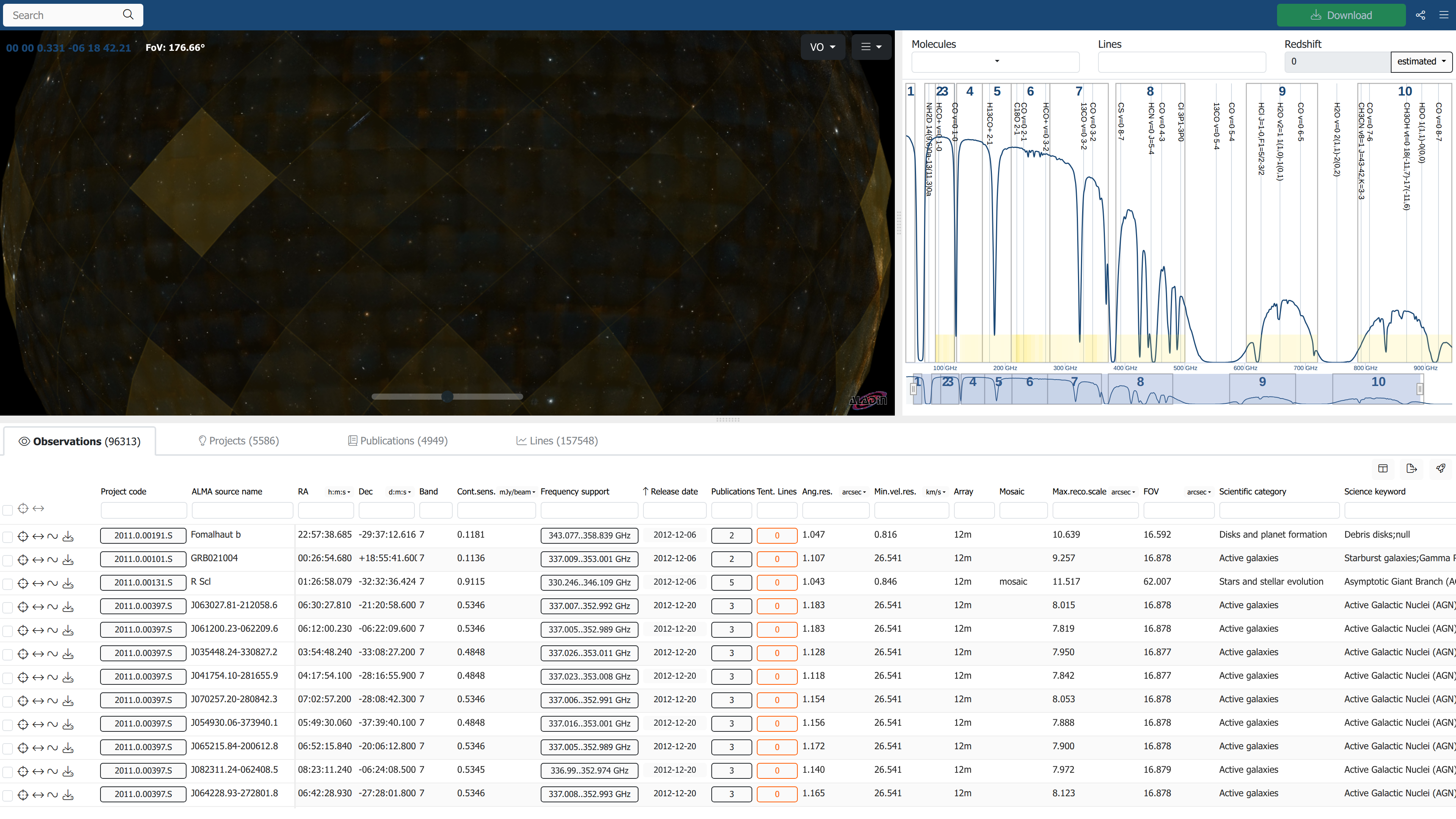
This dataset comprises ALMA (Atacama Large Millimeter/submillimeter Array) observations spanning multiple projects, including studies of debris disks, gamma-ray bursts, asymptotic giant branch stars, and active galactic nuclei, with a total of 96,313 observations across 5,586 projects. It contains 157,548 spectral lines from molecules such as CO, HCO+, CS, HCN, and H2O, observed over frequency ranges from 100 to 900 GHz. The data include detailed parameters for each source, such as coordinates, band, continuum sensitivity, angular resolution, velocity resolution, and integration time, with metadata on project codes, principal investigators, and publication references. This collection supports research into star and planet formation, stellar evolution, and galaxy evolution.

almascience.eso.org
IP: 134.171.46.218
访问数据源
加载中...

相关论文

19

Phosphine gas in the cloud decks of Venus

Jane S. GreavesAnita M. S. RichardsWilliam BainsPaul B. RimmerHideo Sagawa19
Nature Astronomy
2020
2020/9/14
00 p.1-10
Measurements of trace gases in planetary atmospheres help us explore chemical conditions different to those on Earth. Our nearest neighbour, Venus, has cloud decks that are temperate but hyperacidic. Here we report the apparent presence of phosphine (PH3) gas in Venus’s atmosphere, where any phospho...
Astronomy and planetary scienceChemistry
10.1038/S41550-020-1174-4
ISSN:2397-3366

A dynamically cold disk galaxy in the early Universe

F. RizzoS. VegettiD. PowellF. FraternaliJ. P. McKean7
Nature
2020
2020/8/12
Vol.584 No.7820 p.201-204
The extreme astrophysical processes and conditions that characterize the early Universe are expected to result in young galaxies that are dynamically different from those observed today1–5. This is because the strong effects associated with galaxy mergers and supernova explosions would lead to most ...
Science, Humanities and Social Sciences, multidisciplinaryScience, multidisciplinary
10.1038/S41586-020-2572-6
ISSN:0028-0836

Four annular structures in a protostellar disk less than 500,000 years old

Dominique M. Segura-CoxAnika SchmiedekeJaime E. PinedaIan W. StephensManuel Fernández-López11
Nature
2020
2020/10/7
Vol.586 No.7828 p.228-231
Annular structures (rings and gaps) in disks around pre-main-sequence stars have been detected in abundance towards class II protostellar objects that are approximately 1,000,000 years old1. These structures are often interpreted as evidence of planet formation1–3, with planetary-mass bodies carving...
Science, Humanities and Social Sciences, multidisciplinaryScience, multidisciplinary
10.1038/S41586-020-2779-6
ISSN:0028-0836

Binary progenitor systems for Type Ic supernovae

Martín SolarMichał J. MichałowskiJakub NadolnyLluís GalbanyJens Hjorth21
Nature Communications
2024
2024/9/3
Vol.15 No.1 p.1-9
Core-collapse supernovae are explosions of massive stars at the end of their evolution. They are responsible for metal production and for halting star formation, having a significant impact on galaxy evolution. The details of these processes depend on the nature of supernova progenitors, but it is u...
Interstellar mediumStellar evolution
10.1038/S41467-024-51863-Z
ISSN:2041-1723

Bowshocks driven by the pole-on molecular jet of outbursting protostar SVS 13

Guillermo Blázquez-CaleroGuillem AngladaSylvie CabritMayra OsorioAlejandro C. Raga16
Nature Astronomy
2025
2025/12/16
00 p.1-19
Outflows play a key role in the star and planet formation processes. Some outflows show discrete clumps of cold molecular gas moving at extremely high velocities (EHVs) of ~100 km s−1, known as ‘molecular bullets’, that are likely closely associated with their primary driving agent. Here we present ...
Interstellar mediumStellar evolution
10.1038/S41550-025-02716-2
ISSN:2397-3366

A [C ii] 158 μm emitter associated with an O i absorber at the end of the reionization epoch

Wu YunjingCai ZhengNeeleman MarcelFinlator KristianZhang Shiwu14
Nature Astronomy
2021
2021/9/27
00 p.1-8
The physical and chemical properties of the circumgalactic medium at z ≳ 6 have been studied successfully through the absorption in the spectra of background quasi-stellar objects1–3. One of the most crucial questions is to investigate the nature and location of the source galaxies that give rise to...
Astrophysical dustGalaxies and clusters
10.1038/S41550-021-01471-4
ISSN:2397-3366

Evidence for the Keplerian orbit of a close companion around a giant star

Mats EsseldeursLeen DecinJoris De RidderYoshiya MoriAmanda I. Karakas34
Nature Astronomy
2025
2025/11/13
00 p.1-20
Close companions influence stellar evolution through tidal interactions, mass transfer and mass-loss effects. While such companions are detected around young stellar objects, main-sequence stars, red giants and compact objects, direct observational evidence of close-in companions around asymptotic g...
StarsStellar evolutionTime-domain astronomy
10.1038/S41550-025-02697-2
ISSN:2397-3366

Measurement of the gas consumption history of a massive quiescent galaxy

Jan ScholtzFrancesco D’EugenioRoberto MaiolinoPablo G. Pérez-GonzálezChiara Circosta26
Nature Astronomy
2026
2026/1/12
Vol.10 No.3 p.431-439
The James Webb Space Telescope is discovering increasing numbers of quiescent galaxies 1–2 billion years after the Big Bang, whose redshift, high mass and old stellar ages indicate that their formation and quenching were surprisingly rapid. This fast-paced evolution seems to require that feedback fr...
Early universeGalaxies and clusters
10.1038/S41550-025-02751-Z
ISSN:2397-3366

A likely flyby of binary protostar Z CMa caught in action

Dong RuobingLiu Hauyu BaobabCuello NicolásPinte ChristopheÁbrahám Péter19
Nature Astronomy
2022
2022/1/13
00 p.1-8
Close encounters between young stellar objects in star-forming clusters are expected to markedly perturb circumstellar disks. Such events are witnessed in numerical simulations of star formation1–3, but few direct observations of ongoing encounters have been made. Here we report sub-0.1″-resolution ...
Astrophysical disksStars
10.1038/S41550-021-01558-Y
ISSN:2397-3366

Detection of companion galaxies around hot dust-obscured hyper-luminous galaxy W0410-0913

Ginolfi M.Piconcelli E.Zappacosta L.Jones G. C.Pentericci L.21
Nature Communications
2022
2022/8/5
Vol.13 No.1 p.1-15
The phase transition between galaxies and quasars is often identified with the rare population of hyper-luminous, hot dust-obscured galaxies. Galaxy formation models predict these systems to grow via mergers, that can deliver large amounts of gas toward their centers, induce intense bursts of star f...
Early universeGalaxies and clustersInterstellar medium
10.1038/S41467-022-32297-X
ISSN:2041-1723

One month convection timescale on the surface of a giant evolved star

Wouter VlemmingsTheo KhouriBehzad Bojnordi ArbabElvire De BeckMatthias Maercker
Nature
2024
2024/9/11
Vol.633 No.8029 p.323-326
The transport of energy through convection is important during many stages of stellar evolution1,2, and is best studied in our Sun3 or giant evolved stars4. Features that are attributed to convection are found on the surface of massive red supergiant stars5–8. Also for lower-mass evolved stars, indi...
StarsStellar evolution
10.1038/S41586-024-07836-9
ISSN:0028-0836

Ram-pressure stripping caught in action in a young cluster at z = 2.51

Ke XuTao WangEmanuele DaddiDavid ElbazHanwen Sun19
Nature Astronomy
2026
2026/6/22
00 p.1-10
Galaxy clusters in the local Universe are dominated by massive quiescent galaxies with old ages, formed at high redshifts. Whether their quenching is driven by internal processes or environmental effects is a matter of debate that has been challenging to resolve due to the lack of observations durin...
Early universeGalaxies and clusters
10.1038/S41550-026-02892-9
ISSN:2397-3366

Quasar radiation transforms the gas in a merging companion galaxy

Sergei BalashevPasquier NoterdaemeNeeraj GuptaJens-Kristian KrogagerFrançoise Combes10
Nature
2025
2025/5/21
Vol.641 No.8065 p.1137-1141
Quasars, powered by gas accretion onto supermassive black holes1,2, rank among the most energetic objects in the Universe3,4. Although they are thought to be ignited by galaxy mergers5–11 and affect the surrounding gas12–15, observational constraints on both processes remain scarce16–18. Here we des...
Galaxies and clustersInterstellar medium
10.1038/S41586-025-08966-4
ISSN:0028-0836

Fast and inefficient star formation due to short-lived molecular clouds and rapid feedback

J. M. Diederik KruijssenAndreas SchrubaMélanie ChevanceSteven N. LongmoreAlexander P. S. Hygate10
Nature
2019
2019/5/22
Vol.569 No.7757 p.519-522
The physics of star formation and the deposition of mass, momentum and energy into the interstellar medium by massive stars (‘feedback’) are the main uncertainties in modern cosmological simulations of galaxy formation and evolution1,2. These processes determine the properties of galaxies3,4 but are...
Galaxies and clustersInterstellar medium
10.1038/S41586-019-1194-3
ISSN:0028-0836

Detailed study of a rare hyperluminous rotating disk in an Einstein ring 10 billion years ago

Daizhong LiuNatascha M. Förster SchreiberKevin C. HarringtonLilian L. LeePatrick S. Kamieneski86
Nature Astronomy
2024
2024/7/15
00 p.1-14
Hyperluminous infrared galaxies (HyLIRGs) are the rarest and most extreme starbursts and found only in the distant Universe (z ≳ 1). They have intrinsic infrared (IR) luminosities LIR ≥ 1013 L⊙ and are commonly found to be major mergers. Recently, the Planck All-Sky Survey to Analyze Gravitationally...
Astrophysical disksEarly universeGalaxies and clusters
10.1038/S41550-024-02296-7
ISSN:2397-3366

Compact dusty starbursts at cosmic noon linked to high-energy neutrinos

Yuji UrataKuiyun HuangBunyo HatsukadeMansi KasliwalShigeo S. Kimura10
Nature Astronomy
2026
2026/6/17
00 p.1-14
The origin of high-energy astrophysical neutrinos remains unresolved, and secure electromagnetic counterparts to individual events are rare despite rapid follow-up. Dusty star-forming galaxies (DSFGs) at cosmic noon (z ≈ 1–4) are natural cosmic-ray calorimeters, yet observational links between DSFGs...
Astrophysical dustGalaxies and clustersHigh-energy astrophysicsParticle astrophysics
10.1038/S41550-026-02884-9
ISSN:2397-3366

A cold, massive, rotating disk galaxy 1.5 billion years after the Big Bang

Marcel NeelemanJ. Xavier ProchaskaNissim KanekarMarc Rafelski
Nature
2020
2020/5/20
Vol.581 No.7808 p.269-272
Massive disk galaxies like the Milky Way are expected to form at late times in traditional models of galaxy formation1,2, but recent numerical simulations suggest that such galaxies could form as early as a billion years after the Big Bang through the accretion of cold material and mergers3,4. Obser...
Astrophysical disksEarly universe
10.1038/S41586-020-2276-Y
ISSN:0028-0836

Ubiquitous velocity fluctuations throughout the molecular interstellar medium

Jonathan D. HenshawJ. M. Diederik KruijssenSteven N. LongmoreManuel RienerAdam K. Leroy26
Nature Astronomy
2020
2020/7/6
Vol.4 No.11 p.1064-1071
The density structure of the interstellar medium determines where stars form and release energy, momentum and heavy elements, driving galaxy evolution1–4. Density variations are seeded and amplified by gas motion, but the exact nature of this motion is unknown across spatial scales and galactic envi...
Astronomy and astrophysicsGalaxies and clustersInterstellar mediumStars
10.1038/S41550-020-1126-Z
ISSN:2397-3366

Reduction of the maximum mass-loss rate of OH/IR stars due to unnoticed binary interaction

L. DecinW. HomanT. DanilovichA. de KoterD. Engels15
Nature Astronomy
2019
2019/2/25
Vol.3 No.5 p.408-415
In 1981, the idea of a superwind that ends the life of cool giant stars was proposed1. Extreme oxygen-rich giants, OH/IR stars, develop superwinds with the highest mass-loss rates known so far, up to a few 10−4 solar masses (M⊙) per year2–12, informing our understanding of the maximum mass-loss rate...
Astronomy and astrophysicsAstronomy and planetary science
10.1038/S41550-019-0703-5
ISSN:2397-3366