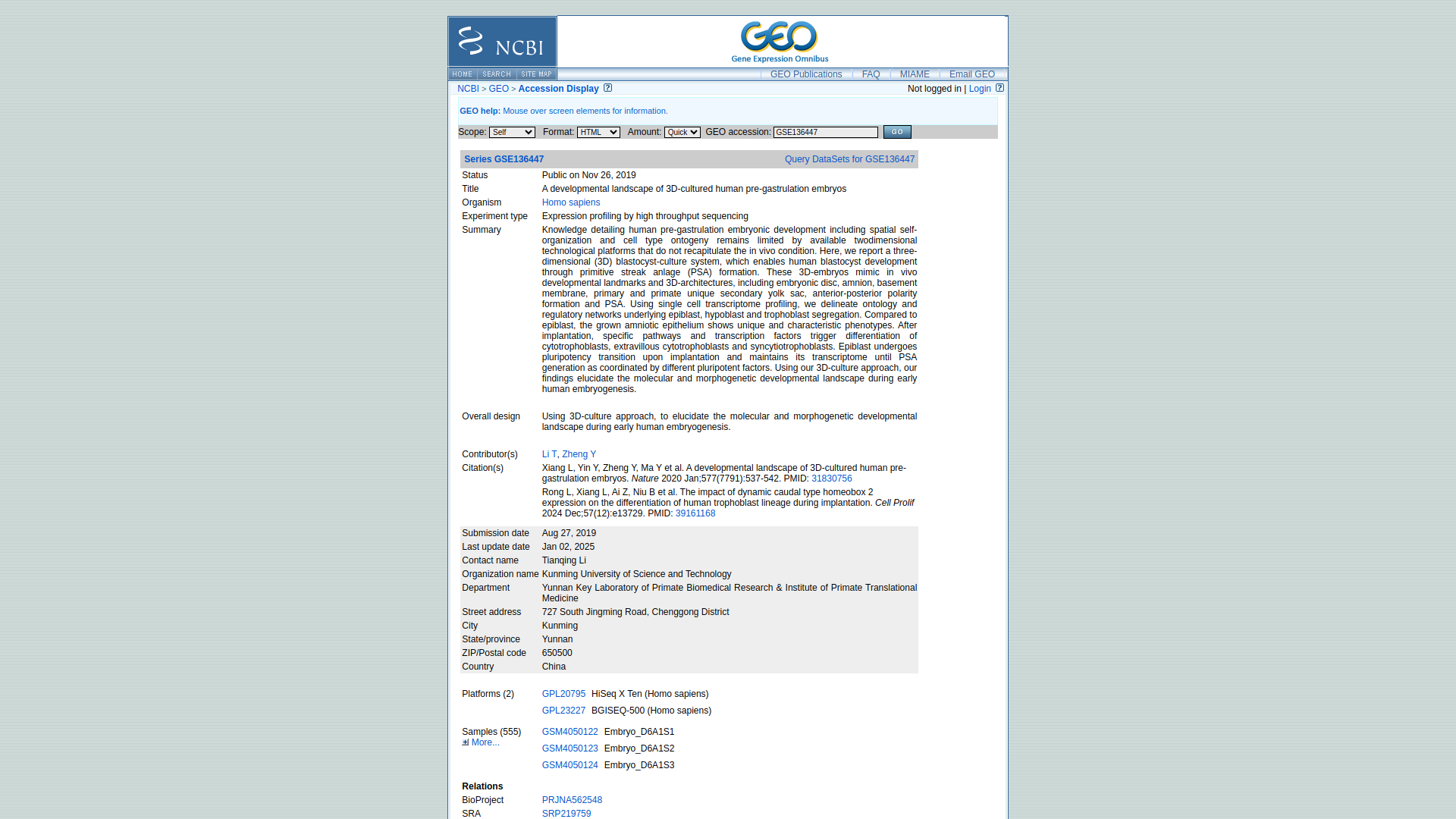
A developmental landscape of 3D-cultured human pre-gastrulation embryos
Tianqing Li
2019
2019/11/26
United States, Cabin John
Kunming University of Science and Technology

数据描述

A developmental landscape of 3D-cultured human pre-gastrulation embryos

Knowledge detailing human pre-gastrulation embryonic development including spatial self-organization and cell type ontogeny remains limited by available twodimensional technological platforms that do not recapitulate the in vivo condition. Here, we report a three-dimensional (3D) blastocyst-culture system, which enables human blastocyst development through primitive streak anlage (PSA) formation. These 3D-embryos mimic in vivo developmental landmarks and 3D-architectures, including embryonic disc, amnion, basement membrane, primary and primate unique secondary yolk sac, anterior-posterior polarity formation and PSA. Using single cell transcriptome profiling, we delineate ontology and regulatory networks underlying epiblast, hypoblast and trophoblast segregation. Compared to epiblast, the grown amniotic epithelium shows unique and characteristic phenotypes. After implantation, specific pathways and transcription factors trigger differentiation of cytotrophoblasts, extravillous cytotrophoblasts and syncytiotrophoblasts. Epiblast undergoes pluripotency transition upon implantation and maintains its transcriptome until PSA generation as coordinated by different pluripotent factors. Using our 3D-culture approach, our findings elucidate the molecular and morphogenetic developmental landscape during early human embryogenesis.

关键词

1
Homo sapiens

数据列表

5

SOFT formatted family file(s)

格式SOFT
下载

MINiML formatted family file(s)

格式MINiML
下载

Series Matrix File(s)

格式TXT
下载

GSE136447_555-samples-fpkm.txt.gz

格式TXT
大小38.3 Mb
下载

GSE136447_555sample_gene_count_matrix.txt.gz

格式TXT
大小14.9 Mb
下载
www.ncbi.nlm.nih.gov
IP: 130.14.29.110
访问数据源
加载中...

相关论文

14

Basement membrane perforations guide anterior–posterior axis formation

Dong-Yuan ChenNikolas H. ClaussenShiny TitusWenqi HuBailey A. T. Weatherbee10
Nature Communications
2025
2025/7/22
Vol.16 No.1 p.1-19
Establishment of the anterior-posterior (AP) axis is a critical symmetry-breaking event in mammalian development. In mice, this process involves the directed migration of the distal visceral endoderm (DVE). Here, we use targeted perturbations to demonstrate that asymmetric perforations in the baseme...
Collective cell migrationEmbryologyPattern formationStem cells
10.1038/S41467-025-61441-6
ISSN:2041-1723

α-Ketoglutarate promotes trophectoderm induction and maturation from naive human embryonic stem cells

Karlien Van NerumAnne WenzelLidia Argemi-MuntadasEleni KafkiaAntar Drews16
Nature Cell Biology
2025
2025/4/23
00 p.1-13
Development and lineage choice are driven by interconnected transcriptional, epigenetic and metabolic changes. Specific metabolites, such as α-ketoglutarate (αKG), function as signalling molecules affecting the activity of chromatin-modifying enzymes. However, how metabolism coordinates cell-state c...
EmbryologyEmbryonic stem cells
10.1038/S41556-025-01658-1
ISSN:1465-7392

TemporalVAE: atlas-assisted temporal mapping of time-series single-cell transcriptomes during embryogenesis

Yijun LiuFangxin CaiMelania BarileYi ChangDandan Cao6
Nature Cell Biology
2025
2025/10/28
00 p.1-11
International efforts have yielded extensive single-cell time-series atlas datasets, such as those on mouse embryogenesis, providing a reference for mapping disease models across biomedical research. However, effectively using such data for temporal analysis of individual datasets is challenging due...
Cell biologyComputational biology and bioinformaticsDevelopmental biology
10.1038/S41556-025-01787-7
ISSN:1465-7392

A single-cell transcriptome atlas of human euploid and aneuploid blastocysts

Shengpeng WangLizhi LengQuanlei WangYifan GuJinlu Li23
Nature Genetics
2024
2024/6/5
00 p.1-14
Aneuploidy is frequently detected in early human embryos as a major cause of early pregnancy failure. However, how aneuploidy affects cellular function remains elusive. Here, we profiled the transcriptomes of 14,908 single cells from 203 human euploid and aneuploid blastocysts involving autosomal an...
Cell lineageInfertility
10.1038/S41588-024-01788-6
ISSN:1061-4036

A human epiblast model reveals dynamic TGFβ-mediated control of epithelial identity during mammalian epiblast development

Irene ZorzanElena CarbogninAndrea LauriaValentina ProserpioDavide Benvegnù21
Nature Cell Biology
2025
2025/12/3
00 p.1-17
Pluripotency, the ability to generate all body cell types, emerges in a disorganized embryonic cell mass. After implantation, these cells form a columnar epithelium and initiate lumenogenesis. During gastrulation, some undergo epithelial-to-mesenchymal transition to form the primitive streak (PS). T...
Embryonic stem cellsEpithelial–mesenchymal transitionGrowth factor signalling
10.1038/S41556-025-01831-6
ISSN:1465-7392

A developmental landscape of 3D-cultured human pre-gastrulation embryos

Lifeng XiangYu YinYun ZhengYanping MaYonggang Li18
Nature
2019
2019/12/12
Vol.577 No.7791 p.537-542
Our understanding of how human embryos develop before gastrulation, including spatial self-organization and cell type ontogeny, remains limited by available two-dimensional technological platforms1,2 that do not recapitulate the in vivo conditions3–5. Here we report a three-dimensional (3D) blastocy...
EmbryologyEmbryonic induction
10.1038/S41586-019-1875-Y
ISSN:0028-0836

A single cell characterisation of human embryogenesis identifies pluripotency transitions and putative anterior hypoblast centre

Matteo A. MolèTim H. H. CoorensMarta N. ShahbaziAntonia WeberlingBailey A. T. Weatherbee19
Nature Communications
2021
2021/6/17
Vol.12 No.1 p.1-12
Following implantation, the human embryo undergoes major morphogenetic transformations that establish the future body plan. While the molecular events underpinning this process are established in mice, they remain unknown in humans. Here we characterise key events of human embryo morphogenesis, in t...
Cell signallingEmbryogenesisEmbryonic stem cellsPluripotency
10.1038/S41467-021-23758-W
ISSN:2041-1723

A genome-wide CRISPR-Cas9 knockout screen identifies essential and growth-restricting genes in human trophoblast stem cells

Dong ChenFu ShuhuaKarvas Rowan M.Chew BrianFischer Laura A.12
Nature Communications
2022
2022/5/10
Vol.13 No.1 p.1-16
The recent derivation of human trophoblast stem cells (hTSCs) provides a scalable in vitro model system of human placental development, but the molecular regulators of hTSC identity have not been systematically explored thus far. Here, we utilize a genome-wide CRISPR-Cas9 knockout screen to comprehe...
CRISPR-Cas systemsSelf-renewal
10.1038/S41467-022-30207-9
ISSN:2041-1723

Epiblast diversification and blood formation in a human pregastrula

Zhenyu XiaoYandong GongXiaolong YangNannan HeXinyuan Wang13
Nature
2026
2026/6/24
00 p.1-9
The incipient stage of gastrulation in human, when the primitive streak is about to emerge, represents a critical yet underexplored period. Here we present the high-resolution spatial transcriptomic landscape of a human embryo at Carnegie stage 6 (approximately 13–14 days post-conception), a stage a...
GastrulationHaematopoiesisHaematopoietic stem cells
10.1038/S41586-026-10698-Y
ISSN:0028-0836

A comprehensive human embryo reference tool using single-cell RNA-sequencing data

Cheng ZhaoAlvaro Plaza ReyesJohn Paul SchellJere WeltnerNicolás M. Ortega15
Nature Methods
2024
2024/11/14
00 p.1-14
Stem cell-based embryo models offer unprecedented experimental tools for studying early human development. The usefulness of embryo models hinges on their molecular, cellular and structural fidelities to their in vivo counterparts. To authenticate human embryo models, single-cell RNA sequencing has ...
Classification and taxonomyEmbryogenesisEmbryonic stem cells
10.1038/S41592-024-02493-2
ISSN:1548-7091

Distinct pathways drive anterior hypoblast specification in the implanting human embryo

Bailey A. T. WeatherbeeAntonia WeberlingCarlos W. GantnerLisa K. Iwamoto-StohlZoe Barnikel23
Nature Cell Biology
2024
2024/3/5
00 p.1-13
Development requires coordinated interactions between the epiblast, which generates the embryo proper; the trophectoderm, which generates the placenta; and the hypoblast, which forms both the anterior signalling centre and the yolk sac. These interactions remain poorly understood in human embryogene...
EmbryologyEmbryonic induction
10.1038/S41556-024-01367-1
ISSN:1465-7392

Self-renewing human naïve pluripotent stem cells dedifferentiate in 3D culture and form blastoids spontaneously

Mingyue GuoJinyi WuChuanxin ChenXinggu WangAn Gong13
Nature Communications
2024
2024/1/22
Vol.15 No.1 p.1-18
Human naïve pluripotent stem cells (hnPSCs) can generate integrated models of blastocysts termed blastoids upon switch to inductive medium. However, the underlying mechanisms remain obscure. Here we report that self-renewing hnPSCs spontaneously and efficiently give rise to blastoids upon three dime...
Cell cultureEmbryologyPluripotent stem cells
10.1038/S41467-024-44969-X
ISSN:2041-1723

Deep learning-based models for preimplantation mouse and human embryos based on single-cell RNA sequencing

Martin ProksNazmus SalehinJoshua M. Brickman
Nature Methods
2024
2024/11/14
00 p.1-10
The rapid growth of single-cell transcriptomic technology has produced an increasing number of datasets for both embryonic development and in vitro pluripotent stem cell-derived models. This avalanche of data surrounding pluripotency and the process of lineage specification has meant it has become i...
EmbryologyMachine learningPluripotencyRNA sequencing
10.1038/S41592-024-02511-3
ISSN:1548-7091

VGLL1 cooperates with TEAD4 to control human trophectoderm lineage specification

Yueli YangWenqi JiaZhiwei LuoYunpan LiHao Liu23
Nature Communications
2024
2024/1/17
Vol.15 No.1 p.1-18
In contrast to rodents, the mechanisms underlying human trophectoderm and early placenta specification are understudied due to ethical barriers and the scarcity of embryos. Recent reports have shown that human pluripotent stem cells (PSCs) can differentiate into trophectoderm (TE)-like cells (TELCs)...
DifferentiationPluripotent stem cellsSelf-renewal
10.1038/S41467-024-44780-8
ISSN:2041-1723