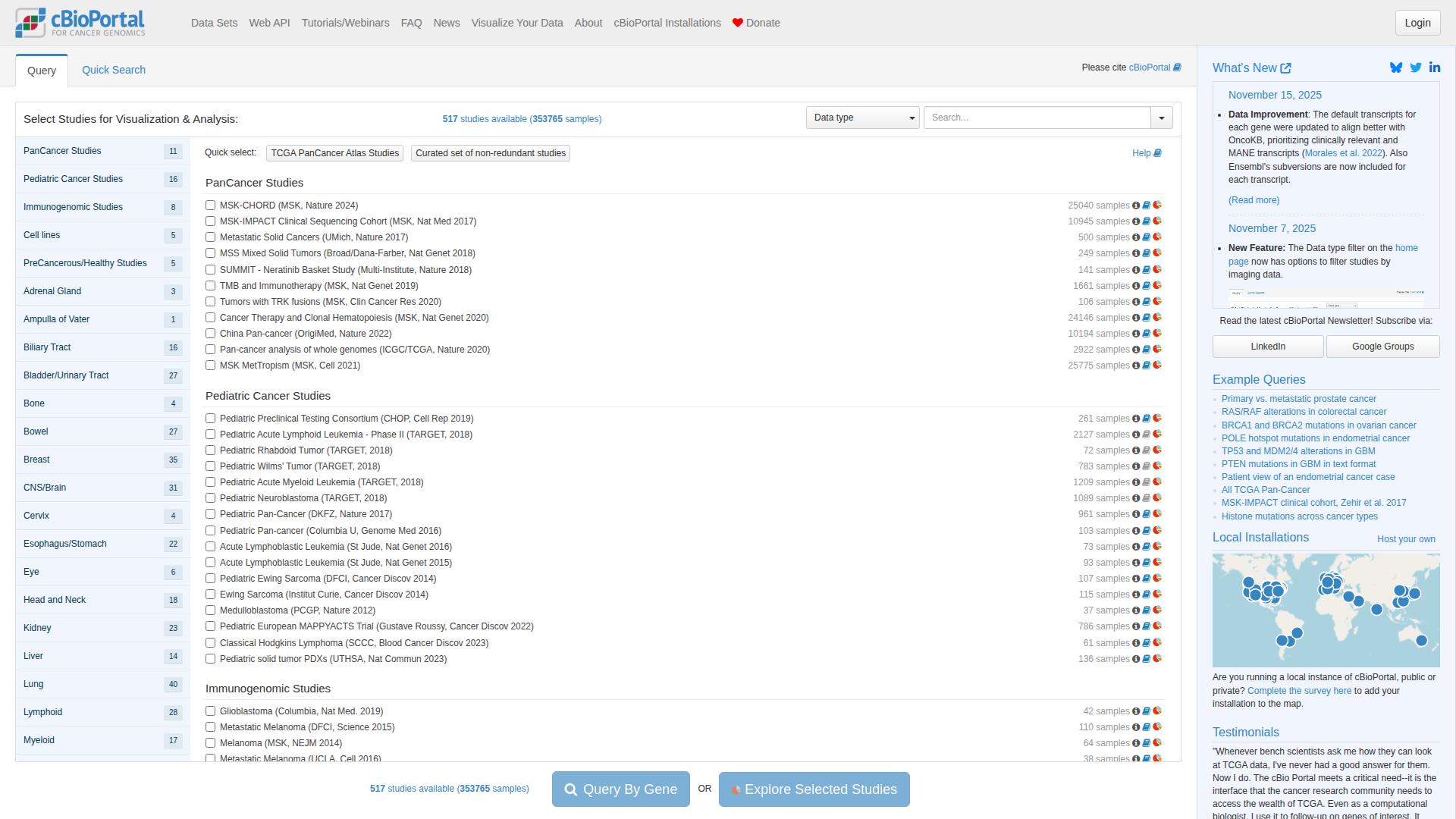
PanCancer Studies
English
United States, Ashburn
Johns Hopkins University

数据描述

PanCancer Studies

The dataset is a comprehensive collection of molecular and clinical information from multiple large-scale cancer studies, including The Cancer Genome Atlas (TCGA), MSKCC, and others. It contains detailed genomic profiles, clinical annotations, and therapeutic response data for various cancers, such as breast, colorectal, bladder, and lung adenocarcinoma. The purpose of this dataset is to support research in understanding cancer biology, identifying biomarkers, and developing targeted therapies. It provides a unified platform for integrating omics data across different cancer types, enabling large-scale comparative analyses and translational studies. ### Result: The dataset consists of molecular and clinical information from multiple large-scale cancer studies, including TCGA and MSKCC. It contains genomic profiles and therapeutic response data for various cancers, such as breast, colorectal, bladder, and lung adenocarcinoma. Its purpose is to support research in understanding cancer biology, identifying biomarkers, and developing targeted therapies. The dataset allows integration of omics data across different cancer types, enabling comparative analyses and translational studies.

www.cbioportal.org
IP: 52.72.198.244
访问数据源
加载中...

相关论文

291

A T cell receptor targeting a recurrent driver mutation in FLT3 mediates elimination of primary human acute myeloid leukemia in vivo

Eirini GiannakopoulouMadeleine LehanderStina Virding CulletonWeiwen YangYingqian Li29
Nature Cancer
2023
2023/10/2
00 p.1-17
Acute myeloid leukemia (AML), the most frequent leukemia in adults, is driven by recurrent somatically acquired genetic lesions in a restricted number of genes. Treatment with tyrosine kinase inhibitors has demonstrated that targeting of prevalent FMS-related receptor tyrosine kinase 3 (FLT3) gain-o...
Acute myeloid leukaemiaCancerCytotoxic T cellsImmunizationT-cell receptor
10.1038/S43018-023-00642-8
ISSN:2662-1347

NOTCH1 activation compensates BRCA1 deficiency and promotes triple-negative breast cancer formation

Kai MiaoJosh Haipeng LeiMonica Vishnu ValechaAiping ZhangJun Xu22
Nature Communications
2020
2020/6/26
Vol.11 No.1 p.1-15
BRCA1 mutation carriers have a higher risk of developing triple-negative breast cancer (TNBC), which is a refractory disease due to its non-responsiveness to current clinical targeted therapies. Using the Sleeping Beauty transposon system in Brca1-deficient mice, we identified 169 putative cancer dr...
Breast cancerHigh-throughput screeningMutagenesisPersonalized medicine
10.1038/S41467-020-16936-9
ISSN:2041-1723

Metabolic profiling stratifies colorectal cancer and reveals adenosylhomocysteinase as a therapeutic target

Johan Vande VoordeRory T. StevenArafath K. NajumudeenCatriona A. FordAlex Dexter54
Nature Metabolism
2023
2023/8/14
00 p.1-16
The genomic landscape of colorectal cancer (CRC) is shaped by inactivating mutations in tumour suppressors such as APC, and oncogenic mutations such as mutant KRAS. Here we used genetically engineered mouse models, and multimodal mass spectrometry-based metabolomics to study the impact of common gen...
Cancer metabolismExperimental models of diseaseMetabolism
10.1038/S42255-023-00857-0
ISSN:2522-5812

Loss of wild-type p53 promotes mutant p53-driven metastasis through acquisition of survival and tumor-initiating properties

Mizuho NakayamaChang Pyo HongHiroko OshimaEri SakaiSeong-Jin Kim6
Nature Communications
2020
2020/5/11
Vol.11 No.1 p.1-14
Missense-type mutant p53 plays a tumor-promoting role through gain-of-function (GOF) mechanism. In addition, the loss of wild-type TP53 through loss of heterozygosity (LOH) is widely found in cancer cells. However, malignant progression induced by cooperation of TP53 GOF mutation and LOH remains poo...
CancerGastrointestinal cancerTumour-suppressor proteins
10.1038/S41467-020-16245-1
ISSN:2041-1723

Bladder cancer organoids as a functional system to model different disease stages and therapy response

Minoli MartinaCantore ThomasHanhart DanielKiener MirjamFedrizzi Tarcisio18
Nature Communications
2023
2023/4/18
Vol.14 No.1 p.1-16
Bladder Cancer (BLCa) inter-patient heterogeneity is the primary cause of treatment failure, suggesting that patients could benefit from a more personalized treatment approach. Patient-derived organoids (PDOs) have been successfully used as a functional model for predicting drug response in differen...
Bladder cancerCancer genomicsGenetic databases
10.1038/S41467-023-37696-2
ISSN:2041-1723

Distinct and targetable role of calcium-sensing receptor in leukaemia

Raquel S. PereiraRahul KumarAlessia CaisLara PauliniAlisa Kahler22
Nature Communications
2023
2023/10/6
Vol.14 No.1 p.1-19
Haematopoietic stem cells (HSC) reside in the bone marrow microenvironment (BMM), where they respond to extracellular calcium [eCa2+] via the G-protein coupled calcium-sensing receptor (CaSR). Here we show that a calcium gradient exists in this BMM, and that [eCa2+] and response to [eCa2+] differ be...
Cancer microenvironmentCancer stem cells
10.1038/S41467-023-41770-0
ISSN:2041-1723

MACHETE identifies interferon-encompassing chromosome 9p21.3 deletions as mediators of immune evasion and metastasis

Barriga Francisco M.Tsanov Kaloyan M.Ho Yu-JuiSohail NoorZhang Amy20
Nature Cancer
2022
2022/11/7
Vol.3 No.11 p.1367-1385
The most prominent homozygous deletions in cancer affect chromosome 9p21.3 and eliminate CDKN2A/B tumor suppressors, disabling a cell-intrinsic barrier to tumorigenesis. Half of 9p21.3 deletions, however, also encompass a type I interferon (IFN) gene cluster; the consequences of this co-deletion rem...
CancerGene targetingTumour immunology
10.1038/S43018-022-00443-5
ISSN:2662-1347

NF1 mutations as biomarker of response to immune checkpoint blockades for lung adenocarcinoma patients

Jean-Stéphane GiraudAnne JouinotEric PasmantCamille Tlemsani
Npj Precision Oncology
2024
2024/2/10
Vol.8 No.1 p.1-6
Little is known about immune checkpoint inhibitors (ICI) response of NF1-mutated lung adenocarcinomas. 341/4,181 (8.2%) TCGA lung adenocarcinomas samples have a somatic NF1 mutation. NF1-mutated tumors have higher TMB (p < 0.0001), higher expression of immune genes (“hot phenotype”) and higher CD...
Health sciencesLung cancer
10.1038/S41698-024-00524-X
ISSN:2397-768X

Rapid acceleration of KRAS-mutant pancreatic carcinogenesis via remodeling of tumor immune microenvironment by PPARδ

Liu YiDeguchi YasunoriWei DaoyanLiu FuyaoMoussalli Micheline J.19
Nature Communications
2022
2022/5/13
Vol.13 No.1 p.1-18
Pancreatic intraepithelial neoplasia (PanIN) is a precursor of pancreatic ductal adenocarcinoma (PDAC), which commonly occurs in the general populations with aging. Although most PanIN lesions (PanINs) harbor oncogenic KRAS mutations that initiate pancreatic tumorigenesis; PanINs rarely progress to ...
Cancer genomicsCancer metabolismCancer microenvironmentCancer modelsPancreatic cancer
10.1038/S41467-022-30392-7
ISSN:2041-1723

Genome-wide mapping of somatic mutation rates uncovers drivers of cancer

Sherman Maxwell A.Yaari Adam U.Priebe OliverDietlein FelixLoh Po-Ru6
Nature Biotechnology
2022
2022/6/20
00 p.1-10
Identification of cancer driver mutations that confer a proliferative advantage is central to understanding cancer; however, searches have often been limited to protein-coding sequences and specific non-coding elements (for example, promoters) because of the challenge of modeling the highly variable...
Cancer genomicsMachine learning
10.1038/S41587-022-01353-8
ISSN:1087-0156

TRIM17 downregulation modulates CRPC progression and enzalutamide resistance by derepressing BCL2 expression via the p53-dependent and p53-independent pathways

Zhi ShangGuowen LinLiu YuShiwei LiuYongqing Zhang9
Cell Death & Differentiation
2026
2026/6/13
00 p.1-17
The failure of second-generation antiandrogen drugs such as enzalutamide (ENZ) treatment indicates that prostate cancer (PCa) can progress to castration-resistant prostate cancer (CRPC). CRPC is considered the terminal stage of PCa and currently has no effective treatment options due to drug resista...
OncogenesTumour biomarkers
10.1038/S41418-026-01778-7
ISSN:1350-9047

Proteogenomic insights into early-onset endometrioid endometrial carcinoma: predictors for fertility-sparing therapy response

Zhe HuZimeng WuWei LiuYan NingJingbo Liu35
Nature Genetics
2024
2024/4/2
00 p.1-15
Endometrial carcinoma remains a public health concern with a growing incidence, particularly in younger women. Preserving fertility is a crucial consideration in the management of early-onset endometrioid endometrial carcinoma (EEEC), particularly in patients under 40 who maintain both reproductive ...
Endometrial cancerPersonalized medicineTumour biomarkers
10.1038/S41588-024-01703-Z
ISSN:1061-4036

An 18-gene signature of recurrence-associated endothelial cells predicts tumor progression and castration resistance in prostate cancer

Bing-Biao LinQingqing HuangBinyuan YanMingcheng LiuZhiqian Zhang9
British Journal Of Cancer
2024
2024/7/12
00 p.1-13
The prognostic and therapeutic implications of endothelial cells (ECs) heterogeneity in prostate cancer (PCa) are poorly understood. We investigated associations of EC heterogeneity with PCa recurrence and castration resistance in 8 bulk transcriptomic and 4 single-cell RNA-seq cohorts. A recurrence...
Cancer microenvironmentMachine learningPredictive medicineProstate cancerTumour biomarkers
10.1038/S41416-024-02761-0
ISSN:0007-0920

Clustering of lymphoid neoplasms by cell of origin, somatic mutation and drug usage profiles: a multi-trait genome-wide association study

Murat GülerFederico Canzian
Blood Cancer Journal
2025
2025/8/29
Vol.15 No.1 p.1-15
Lymphoid neoplasms (LNs) are heterogeneous malignancies arising from lymphoid cells, displaying diverse clinical and molecular features. Although LNs are collectively frequent, individual subtypes are rare, posing challenges for genetic association studies. Indeed, genome-wide association studies (G...
Cancer geneticsHaematological cancerRisk factors
10.1038/S41408-025-01351-4
ISSN:2044-5385

The CINSARC signature predicts the clinical outcome in patients with Luminal B breast cancer

Anthony GoncalvesPascal FinettiDaniel BirnbaumFrançois Bertucci
Npj Breast Cancer
2021
2021/5/5
Vol.7 No.1 p.1-9
CINSARC, a multigene expression signature originally developed in sarcomas, was shown to have prognostic impact in various cancers. We tested the prognostic value for disease-free survival (DFS) of CINSARC in a series of 6035 early-stage invasive primary breast cancers. CINSARC had independent progn...
Breast cancerPrognostic markers
10.1038/S41523-021-00256-2
ISSN:2374-4677

Targeting glutamine dependence through GLS1 inhibition suppresses ARID1A -inactivated clear cell ovarian carcinoma

Shuai WuTakeshi FukumotoJianhuang LinTimothy NacarelliYemin Wang21
Nature Cancer
2021
2021/1/11
Vol.2 No.2 p.189-200
Alterations in components of the SWI/SNF chromatin-remodeling complex occur in ~20% of all human cancers. For example, ARID1A is mutated in up to 62% of ovarian clear cell carcinomas (OCCC), a disease lacking effective therapies. Here we show that ARID1A mutation creates a dependence on glutamine me...
CancerCancer epigeneticsCancer metabolismOvarian cancer
10.1038/S43018-020-00160-X
ISSN:2662-1347

Antigen presentation in cancer: insights into tumour immunogenicity and immune evasion

Suchit JhunjhunwalaChristian HammerLélia Delamarre
Nature Reviews Cancer
2021
2021/3/9
00 p.1-15
Immune checkpoint blockade, which blocks inhibitory signals of T cell activation, has shown tremendous success in treating cancer, although success still remains limited to a fraction of patients. To date, clinically effective CD8+ T cell responses appear to target predominantly antigens derived fro...
Cancer immunotherapyCancer microenvironmentImmunosurveillance
10.1038/S41568-021-00339-Z
ISSN:1474-175X

Benchmarking foundation models as feature extractors for weakly supervised computational pathology

Peter NeidlingerOmar S. M. El NahhasHannah Sophie MutiTim LenzMichael Hoffmeister16
Nature Biomedical Engineering
2025
2025/10/1
00 p.1-11
Numerous pathology foundation models have been developed to extract clinically relevant information. There is currently limited literature independently evaluating these foundation models on external cohorts and clinically relevant tasks to uncover adjustments for future improvements. Here we benchm...
Cancer imagingTumour biomarkers
10.1038/S41551-025-01516-3
ISSN:2157-846X

Targeting purine synthesis in ASS1-expressing tumors enhances the response to immune checkpoint inhibitors

Rom KeshetJoo Sang LeeLital AdlerMuhammed IraqiYarden Ariav30
Nature Cancer
2020
2020/8/31
Vol.1 No.9 p.894-908
Argininosuccinate synthase (ASS1) downregulation in different tumors has been shown to support cell proliferation and yet, in several common cancer subsets ASS1 expression associates with poor patient prognosis. Here we demonstrate that ASS1 expression under glucose deprivation is induced by c-MYC, ...
CancerCancer metabolism
10.1038/S43018-020-0106-7
ISSN:2662-1347

HIF sustain a transcriptional regulatory circuit of EPAS1 expression in renal clear cell carcinoma

Stephanie NaasRené KrügerSteffen GramppVictoria LauerAndre Kraus13
Nature Communications
2026
2026/2/19
Vol.17 No.1 p.17640
Initiation and sustainment of oncogenic signaling is a hallmark of cancer evolution and progression. In renal clear cell carcinoma, loss of von Hippel-Lindau protein causes stabilization of hypoxia-inducible transcription factors (HIF) evoking a pseudo-hypoxic response, perturbing epithelial homeost...
Gene regulationRenal cell carcinoma
10.1038/S41467-026-68576-0
ISSN:2041-1723

Genetic alterations in the 3q26.31-32 locus confer an aggressive prostate cancer phenotype

Benjamin S. SimpsonNiedzica CamachoHayley J. LuxtonHayley PyeRon Finn9
Communications Biology
2020
2020/8/14
Vol.3 No.1 p.1-10
Large-scale genetic aberrations that underpin prostate cancer development and progression, such as copy-number alterations (CNAs), have been described but the consequences of specific changes in many identified loci is limited. Germline SNPs in the 3q26.31 locus are associated with aggressive prosta...
Cancer genomicsGenomic instability
10.1038/S42003-020-01175-X
ISSN:2399-3642

Targeting the IRE1α/XBP1s pathway suppresses CARM1-expressing ovarian cancer

Lin JianhuangLiu HengFukumoto TakeshiZundell JosephYan Qingqing14
Nature Communications
2021
2021/9/7
Vol.12 No.1 p.1-14
CARM1 is often overexpressed in human cancers including in ovarian cancer. However, therapeutic approaches based on CARM1 expression remain to be an unmet need. Cancer cells exploit adaptive responses such as the endoplasmic reticulum (ER) stress response for their survival through activating pathwa...
ApoptosisOvarian cancer
10.1038/S41467-021-25684-3
ISSN:2041-1723

p85β regulates autophagic degradation of AXL to activate oncogenic signaling

Ling RaoVictor C. Y. MakYuan ZhouDong ZhangXinran Li13
Nature Communications
2020
2020/5/8
Vol.11 No.1 p.1-15
PIK3R2 encodes the p85β regulatory subunit of phosphatidylinositol 3-kinase and is frequently amplified in cancers. The signaling mechanism and therapeutic implication of p85β are poorly understood. Here we report that p85β upregulates the protein level of the receptor tyrosine kinase AXL to induce ...
CancerCell biology
10.1038/S41467-020-16061-7
ISSN:2041-1723

Identification of a 5-gene signature panel for the prediction of prostate cancer progression

Michelle ShenFernando García-MarquésArvind MurugananthamShiqin LiuJames Robert White16
British Journal Of Cancer
2024
2024/10/14
00 p.1-14
Despite nearly 100% 5-year survival for localised prostate cancer, the survival rate for metastatic prostate cancer significantly declines to 32%. Thus, it is crucial to identify molecular indicators that reflect the progression from localised disease to metastatic prostate cancer. To search for mol...
Prognostic markersUrological cancer
10.1038/S41416-024-02854-W
ISSN:0007-0920

Molecular features and clinical implications of the heterogeneity in Chinese patients with HER2-low breast cancer

Lei-Jie DaiDing MaYu-Zheng XuMing LiYu-Wei Li13
Nature Communications
2023
2023/8/22
Vol.14 No.1 p.1-13
The molecular heterogeneity and distinct features of HER2-low breast cancers, particularly in the Chinese population, are not well understood, limiting its precise management in the era of antibody‒drug conjugates. To address this issue, we established a cohort of 434 Chinese patients with HER2-low ...
Breast cancerCancer genomicsTargeted therapiesTumour heterogeneity
10.1038/S41467-023-40715-X
ISSN:2041-1723

PRMT inhibition induces a viral mimicry response in triple-negative breast cancer

Wu QinNie David Y.Ba-alawi WailJi YiShuaiZhang ZiWen29
Nature Chemical Biology
2022
2022/5/16
00 p.1-10
Triple-negative breast cancer (TNBC) is the most aggressive breast cancer subtype with the worst prognosis and few effective therapies. Here we identified MS023, an inhibitor of type I protein arginine methyltransferases (PRMTs), which has antitumor growth activity in TNBC. Pathway analysis of TNBC ...
Cancer therapyChemical geneticsRNA splicingScreening
10.1038/S41589-022-01024-4
ISSN:1552-4450

Orthogonal proteogenomic analysis identifies the druggable PA2G4-MYC axis in 3q26 AML

Matteo MarchesiniAndrea GherliElisa SimonciniLucas Moron Dalla TorAnna Montanaro34
Nature Communications
2024
2024/6/4
Vol.15 No.1 p.1-22
The overexpression of the ecotropic viral integration site-1 gene (EVI1/MECOM) marks the most lethal acute myeloid leukemia (AML) subgroup carrying chromosome 3q26 abnormalities. By taking advantage of the intersectionality of high-throughput cell-based and gene expression screens selective and pan-...
Acute myeloid leukaemiaAnimal disease modelsHigh-throughput screeningTarget identificationTranslational research
10.1038/S41467-024-48953-3
ISSN:2041-1723

A tissue-specific atlas of protein–protein associations enables prioritization of candidate disease genes

Diederik S. Laman TripMarc van OostrumDanish MemonFabian FrommeltDelora Baptista17
Nature Biotechnology
2025
2025/5/2
00 p.1-14
Despite progress in mapping protein–protein interactions, their tissue specificity is understudied. Here, given that protein coabundance is predictive of functional association, we compiled and analyzed protein abundance data of 7,811 proteomic samples from 11 human tissues to produce an atlas of ti...
Computational biology and bioinformaticsProteomic analysisTarget identification
10.1038/S41587-025-02659-Z
ISSN:1087-0156

Sox2 protein stability is enhanced by BRafV600E and Pten deletion in adult neural stem/progenitor cells

Eugenia GuidaAmbra ColopiValeriana CesariniMarco PieraccioliLuca Mignini13
Npj Precision Oncology
2026
2026/4/20
0
BRAF mutations are oncogenic drivers present in about 7% of human cancers, with the V600E substitution being the most frequent. In the nervous system, BRAFV600E has been identified in both low- and high-grade gliomas (LGG and HGG) and in tumors of the peripheral nervous system. To investigate the me...
CancerCell biologyMolecular biologyNeuroscienceOncology
10.1038/S41698-026-01439-5
ISSN:2397-768X

Differential whole-genome doubling and homologous recombination deficiencies across breast cancer subtypes from the Taiwanese population

Wu Chia-HsinHsieh Chia-ShanChang Yo-ChengHuang Chi-ChengYeh Hsien-Tang15
Communications Biology
2021
2021/9/9
Vol.4 No.1 p.1-12
Whole-genome doubling (WGD) is an early macro-evolutionary event in tumorigenesis, involving the doubling of an entire chromosome complement. However, its impact on breast cancer subtypes remains unclear. Here, we performed a comprehensive and quantitative analysis of WGD and its influence on breast...
Breast cancerCancer geneticsCancer genomics
10.1038/S42003-021-02597-X
ISSN:2399-3642

Targeting branched N-glycans and fucosylation sensitizes ovarian tumors to immune checkpoint blockade

Hao NiePratima SainiTaito MiyamotoLiping LiaoRafal J. Zielinski19
Nature Communications
2024
2024/4/2
Vol.15 No.1 p.1-16
Aberrant glycosylation is a crucial strategy employed by cancer cells to evade cellular immunity. However, it’s unclear whether homologous recombination (HR) status-dependent glycosylation can be therapeutically explored. Here, we show that the inhibition of branched N-glycans sensitizes HR-proficie...
Cancer immunotherapyOvarian cancerTumour immunology
10.1038/S41467-024-47069-Y
ISSN:2041-1723

Cytogenetic signatures favoring metastatic organotropism in colorectal cancer

Mariola Monika GolasBastian GunawanAngelika GutenbergBernhard C. DannerJan S. Gerdes9
Nature Communications
2025
2025/4/5
Vol.16 No.1 p.1-19
Colorectal carcinoma (CRC) exhibits metastatic organotropism, primarily targeting liver, lung, and rarely the brain. Here, we study chromosomal imbalances (CIs) in cohorts of primary CRCs and metastases. Brain metastases show the highest burden of CIs, including aneuploidies and focal CIs, with enri...
Cancer geneticsCancer genomicsColorectal cancerGenomic instability
10.1038/S41467-025-58413-1
ISSN:2041-1723

Sequence determinant of small RNA production by DICER

Lee Young-YoonKim HaedongKim V. Narry
Nature
2023
2023/2/22
Vol.615 No.7951 p.323-330
RNA silencing relies on specific and efficient processing of double-stranded RNA by Dicer, which yields microRNAs (miRNAs) and small interfering RNAs (siRNAs)1,2. However, our current knowledge of the specificity of Dicer is limited to the secondary structures of its substrates: a double-stranded RN...
miRNAsRNAisiRNAs
10.1038/S41586-023-05722-4
ISSN:0028-0836

BRAF activation by metabolic stress promotes glycolysis sensitizing NRASQ61-mutated melanomas to targeted therapy

McGrail KimberleyGranado-Martínez PaulaEsteve-Puig RosauraGarcía-Ortega SaraDing Yuxin17
Nature Communications
2022
2022/11/19
Vol.13 No.1 p.1-22
NRAS-mutated melanoma lacks a specific line of treatment. Metabolic reprogramming is considered a novel target to control cancer; however, NRAS-oncogene contribution to this cancer hallmark is mostly unknown. Here, we show that NRASQ61-mutated melanomas specific metabolic settings mediate cell sensi...
Cancer metabolismMelanoma
10.1038/S41467-022-34907-0
ISSN:2041-1723

Defining the therapeutic selective dependencies for distinct subtypes of PI3K pathway-altered prostate cancers

Mao NinghuiZhang ZedaLee Young SunChoi DanielleRivera Aura Agudelo18
Nature Communications
2021
2021/8/20
Vol.12 No.1 p.1-13
Previous studies have suggested that PTEN loss is associated with p110β signaling dependency, leading to the clinical development of p110β-selective inhibitors. Here we use a panel pre-clinical models to reveal that PI3K isoform dependency is not governed by loss of PTEN and is impacted by feedback ...
Prostate cancerTargeted therapies
10.1038/S41467-021-25341-9
ISSN:2041-1723

Exploitation of the fibrinolytic system by B-cell acute lymphoblastic leukemia and its therapeutic targeting

Valentina R. MinciacchiJimena BravoChristina KarantanouRaquel S. PereiraCostanza Zanetti20
Nature Communications
2024
2024/11/20
Vol.15 No.1 p.1-19
Fibrinolysis influences the mobilization of hematopoietic stem cells from their bone marrow microenvironment (BMM). Here we show that activation of plasmin, a key fibrinolytic agent, by annexin A2 (ANXA2) distinctly impacts progression of BCR-ABL1+ B-cell acute lymphoblastic leukemia (B-ALL) via mod...
Acute lymphocytic leukaemiaLeukaemiaTranslational research
10.1038/S41467-024-54361-4
ISSN:2041-1723

A multimodal knowledge-enhanced whole-slide pathology foundation model

Yingxue XuYihui WangFengtao ZhouJiabo MaCheng Jin19
Nature Communications
2025
2025/12/12
0
Computational pathology has advanced through foundation models, yet faces challenges in multimodal integration and capturing whole-slide context. Current approaches typically utilize either vision-only or image-caption data, overlooking distinct insights from pathology reports and gene expression pr...
Biomedical engineeringComputational modelsComputational scienceMachine learningMedical research
10.1038/S41467-025-66220-X
ISSN:2041-1723

Glycoproteomics-based signatures for tumor subtyping and clinical outcome prediction of high-grade serous ovarian cancer

Jianbo PanYingwei HuShisheng SunLijun ChenMichael Schnaubelt11
Nature Communications
2020
2020/12/1
Vol.11 No.1 p.1-13
Inter-tumor heterogeneity is a result of genomic, transcriptional, translational, and post-translational molecular features. To investigate the roles of protein glycosylation in the heterogeneity of high-grade serous ovarian carcinoma (HGSC), we perform mass spectrometry-based glycoproteomic charact...
GlycosylationMass spectrometryProteomicsTumour heterogeneity
10.1038/S41467-020-19976-3
ISSN:2041-1723

The deubiquitinating enzyme USP4 regulates BRCA1 stability and function

Xueyuan GuoYanfang MaTing ZhangRunyu LiuFen Chang14
Npj Breast Cancer
2024
2024/5/11
Vol.10 No.1 p.1-14
BRCA1 plays a suppressive role in breast tumorigenesis. Ubiquitin-dependent degradation is a common mechanism that regulates BRCA1 protein stability, and several ubiquitin ligases involved have been identified. However, the deubiquitinating enzyme for BRCA1 remains less defined. Here, we report that...
Breast cancerHomologous recombinationUbiquitylation
10.1038/S41523-024-00641-7
ISSN:2374-4677

Activation of melanocortin-1 receptor signaling in melanoma cells impairs T cell infiltration to dampen antitumor immunity

Yazhong CuiYang MiaoLongzhi CaoLifang GuoYue Cui9
Nature Communications
2023
2023/9/15
Vol.14 No.1 p.1-18
Inhibition of T cell infiltration dampens antitumor immunity and causes resistance to immune checkpoint blockade (ICB) therapy. By in vivo CRISPR screening in B16F10 melanoma in female mice, here we report that loss of melanocortin-1 receptor (MC1R) in melanoma cells activates antitumor T cell respo...
Immune evasionTumour immunology
10.1038/S41467-023-41101-3
ISSN:2041-1723

Delineating the interplay between oncogenic pathways and immunity in anaplastic Wilms tumors

Xiaoping SuXiaofan LuSehrish Khan BazaiLinda DaineseArnauld Verschuur16
Nature Communications
2023
2023/11/30
Vol.14 No.1 p.1-15
Wilms tumors are highly curable in up to 90% of cases with a combination of surgery and radio-chemotherapy, but treatment-resistant types such as diffuse anaplastic Wilms tumors pose significant therapeutic challenges. Our multi-omics profiling unveils a distinct desert-like diffuse anaplastic Wilms...
Cancer genomicsPaediatric cancerWilms tumour
10.1038/S41467-023-43290-3
ISSN:2041-1723

Neutrophil-induced ferroptosis promotes tumor necrosis in glioblastoma progression

Patricia P. YeeYiju WeiSoo-Yeon KimTong LuStephen Y. Chih17
Nature Communications
2020
2020/10/27
Vol.11 No.1 p.1-22
Tumor necrosis commonly exists and predicts poor prognoses in many cancers. Although it is thought to result from chronic ischemia, the underlying nature and mechanisms driving the involved cell death remain obscure. Here, we show that necrosis in glioblastoma (GBM) involves neutrophil-triggered fer...
CancerCancer microenvironmentCell biologyCell deathCNS cancer
10.1038/S41467-020-19193-Y
ISSN:2041-1723

Ligand-receptor interactions combined with histopathology for improved prognostic modeling in HPV-negative head and neck squamous cell carcinoma

Bohai FengDi ZhaoZheng ZhangRu JiaPatrick J. Schuler6
Npj Precision Oncology
2025
2025/2/28
Vol.9 No.1 p.1-17
Head and neck squamous cell carcinoma (HNSC) is a prevalent malignancy, with HPV-negative tumors exhibiting aggressive behavior and poor prognosis. Understanding the intricate interactions within the tumor microenvironment (TME) is crucial for improving prognostic models and identifying therapeutic ...
Computational biology and bioinformaticsHead and neck cancer
10.1038/S41698-025-00844-6
ISSN:2397-768X

NRF2 mediates melanoma addiction to GCDH by modulating apoptotic signalling

Verma SachinCrawford DavidKhateb AliFeng YongmeiSergienko Eduard13
Nature Cell Biology
2022
2022/9/1
Vol.24 No.9 p.1422-1432
Tumour dependency on specific metabolic signals has been demonstrated and often guided numerous therapeutic approaches. We identify melanoma addiction to the mitochondrial protein glutaryl-CoA dehydrogenase (GCDH), which functions in lysine metabolism and controls protein glutarylation. GCDH knockdo...
ApoptosisCancer metabolismMelanomaStress signalling
10.1038/S41556-022-00985-X
ISSN:1465-7392

Brca1 haploinsufficiency promotes early tumor onset and epigenetic alterations in a mouse model of hereditary breast cancer

Carman Man-Chung LiAlyssa CordesMichael U. J. OliphantS. Aidan QuinnMayura Thomas18
Nature Genetics
2024
2024/11/11
00 p.1-13
Germline BRCA1 mutation carriers face a high breast cancer risk; however, the underlying mechanisms for this risk are not completely understood. Using a new genetically engineered mouse model of germline Brca1 heterozygosity, we demonstrate that early tumor onset in a Brca1 heterozygous background c...
Breast cancerEpigeneticsGenetic engineering
10.1038/S41588-024-01958-6
ISSN:1061-4036

Single-cell integrative analysis reveals consensus cancer cell states and clinical relevance in breast cancer

Lin PangFengyu XiangHuan YangXinyue ShenMing Fang10
Scientific Data
2024
2024/3/12
Vol.11 No.1 p.1-16
High heterogeneity and complex interactions of malignant cells in breast cancer has been recognized as a driver of cancer progression and therapeutic failure. However, complete understanding of common cancer cell states and their underlying driver factors remain scarce and challenging. Here, we reve...
Breast cancerTumour heterogeneity
10.1038/S41597-024-03127-0
ISSN:2052-4463

Context-dependent effects of CDKN2A and other 9p21 gene losses during the evolution of esophageal cancer

Piyali GanguliCelia C. BasantaAmelia Acha-SagredoHrvoje MiseticMaria Armero18
Nature Cancer
2025
2025/1/3
00 p.1-17
CDKN2A is a tumor suppressor located in chromosome 9p21 and frequently lost in Barrett’s esophagus (BE) and esophageal adenocarcinoma (EAC). How CDKN2A and other 9p21 gene co-deletions affect EAC evolution remains understudied. We explored the effects of 9p21 loss in EACs and cancer progressor and n...
CancerCancer genomicsOesophageal cancerTumour-suppressor proteins
10.1038/S43018-024-00876-0
ISSN:2662-1347

JAK2-CHK2 signaling safeguards the integrity of the mitotic spindle assembly checkpoint and genome stability

Chowdhury Md Al NayemWang Shih-WeiSuen Ching-ShuHwang Ming-JingHsueh Yi-An6
Cell Death & Disease
2022
2022/7/18
Vol.13 No.7 p.1-13
Checkpoint kinase 2 (CHK2) plays an important role in safeguarding the mitotic progression, specifically the spindle assembly, though the mechanism of regulation remains poorly understood. Here, we identified a novel mitotic phosphorylation site on CHK2 Tyr156, and its responsible kinase JAK2. Expre...
Cancer genomicsCheckpoint signalling
10.1038/S41419-022-05077-0
ISSN:2041-4889

Molecular classification of hormone receptor-positive HER2-negative breast cancer

Xi JinYi-Fan ZhouDing MaShen ZhaoCai-Jin Lin19
Nature Genetics
2023
2023/9/28
00 p.1-13
Hormone receptor-positive (HR+)/human epidermal growth factor receptor 2-negative (HER2−) breast cancer is the most prevalent type of breast cancer, in which endocrine therapy resistance and distant relapse remain unmet challenges. Accurate molecular classification is urgently required for guiding p...
Breast cancerTranslational research
10.1038/S41588-023-01507-7
ISSN:1061-4036

A unique subset of glycolytic tumour-propagating cells drives squamous cell carcinoma

Jee-Eun ChoiCarlos SebastianChristina M. FerrerCaroline A. LewisMoshe Sade-Feldman24
Nature Metabolism
2021
2021/2/22
Vol.3 No.2 p.182-195
Head and neck squamous cell carcinoma (SCC) remains among the most aggressive human cancers. Tumour progression and aggressiveness in SCC are largely driven by tumour-propagating cells (TPCs). Aerobic glycolysis, also known as the Warburg effect, is a characteristic of many cancers; however, whether...
Cancer metabolismCancer stem cellsMetabolism
10.1038/S42255-021-00350-6
ISSN:2522-5812

Ancestry and somatic profile indicate acral melanoma origin and prognosis

Patricia Basurto-LozadaMartha Estefania Vázquez-CruzChristian Molina-AguilarAmanda JiangDekker C. Deacon43
Nature
2026
2026/2/18
Vol.651 No.8104 p.221-230
Acral melanoma, which is not ultraviolet-associated, is the type of melanoma reported most commonly in several non-European-descent populations1–3, including in Mexican people4. Latin American samples are substantially under-represented in global cancer genomics studies5, which directly af...
Cancer genomics
10.1038/S41586-025-09967-Z
ISSN:0028-0836

Androgen deprivation upregulates SPINK1 expression and potentiates cellular plasticity in prostate cancer

Ritika TiwariNishat ManzarVipul BhatiaAnjali YadavMushtaq A. Nengroo15
Nature Communications
2020
2020/1/20
Vol.11 No.1 p.1-19
Emergence of an aggressive androgen receptor (AR)-independent neuroendocrine prostate cancer (NEPC) after androgen-deprivation therapy (ADT) is well-known. Nevertheless, the majority of advanced-stage prostate cancer patients, including those with SPINK1-positive subtype, are treated with AR-antagon...
Mechanisms of diseaseOncogenesProstate cancer
10.1038/S41467-019-14184-0
ISSN:2041-1723

Targeting PRMT9-mediated arginine methylation suppresses cancer stem cell maintenance and elicits cGAS-mediated anticancer immunity

Haojie DongXin HeLei ZhangWei ChenYi-Chun Lin32
Nature Cancer
2024
2024/2/27
00 p.1-24
Current anticancer therapies cannot eliminate all cancer cells, which hijack normal arginine methylation as a means to promote their maintenance via unknown mechanisms. Here we show that targeting protein arginine N-methyltransferase 9 (PRMT9), whose activities are elevated in blasts and leukemia st...
CancerTumour immunology
10.1038/S43018-024-00736-X
ISSN:2662-1347

VHL suppresses UBE3B-mediated breast tumor growth and metastasis

Shuo WangHuiyan LiXiong LiuTingting YinTingru Li11
Cell Death & Disease
2024
2024/6/24
Vol.15 No.6 p.1-12
Protein homeostasis is predominantly governed through post-translational modification (PTM). UBE3B, identified as an oncoprotein, exhibits elevated protein levels in breast cancer. However, the impact of PTM on UBE3B remains unexplored. In this study, we show that VHL is a bona fide E3 ligase for UB...
Breast cancerUbiquitylation
10.1038/S41419-024-06844-X
ISSN:2041-4889

An mRNA processing pathway suppresses metastasis by governing translational control from the nucleus

Albertas NavickasHosseinali AsgharianJuliane WinklerLisa FishKristle Garcia18
Nature Cell Biology
2023
2023/5/8
00 p.1-12
Cancer cells often co-opt post-transcriptional regulatory mechanisms to achieve pathologic expression of gene networks that drive metastasis. Translational control is a major regulatory hub in oncogenesis; however, its effects on cancer progression remain poorly understood. Here, to address this, we...
Breast cancerGene regulatory networksMetastasisRNA metabolismTranslation
10.1038/S41556-023-01141-9
ISSN:1465-7392

Obesity-dependent selection of driver mutations in cancer

Cerise TangVenise Jan CastillonMichele WatersChris FongTricia Park15
Nature Genetics
2024
2024/10/28
00 p.1-4
Obesity is a risk factor for cancer, but whether obesity is linked to specific genomic subtypes of cancer is unknown. We examined the relationship between obesity and tumor genotype in two clinicogenomic corpora. Obesity was associated with specific driver mutations in lung adenocarcinoma, endometri...
CancerGenetics researchOncogenes
10.1038/S41588-024-01969-3
ISSN:1061-4036

Splicing is an alternate oncogenic pathway activation mechanism in glioma

Siddaway RobertMilos ScottVadivel Arun Kumaran AngurajDobson Tara H. W.Swaminathan Jyothishmathi14
Nature Communications
2022
2022/1/31
Vol.13 No.1 p.1-14
High-grade diffuse glioma (HGG) is the leading cause of brain tumour death. While the genetic drivers of HGG have been well described, targeting these has thus far had little impact on survival suggesting other mechanisms are at play. Here we interrogate the alternative splicing landscape of pediatr...
Cancer genomicsCNS cancerPaediatric cancerRNA splicing
10.1038/S41467-022-28253-4
ISSN:2041-1723

The splicing factor RBM17 drives leukemic stem cell maintenance by evading nonsense-mediated decay of pro-leukemic factors

Liu LinaVujovic AnaDeshpande Nandan P.Sathe ShashankAnande Govardhan12
Nature Communications
2022
2022/7/4
Vol.13 No.1 p.1-17
Chemo-resistance in acute myeloid leukemia (AML) patients is driven by leukemic stem cells (LSCs) resulting in high rates of relapse and low overall survival. Here, we demonstrate that upregulation of the splicing factor, RBM17 preferentially marks and sustains LSCs and directly correlates with shor...
Acute myeloid leukaemiaCancer stem cellsRNA-binding proteins
10.1038/S41467-022-31155-0
ISSN:2041-1723

DDX6 undergoes phase separation to modulate metabolic plasticity and chemoresistance

Hongjie BiWei LiLili RenHonghai ZhangLei Dong22
Nature Communications
2025
2025/12/2
0
Stress granules (SGs) and processing bodies (PBs), assembled via liquid-liquid phase separation (LLPS), are critical for spatial regulation of gene expression in the cytoplasm. However, their roles in tumorigenesis remain poorly understood. Here, we show DEAD-box helicase 6 (DDX6) as the most promis...
Acute myeloid leukaemiaOncogenesRNA decay
10.1038/S41467-025-66966-4
ISSN:2041-1723

Prediction models for hormone receptor status in female breast cancer do not extend to males: further evidence of sex-based disparity in breast cancer

Subarnarekha ChatterjiJan Moritz NiehuesMarko van TreeckChiara Maria Lavinia LoefflerOliver Lester Saldanha11
Npj Breast Cancer
2023
2023/11/8
Vol.9 No.1 p.1-10
Breast cancer prognosis and management for both men and women are reliant upon estrogen receptor alpha (ERα) and progesterone receptor (PR) expression to inform therapy. Previous studies have shown that there are sex-specific binding characteristics of ERα and PR in breast cancer and, counterintuiti...
Breast cancerPrognostic markers
10.1038/S41523-023-00599-Y
ISSN:2374-4677

Reprogramming of palmitic acid induced by dephosphorylation of ACOX1 promotes β-catenin palmitoylation to drive colorectal cancer progression

Zhang QiangYang XiaoyaWu JinjieYe ShubiaoGong Junli15
Cell Discovery
2023
2023/3/7
Vol.9 No.1 p.1-19
Metabolic reprogramming is a hallmark of cancer. However, it is not well known how metabolism affects cancer progression. We identified that metabolic enzyme acyl-CoA oxidase 1 (ACOX1) suppresses colorectal cancer (CRC) progression by regulating palmitic acid (PA) reprogramming. ACOX1 is highly down...
Cancer metabolismColorectal cancerPost-translational modifications
10.1038/S41421-022-00515-X
ISSN:2056-5968

High p16 expression and heterozygous RB1 loss are biomarkers for CDK4/6 inhibitor resistance in ER+ breast cancer

Palafox MartaMonserrat LaiaBellet MeritxellVillacampa GuillermoGonzalez-Perez Abel38
Nature Communications
2022
2022/9/7
Vol.13 No.1 p.1-20
CDK4/6 inhibitors combined with endocrine therapy have demonstrated higher antitumor activity than endocrine therapy alone for the treatment of advanced estrogen receptor-positive breast cancer. Some of these tumors are de novo resistant to CDK4/6 inhibitors and others develop acquired resistance. H...
Breast cancerCancer modelsPredictive markers
10.1038/S41467-022-32828-6
ISSN:2041-1723

Implications of TP53 allelic state for genome stability, clinical presentation and outcomes in myelodysplastic syndromes

Elsa BernardYasuhito NannyaRobert P. HasserjianSean M. DevlinHeinz Tuechler79
Nature Medicine
2020
2020/8/3
Vol.26 No.10 p.1549-1556
Tumor protein p53 (TP53) is the most frequently mutated gene in cancer1,2. In patients with myelodysplastic syndromes (MDS), TP53 mutations are associated with high-risk disease3,4, rapid transformation to acute myeloid leukemia (AML)5, resistance to conventional therapies6–8 and dismal outcomes9. C...
CancerDiagnostic markersHaematological diseasesPredictive markersPrognostic markers
10.1038/S41591-020-1008-Z
ISSN:1078-8956

Gas6 expression is reduced in advanced breast cancers

Ayman M. IbrahimZane GrayAngelica M. GomesLeann MyersFariba Behbod6
Npj Precision Oncology
2020
2020/4/24
Vol.4 No.1 p.1-8
Growth arrest-specific gene 6 (Gas6) is a cytokine that binds to receptor tyrosine kinases Tyro3, Axl, and Mer. Numerous studies have suggested that macrophage-derived Gas6 interacts with Axl to promote cancer progression, and Axl has been associated with poor clinical outcome. However, the expressi...
Breast cancerTargeted therapies
10.1038/S41698-020-0116-Z
ISSN:2397-768X

A rare variant of African ancestry activates 8q24 lncRNA hub by modulating cancer associated enhancer

Kaivalya WalavalkarBharath SaravananAnurag Kumar SinghRanveer Singh JayaniAshwin Nair14
Nature Communications
2020
2020/7/17
Vol.11 No.1 p.1-14
Genetic variation at the 8q24 locus is linked with the greater susceptibility to prostate cancer in men of African ancestry. One such African ancestry specific rare variant, rs72725854 (A>G/T) (~6% allele frequency) has been associated with a ~2-fold increase in prostate cancer risk. However, the fu...
Cancer epigeneticsChromatin structureFunctional genomics
10.1038/S41467-020-17325-Y
ISSN:2041-1723

Dominant role of CDKN2B/p15INK4B of 9p21.3 tumor suppressor hub in inhibition of cell-cycle and glycolysis

Yong XiaYan LiuChao YangDiane M. SimeoneTung-Tien Sun9
Nature Communications
2021
2021/4/6
Vol.12 No.1 p.1-15
Human chromosome 9p21.3 is susceptible to inactivation in cell immortalization and diseases, such as cancer, coronary artery disease and type-2 diabetes. Although this locus encodes three cyclin-dependent kinase (CDK) inhibitors (p15INK4B, p14ARF and p16INK4A), our understanding of their functions a...
Bladder cancerTumour-suppressor proteins
10.1038/S41467-021-22327-5
ISSN:2041-1723

Elucidating molecularly stratified single agent, and combination, therapeutic strategies targeting MCL1 for lethal prostate cancer

Juan M. Jiménez-VacasDaniel WestabyInes FigueiredoAlexis De Haven BrandonAna Padilha58
Nature Communications
2025
2025/10/8
Vol.16 No.1 p.1-22
Metastatic castration-resistant prostate cancer (mCRPC) is a lethal disease requiring additional therapeutic strategies. MCL1, an anti-apoptotic BCL2 family member, promotes cancer-cell survival, but its role in mCRPC remains poorly understood. Here, we characterise MCL1 in multiple mCRPC biopsy coh...
ApoptosisCancer therapeutic resistanceProstate cancer
10.1038/S41467-025-64042-5
ISSN:2041-1723

ANP32E drives vulnerability to ATR inhibitors by inducing R-loops-dependent transcription replication conflicts in triple negative breast cancer

Sara LagoVittoria PoliLisa FolMattia BotteonFederica Busi14
Nature Communications
2025
2025/5/17
Vol.16 No.1 p.1-22
Oncogene-induced replicative stress (RS) drives tumor progression by disrupting genome stability, primarily through transcription-replication conflicts (TRCs), which promote R-loop accumulation and trigger the DNA damage response (DDR). In this study, we investigate the role of chromatin regulators ...
Breast cancerDNA damage checkpointsFragile sitesHistone variants
10.1038/S41467-025-59804-0
ISSN:2041-1723

Breast Cancer Consensus Subtypes: A system for subtyping breast cancer tumors based on gene expression

Horr ChristinaBuechler Steven A.
Npj Breast Cancer
2021
2021/10/12
Vol.7 No.1 p.1-13
Breast cancer is heterogeneous in prognoses and drug responses. To organize breast cancers by gene expression independent of statistical methodology, we identified the Breast Cancer Consensus Subtypes (BCCS) as the consensus groupings of six different subtyping methods. Our classification software i...
Breast cancerCancer genomicsDiagnostic markersTranscriptomics
10.1038/S41523-021-00345-2
ISSN:2374-4677

Alterations in PD-L1 succinylation shape anti-tumor immune responses in melanoma

Long LiangXinwei KuangYi HeLin ZhuPoyee Lau22
Nature Genetics
2025
2025/3/11
Vol.57 No.3 p.680-693
Tumors undergo metabolic reprogramming to meet the energetic, synthetic and redox demands essential for malignancy, often characterized by increased glycolysis and lactate production. However, the role of mitochondrial metabolism in tumor immunity remains unclear. The present study integrates spatia...
ImmunotherapyMelanomaTumour immunology
10.1038/S41588-025-02077-6
ISSN:1061-4036

Uridine-derived ribose fuels glucose-restricted pancreatic cancer

Zeribe C. NwosuMatthew H. WardPeter SajjakulnukitPawan PoudelChanthirika Ragulan29
Nature
2023
2023/5/17
00 p.1-8
Pancreatic ductal adenocarcinoma (PDA) is a lethal disease notoriously resistant to therapy1,2. This is mediated in part by a complex tumour microenvironment3, low vascularity4, and metabolic aberrations5,6. Although altered metabolism drives tumour progression, the spectrum of metabolites used as n...
Cancer metabolismMetabolomicsPancreatic cancer
10.1038/S41586-023-06073-W
ISSN:0028-0836

Virally programmed extracellular vesicles sensitize cancer cells to oncolytic virus and small molecule therapy

Wedge Marie-EveJennings Victoria A.Crupi Mathieu J. F.Poutou JoannaJamieson Taylor45
Nature Communications
2022
2022/4/7
Vol.13 No.1 p.1-16
Recent advances in cancer therapeutics clearly demonstrate the need for innovative multiplex therapies that attack the tumour on multiple fronts. Oncolytic or “cancer-killing” viruses (OVs) represent up-and-coming multi-mechanistic immunotherapeutic drugs for the treatment of cancer. In this study, ...
CancerCancer therapyOncology
10.1038/S41467-022-29526-8
ISSN:2041-1723

Detailed modeling of positive selection improves detection of cancer driver genes

Siming ZhaoJun LiuPranav NangaYuwen LiuA. Ercument Cicek9
Nature Communications
2019
2019/7/30
Vol.10 No.1 p.1-13
Identifying driver genes from somatic mutations is a central problem in cancer biology. Existing methods, however, either lack explicit statistical models, or use models based on simplistic assumptions. Here, we present driverMAPS (Model-based Analysis of Positive Selection), a model-based approach ...
Cancer genomicsComputational biology and bioinformatics
10.1038/S41467-019-11284-9
ISSN:2041-1723

SF3B1 hotspot mutations confer sensitivity to PARP inhibition by eliciting a defective replication stress response

Philip BlandHarry SavillePatty T. WaiLucinda CurnowGareth Muirhead39
Nature Genetics
2023
2023/7/31
00 p.1-13
SF3B1 hotspot mutations are associated with a poor prognosis in several tumor types and lead to global disruption of canonical splicing. Through synthetic lethal drug screens, we identify that SF3B1 mutant (SF3B1MUT) cells are selectively sensitive to poly (ADP-ribose) polymerase inhibitors (PARPi),...
Chronic lymphocytic leukaemiaEye cancerGenomic analysisPersonalized medicineTranscriptomics
10.1038/S41588-023-01460-5
ISSN:1061-4036

VSTM2L protects prostate cancer cells against ferroptosis via inhibiting VDAC1 oligomerization and maintaining mitochondria homeostasis

Juan YangXiao LuJing-Lan HaoLan LiYong-Tong Ruan9
Nature Communications
2025
2025/1/29
Vol.16 No.1 p.1-21
Ferroptosis is a form of iron-dependent programmed cell death, which is distinct from apoptosis, necrosis, and autophagy. Mitochondria play a critical role in initiating and amplifying ferroptosis in cancer cells. Voltage-Dependent Anion Channel 1 (VDAC1) embedded in the mitochondrial outer membrane...
Cell deathProstate cancer
10.1038/S41467-025-56494-6
ISSN:2041-1723

Histone methyltransferase ASH1L primes metastases and metabolic reprogramming of macrophages in the bone niche

Chenling MengKevin LinWei ShiHongqi TengXinhai Wan18
Nature Communications
2025
2025/5/20
Vol.16 No.1 p.1-23
Bone metastasis is a major cause of cancer death; however, the epigenetic determinants driving this process remain elusive. Here, we report that histone methyltransferase ASH1L is genetically amplified and is required for bone metastasis in men with prostate cancer. ASH1L rewires histone methylation...
Bone metastasesCancer microenvironmentProstate cancer
10.1038/S41467-025-59381-2
ISSN:2041-1723

Negative trade-off between neoantigen repertoire breadth and the specificity of HLA-I molecules shapes antitumor immunity

Máté ManczingerBalázs KonczGergő Mihály BaloghBenjamin Tamás PappLeó Asztalos8
Nature Cancer
2021
2021/7/8
00 p.1-12
Human leukocyte antigen class I (HLA-I) genes shape our immune response against pathogens and cancer. Certain HLA-I variants can bind a wider range of peptides than others, a feature that could be favorable against a range of viral diseases. However, the implications of this phenomenon on cancer imm...
CancerCancer genomicsCancer immunotherapyTumour immunology
10.1038/S43018-021-00226-4
ISSN:2662-1347

THBS1-producing tumor-infiltrating monocyte-like cells contribute to immunosuppression and metastasis in colorectal cancer

Mayuki OmatsuYuki NakanishiKosuke IwaneNaoki AoyamaAngeles Duran43
Nature Communications
2023
2023/9/25
Vol.14 No.1 p.1-19
Mesenchymal activation, characterized by dense stromal infiltration of immune and mesenchymal cells, fuels the aggressiveness of colorectal cancers (CRC), driving progression and metastasis. Targetable molecules in the tumor microenvironment (TME) need to be identified to improve the outcome in CRC ...
Cancer microenvironmentColorectal cancerImmunosuppression
10.1038/S41467-023-41095-Y
ISSN:2041-1723

TRIM15 and CYLD regulate ERK activation via lysine-63-linked polyubiquitination

Zhu GuixinHerlyn MeenhardYang Xiaolu
Nature Cell Biology
2021
2021/9/8
Vol.23 No.9 p.978-991
The extracellular-signal-regulated kinases ERK1 and ERK2 (hereafter ERK1/2) represent the foremost mitogenic pathway in mammalian cells, and their dysregulation drives tumorigenesis and confers therapeutic resistance. ERK1/2 are known to be activated by MAPK/ERK kinase (MEK)-mediated phosphorylation...
CancerCell signallingPhosphoproteinsUbiquitylation
10.1038/S41556-021-00732-8
ISSN:1465-7392

A transcription-based mechanism for oncogenic β-catenin-induced lethality in BRCA1/2-deficient cells

Dagg Rebecca A.Zonderland GijsLombardi Emilia PuigRossetti Giacomo G.Groelly Florian J.12
Nature Communications
2021
2021/8/13
Vol.12 No.1 p.1-17
BRCA1 or BRCA2 germline mutations predispose to breast, ovarian and other cancers. High-throughput sequencing of tumour genomes revealed that oncogene amplification and BRCA1/2 mutations are mutually exclusive in cancer, however the molecular mechanism underlying this incompatibility remains unknown...
CancerCell biologyDNA replication
10.1038/S41467-021-25215-0
ISSN:2041-1723

Inactivation of Arid1a in the endometrium is associated with endometrioid tumorigenesis through transcriptional reprogramming

Yohan Suryo RahmantoWenjing ShenXu ShiXi ChenYu Yu18
Nature Communications
2020
2020/6/1
Vol.11 No.1 p.1-14
Somatic inactivating mutations of ARID1A, a SWI/SNF chromatin remodeling gene, are prevalent in human endometrium-related malignancies. To elucidate the mechanisms underlying how ARID1A deleterious mutation contributes to tumorigenesis, we establish genetically engineered murine models with Arid1a a...
CancerCell biologyGeneticsPathogenesis
10.1038/S41467-020-16416-0
ISSN:2041-1723

ELAVL2 loss promotes aggressive mesenchymal transition in glioblastoma

Yona KimJi Hyeon YouYeonjoo RyuGyuri ParkUrim Lee11
Npj Precision Oncology
2024
2024/3/28
Vol.8 No.1 p.1-16
Glioblastoma (GBM), the most lethal primary brain cancer, exhibits intratumoral heterogeneity and molecular plasticity, posing challenges for effective treatment. Despite this, the regulatory mechanisms underlying such plasticity, particularly mesenchymal (MES) transition, remain poorly understood. ...
CNS cancerPrognostic markers
10.1038/S41698-024-00566-1
ISSN:2397-768X

Distinct aneuploid evolution of astrocytoma and glioblastoma during recurrence

Jinsen ZhangYuan FengGuanghao LiJianhua ZhangXin Zhang17
Npj Precision Oncology
2023
2023/9/23
Vol.7 No.1 p.1-10
Astrocytoma and glioblastoma (GB) are reclassified subtypes of adult diffuse gliomas based on distinct isocitrate dehydrogenase (IDH) mutation in the fifth edition of the WHO Classification of Tumors of the Central Nervous System. The recurrence of gliomas is a common and inevitable challenge, and a...
Cancer genomicsCNS cancer
10.1038/S41698-023-00453-1
ISSN:2397-768X

O-GlcNAcylation of YTHDF2 promotes HBV-related hepatocellular carcinoma progression in an N6-methyladenosine-dependent manner

Yang YangYan YuYin JiaxinTang NiWang Kai10
Signal Transduction And Targeted Therapy
2023
2023/2/10
Vol.8 No.1 p.1-16
Hepatitis B virus (HBV) infection is a major risk factor for hepatocellular carcinoma (HCC), but its pathogenic mechanism remains to be explored. The RNA N6-methyladenosine (m6A) reader, YTH (YT521-B homology) domain 2 (YTHDF2), plays a critical role in the HCC progression. However, the function and...
Gastrointestinal cancerOncogenesisTumour virus infections
10.1038/S41392-023-01316-8
ISSN:2059-3635

Integrated molecular characterisation of the MAPK pathways in human cancers reveals pharmacologically vulnerable mutations and gene dependencies

Musalula SinkalaPanji NkhomaNicola MulderDarren Patrick Martin
Communications Biology
2021
2021/1/4
Vol.4 No.1 p.1-16
The mitogen-activated protein kinase (MAPK) pathways are crucial regulators of the cellular processes that fuel the malignant transformation of normal cells. The molecular aberrations which lead to cancer involve mutations in, and transcription variations of, various MAPK pathway genes. Here, we exa...
Cancer geneticsCancer genomicsData integrationGene regulationGene regulatory networks
10.1038/S42003-020-01552-6
ISSN:2399-3642

Polymer-locking fusogenic liposomes for glioblastoma-targeted siRNA delivery and CRISPR–Cas gene editing

Yu ZhaoJie QinDaohan YuYuxiang LiuDan Song22
Nature Nanotechnology
2024
2024/8/29
00 p.1-11
In patients with glioblastoma (GBM), upregulated midkine (MDK) limits the survival benefits conferred by temozolomide (TMZ). RNA interference (RNAi) and CRISPR–Cas9 gene editing technology are attractive approaches for regulating MDK expression. However, delivering these biologics to GBM tissue is c...
Drug deliveryNanoparticlesNanotechnology in cancer
10.1038/S41565-024-01769-0
ISSN:1748-3387

Erlotinib sensitivity of MAPK1 p.D321N mutation in head and neck squamous cell carcinoma

Hoi-Lam NganPeony Hiu Yan PoonYu-Xiong SuJason Ying Kuen ChanKwok-Wai Lo12
Npj Genomic Medicine
2020
2020/4/20
Vol.5 No.1 p.1-5
Head and neck squamous cell carcinoma (HNSCC) lacks predictive biomarkers for drug responses. By targeted sequencing, we identified two MAPK1 mutations in recurrent HNSCC, MAPK1p.D321N, and p.R135K. We previously reported an exceptional erlotinib responder with MAPK1p.E322K. Here, by in silico and d...
Cancer geneticsHead and neck cancerTargeted therapies
10.1038/S41525-020-0124-5
ISSN:2056-7944

MYC activity at enhancers drives prognostic transcriptional programs through an epigenetic switch

Simon T. JakobsenRikke A. M. JensenMaria S. MadsenTina RavnsborgChristian S. Vaagenso10
Nature Genetics
2024
2024/3/7
00 p.1-12
The transcription factor MYC is overexpressed in most cancers, where it drives multiple hallmarks of cancer progression. MYC is known to promote oncogenic transcription by binding to active promoters. In addition, MYC has also been shown to invade distal enhancers when expressed at oncogenic levels,...
Breast cancerEpigenomicsGene regulationOncogenes
10.1038/S41588-024-01676-Z
ISSN:1061-4036

Biological correlates associated with high-risk breast cancer patients identified using a computational method

Jung Hun OhFresia ParejaRena ElkinKaiming XuLarry Norton6
Npj Breast Cancer
2025
2025/1/29
Vol.11 No.1 p.1-8
Using a novel unsupervised method to integrate multi-omic data, we previously identified a breast cancer group with a poor prognosis. In the current study, we characterize the biological features of this subgroup, defined as the high-risk group, using various data sources. Assessment of three publis...
Breast cancerCancer genomics
10.1038/S41523-025-00725-Y
ISSN:2374-4677

Computational modeling of cancer cell metabolism along the catabolic-anabolic axes

Javier Villela-CastrejonHerbert LevineBenny A. KaipparettuJosé N. OnuchicJason T. George6
Npj Systems Biology And Applications
2025
2025/5/10
Vol.11 No.1 p.1-17
Abnormal metabolism is a hallmark of cancer, this was initially recognized nearly a century ago through the observation of aerobic glycolysis in cancer cells. Mitochondrial respiration can also drive tumor progression and metastasis. However, it remains largely unclear the mechanisms by which cancer...
CancerComputational biology and bioinformaticsRegulatory networks
10.1038/S41540-025-00525-X
ISSN:2056-7189

Overexpression of PDSS2-Del2 in HCC promotes tumor metastasis by interacting with macrophages

Guanghui LiDaqin SuoYuanzhen MaTingting ZengJiarong Zhan8
Cell Death Discovery
2024
2024/12/18
Vol.10 No.1 p.1-9
Hepatocellular carcinoma (HCC) is one of the most frequent solid tumors worldwide. According to the Global Cancer Statistics 2020, liver cancer remains the third cause of cancer death globally. Despite significant advances in systemic therapy, HCC still has one of the worst prognoses due to its freq...
MetastasisOncogenes
10.1038/S41420-024-02274-Y
ISSN:2058-7716

Confounding factors and biases abound when predicting molecular biomarkers from histological images

Muhammad DawoodKim BransonSabine TejparNasir RajpootFayyaz ul Amir Afsar Minhas
Nature Biomedical Engineering
2026
2026/3/2
00 p.1-15
Deep learning models that infer clinically relevant biomarker status from tissue images are being explored as rapid and low-cost alternatives to molecular testing. Here we show, through statistical analysis across multiple cancer types, datasets and modelling approaches, that the datasets used to tr...
Cancer screeningMachine learning
10.1038/S41551-026-01616-8
ISSN:2157-846X

Spatially resolved atlas of breast cancer uncovers intercellular machinery of venular niche governing lymphocyte extravasation

Xin WangZhanyu WangQijun LiaoPei YuanJunpu Mei32
Nature Communications
2025
2025/4/9
Vol.16 No.1 p.1-18
Breast cancers present intricate microenvironments comprising heterotypic cellular interactions, yet a comprehensive spatial map remained to be established. Here, we employed the DNA nanoball-based genome-wide in situ sequencing (Stereo-seq) to visualize the geospatial architecture of 30 primary bre...
Breast cancerCancer microenvironmentImmunoeditingNext-generation sequencing
10.1038/S41467-025-58511-0
ISSN:2041-1723

Phagocytosis-initiated tumor hybrid cells acquire a c-Myc-mediated quasi-polarization state for immunoevasion and distant dissemination

Chih-Wei ChouChia-Nung HungCheryl Hsiang-Ling ChiuXi TanMeizhen Chen25
Nature Communications
2023
2023/10/17
Vol.14 No.1 p.1-20
While macrophage phagocytosis is an immune defense mechanism against invading cellular organisms, cancer cells expressing the CD47 ligand send forward signals to repel this engulfment. Here we report that the reverse signaling using CD47 as a receptor additionally enhances a pro-survival function of...
Prostate cancerTranscriptomics
10.1038/S41467-023-42303-5
ISSN:2041-1723

DNA polymerase POLD1 promotes proliferation and metastasis of bladder cancer by stabilizing MYC

Wang YejinpengJu LingaoWang GangQian KaiyuJin Wan12
Nature Communications
2023
2023/4/27
Vol.14 No.1 p.1-17
To date, most studies on the DNA polymerase, POLD1, have focused on the effect of POLD1 inactivation mutations in tumors. However, the implications of high POLD1 expression in tumorigenesis remains elusive. Here, we determine that POLD1 has a pro-carcinogenic role in bladder cancer (BLCA) and is ass...
Bladder cancerOncogenesUbiquitylation
10.1038/S41467-023-38160-X
ISSN:2041-1723

Single-cell profiling reveals the trajectory of FOLR2-expressing tumor-associated macrophages to regulatory T cells in the progression of lung adenocarcinoma

Chan XiangMin ZhangZhanxian ShangShengnan ChenJikai Zhao15
Cell Death & Disease
2023
2023/8/2
Vol.14 No.8 p.1-12
An immunosuppressive microenvironment enriched with regulatory CD4+ T lymphocytes (Tregs) facilitates the progression of lung adenocarcinoma (LUAD). This study aims to investigate the cellular mechanism underlying the formation of the immunosuppressive microenvironment in LUAD. LUAD samples (n = 12)...
Cancer microenvironmentNon-small-cell lung cancer
10.1038/S41419-023-06021-6
ISSN:2041-4889

The role of CRAF in cancer progression: from molecular mechanisms to precision therapies

Melody RiaudJennifer MaxwellIsabel Soria-BretonesMatthew DanknerMeredith Li6
Nature Reviews Cancer
2024
2024/1/9
00 p.1-18
The RAF family of kinases includes key activators of the pro-tumourigenic mitogen-activated protein kinase pathway. Hyperactivation of RAF proteins, particularly BRAF and CRAF, drives tumour progression and drug resistance in many types of cancer. Although BRAF is the most studied RAF protein, parti...
OncogenesTumour biomarkers
10.1038/S41568-023-00650-X
ISSN:1474-175X

A pre-trained large generative model for translating single-cell transcriptomes to proteomes

Linjing LiuWei LiFang WangYiming LiLong-Kai Huang8
Nature Biomedical Engineering
2025
2025/11/5
00 p.1-20
Measuring protein abundance at the single-cell level can facilitate a high-resolution understanding of biological mechanisms in cellular processes and disease progression. However, current single-cell proteomic technologies face challenges such as limited coverage, constrained throughput and sensiti...
Machine learningProteome informatics
10.1038/S41551-025-01528-Z
ISSN:2157-846X

The landscape of driver mutations in cutaneous squamous cell carcinoma

Darwin ChangA. Hunter Shain
Npj Genomic Medicine
2021
2021/7/16
Vol.6 No.1 p.1-10
Cutaneous squamous cell carcinoma is a form of skin cancer originating from keratinocytes in the skin. It is the second most common type of cancer and is responsible for an estimated 8000 deaths per year in the United States. Compared to other cancer subtypes with similar incidences and death tolls,...
Cancer genomicsSquamous cell carcinoma
10.1038/S41525-021-00226-4
ISSN:2056-7944

Targeting GRPR for sex hormone-dependent cancer after loss of E-cadherin

Jérémy H. RaymondZackie AktaryMarie PouteauxValérie PetitFlavie Luciani18
Nature
2025
2025/6/11
00 p.1-9
Sex inequalities in cancer are well documented, but the current limited understanding is hindering advances in precision medicine and therapies1. Consideration of ethnicity, age and sex is essential for the management of cancer patients because they underlie important differences in both incidence a...
MelanomaTranscription
10.1038/S41586-025-09111-X
ISSN:0028-0836

Inferring signaling pathway abnormalities from histopathological images via logic-constrained gene-pathway heterogeneous knowledge graph

Yu YuWen ShiXin ChenJinghui FengSimin Huang8
Npj Biomedical Innovations
2026
2026/3/25
Vol.3 No.1 p.230
Conventional histopathological analysis focuses on single-gene mutations and struggles to capture pathway-level dysregulation driving cancer. To address this, we propose LCG-HGNN, a Logic-Constrained Gene-Pathway Heterogeneous Graph Neural Network that enables collaborative recognition of gene group...
CancerComputational biology and bioinformatics
10.1038/S44385-026-00078-6
ISSN:3005-1444

Automated cell annotation and classification on histopathology for spatial biomarker discovery

Zhe LiSeyed Hossein MirjahanmardiRasoul SaliFeyisope EwejeMatthew Gopaulchan10
Nature Communications
2025
2025/7/7
Vol.16 No.1 p.1-15
Histopathology with hematoxylin and eosin (H&E) staining is routinely employed for clinical diagnoses. Single-cell analysis of histopathology provides a powerful tool for understanding the intricate cellular interactions underlying disease progression and therapeutic response. However, existing ...
Cancer microenvironmentComputational modelsGastrointestinal cancerPredictive markersPrognostic markers
10.1038/S41467-025-61349-1
ISSN:2041-1723

Acquired genetic and cell-state changes in IDH-mutant glioma progression

Kevin C. JohnsonAvishay SpitzerFrederick S. VarnMasashi NomuraLuciano Garofano51
Nature
2026
2026/6/3
00 p.1-12
Gliomas with mutant isocitrate dehydrogenase (IDH) are malignant brain tumours that typically arise in early to mid-adulthood and nearly always recur following treatment1,2. However, the genetic and cellular-state changes that drive IDH-mutant glioma progression under treatment remain incompletely u...
CNS cancerOncogenesis
10.1038/S41586-026-10612-6
ISSN:0028-0836

Insulin receptor expression to predict resistance to axitinib and elucidation of the underlying molecular mechanism in metastatic renal cell carcinoma

Masayuki TakahashiKei DaizumotoTomoya FukawaYayoi FukuharaYoshimi Bando16
British Journal Of Cancer
2023
2023/6/24
00 p.1-10
The study aimed to examine the significance of insulin receptor (INSR) expression in predicting resistance to axitinib in clear cell renal cell carcinoma (ccRCC). Clinicopathological data were collected from 36 consecutive patients with metastatic RCC who received axitinib. Thirty-three primary tumo...
Molecular biologyRenal cell carcinoma
10.1038/S41416-023-02325-8
ISSN:0007-0920

Functional activation of the AKT-mTOR signalling axis in a real-world metastatic breast cancer cohort

Deepika PrasadElisa BaldelliEdik M. BlaisJustin DavisEmna El Gazzah14
British Journal Of Cancer
2024
2024/9/25
00 p.1-12
Mutations of the PIK3CA/AKT/mTOR axis are common events in metastatic breast cancers (MBCs). This study was designed to evaluate the extent to which genetic alterations of the PIK3CA/AKT/mTOR can predict protein activation of this signalling axis in MBCs. Molecular profiles were generated by CLIA-ce...
Breast cancerMolecular medicine
10.1038/S41416-024-02852-Y
ISSN:0007-0920

A single-cell map of dynamic chromatin landscapes of immune cells in renal cell carcinoma

Kourtis NikosWang QingqingWang BeiOswald ErinAdler Christina22
Nature Cancer
2022
2022/6/6
00 p.1-14
A complete chart of the chromatin regulatory elements of immune cells in patients with cancer and their dynamic behavior is necessary to understand the developmental fates and guide therapeutic strategies. Here, we map the single-cell chromatin landscape of immune cells from blood, normal tumor-adja...
CancerCancer genomicsRenal cancerTumour immunology
10.1038/S43018-022-00391-0
ISSN:2662-1347

DNA liquid biopsy-based prediction of cancer-associated venous thromboembolism

Justin JeeA. Rose BrannonRohan SinghAndriy DerkachChristopher Fong27
Nature Medicine
2024
2024/8/15
00 p.1-9
Cancer-associated venous thromboembolism (VTE) is a major source of oncologic cost, morbidity and mortality. Identifying high-risk patients for prophylactic anticoagulation is challenging and adds to clinician burden. Circulating tumor DNA (ctDNA) sequencing assays (‘liquid biopsies’) are widely imp...
Prognostic markersTranslational research
10.1038/S41591-024-03195-0
ISSN:1078-8956

EGFR Regulates the Hippo pathway by promoting the tyrosine phosphorylation of MOB1

Ando ToshinoriArang NadiaWang ZhiyongCostea Daniela ElenaFeng Xiaodong10
Communications Biology
2021
2021/11/1
Vol.4 No.1 p.1-15
The Hippo pathway is frequently dysregulated in cancer, leading to the unrestrained activity of its downstream targets, YAP/TAZ, and aberrant tumor growth. However, the precise mechanisms leading to YAP/TAZ activation in most cancers is still poorly understood. Analysis of large tissue collections r...
Growth factor signallingTargeted therapies
10.1038/S42003-021-02744-4
ISSN:2399-3642

A radiogenomics application for prognostic profiling of endometrial cancer

Hoivik Erling A.Hodneland ErlendDybvik Julie A.Wagner-Larsen Kari S.Fasmer Kristine E.9
Communications Biology
2021
2021/12/6
Vol.4 No.1 p.1-12
Prognostication is critical for accurate diagnosis and tailored treatment in endometrial cancer (EC). We employed radiogenomics to integrate preoperative magnetic resonance imaging (MRI, n = 487 patients) with histologic-, transcriptomic- and molecular biomarkers (n = 550 patients) aiming to identif...
Cancer imagingEndometrial cancer
10.1038/S42003-021-02894-5
ISSN:2399-3642

Repression of LSD1 potentiates homologous recombination-proficient ovarian cancer to PARP inhibitors through down-regulation of BRCA1/2 and RAD51

Lei TaoYue ZhouXiangyu PanYuan LuoJiahao Qiu33
Nature Communications
2023
2023/11/16
Vol.14 No.1 p.1-21
Poly (ADP-ribose) polymerase inhibitors (PARPi) are selectively active in ovarian cancer (OC) with homologous recombination (HR) deficiency (HRD) caused by mutations in BRCA1/2 and other DNA repair pathway members. We sought molecular targeted therapy that induce HRD in HR-proficient cells to induce...
Ovarian cancerTargeted therapies
10.1038/S41467-023-42850-X
ISSN:2041-1723

Citizen-centered, auditable and privacy-preserving population genomics

Dennis GrishinJean Louis RaisaroJuan Ramón Troncoso-PastorizaKamal ObbadKevin Quinn11
Nature Computational Science
2021
2021/3/25
Vol.1 No.3 p.192-198
The growing number of health-data breaches, the use of genomic databases for law enforcement purposes and the lack of transparency of personal genomics companies are raising unprecedented privacy concerns. To enable a secure exploration of genomic datasets with controlled and transparent data access...
Computational biology and bioinformaticsData processingGenomicsSoftware
10.1038/S43588-021-00044-9
ISSN:2662-8457

The expanding landscape of ‘oncohistone’ mutations in human cancers

Benjamin A. NacevLijuan FengJohn D. BagertAgata E. LemieszJianJiong Gao10
Nature
2019
2019/3/20
Vol.567 No.7749 p.473-478
Mutations in epigenetic pathways are common oncogenic drivers. Histones, the fundamental substrates for chromatin-modifying and remodelling enzymes, are mutated in tumours including gliomas, sarcomas, head and neck cancers, and carcinosarcomas. Classical ‘oncohistone’ mutations occur in the N-termin...
Cancer epigeneticsChromatinEpigenetics
10.1038/S41586-019-1038-1
ISSN:0028-0836

Dissecting tumor transcriptional heterogeneity from single-cell RNA-seq data by generalized binary covariance decomposition

Yusha LiuPeter CarbonettoJason WillwerscheidScott A. OakesKay F. Macleod6
Nature Genetics
2025
2025/1/2
00 p.1-11
Profiling tumors with single-cell RNA sequencing has the potential to identify recurrent patterns of transcription variation related to cancer progression, and to produce therapeutically relevant insights. However, strong intertumor heterogeneity can obscure more subtle patterns that are shared acro...
CancerComputational biology and bioinformaticsStatistics
10.1038/S41588-024-01997-Z
ISSN:1061-4036

Estrogen receptor β target gene expression reveals novel repressive functions in aggressive breast cancer

Spyros TastsoglouIlias V. KaragounisMarios MiliotisHarika NagandlaKristina Diana A. Zambo10
Npj Breast Cancer
2026
2026/2/7
Vol.12 No.1 p.380
Inflammatory breast cancer (IBC) is a highly metastatic breast carcinoma, frequently characterized by estrogen receptor alpha (ERα) negativity and limited treatment options. Our previous research showed that the second ER subtype, ERβ, is associated with reduced metastasis in IBC patients and xenogr...
Breast cancerCancerCancer genomics
10.1038/S41523-026-00905-4
ISSN:2374-4677

Pan-cancer computational histopathology reveals mutations, tumor composition and prognosis

Yu FuAlexander W. JungRamon Viñas TorneSantiago GonzalezHarald Vöhringer10
Nature Cancer
2020
2020/7/27
Vol.1 No.8 p.800-810
We use deep transfer learning to quantify histopathological patterns across 17,355 hematoxylin and eosin-stained histopathology slide images from 28 cancer types and correlate these with matched genomic, transcriptomic and survival data. This approach accurately classifies cancer types and provides ...
CancerCancer genomicsCancer imagingComputational science
10.1038/S43018-020-0085-8
ISSN:2662-1347

Transcriptional network involving ERG and AR orchestrates Distal-less homeobox-1 mediated prostate cancer progression

Goel SakshiBhatia VipulKundu SushmitaBiswas TanayCarskadon Shannon10
Nature Communications
2021
2021/9/7
Vol.12 No.1 p.1-22
Distal-less homeobox-1 (DLX1) is a well-established non-invasive biomarker for prostate cancer (PCa) diagnosis, however, its mechanistic underpinnings in disease pathobiology are not known. Here, we reveal the oncogenic role of DLX1 and show that abrogating its function leads to reduced tumorigenesi...
Prostate cancer
10.1038/S41467-021-25623-2
ISSN:2041-1723

Multi-omics evaluation of cell lines as models for metastatic prostate cancer

Xueying LiuWeixing YuXiuyuan JinYugang WangKe Liu
Communications Biology
2026
2026/3/24
0
Cell lines are indispensable tools in prostate cancer research yet their suitability as models for distance metastasis remains incompletely characterized. Here, we conduct a systematic evaluation study using large-scale public multi-omics data. We reveal substantial genomic differences between cell ...
Cancer modelsComputational biology and bioinformaticsMetastasis
10.1038/S42003-026-09914-2
ISSN:2399-3642

Genomic differences of patients with hematologic malignancies in different age groups

Xiaodi YangQian WangYuhua SunZiding ZhangStefan Wuchty7
Communications Biology
2024
2024/12/6
Vol.7 No.1 p.1-12
Hematologic malignancies cause significant morbidity/mortality in both children and young adults (CYAs) as well as older adults (OAs). Yet their biological underpinnings remain inadequately understood. Here, we analyzed clinical and genomic disparities between CYAs and OAs in various hematologic mal...
Cancer genomicsHaematological cancerNetwork topology
10.1038/S42003-024-07293-0
ISSN:2399-3642

Copy number amplification of ENSA promotes the progression of triple-negative breast cancer via cholesterol biosynthesis

Chen Yi-YuGe Jing-YuZhu Si-YuanShao Zhi-MingYu Ke-Da
Nature Communications
2022
2022/2/10
Vol.13 No.1 p.1-16
Copy number alterations (CNAs) are pivotal genetic events in triple-negative breast cancer (TNBC). Here, our integrated copy number and transcriptome analysis of 302 TNBC patients reveals that gene alpha-endosulfine (ENSA) exhibits recurrent amplification at the 1q21.3 region and is highly expressed...
Breast cancerCancer genomicsCancer metabolism
10.1038/S41467-022-28452-Z
ISSN:2041-1723

AI allows pre-screening of FGFR3 mutational status using routine histology slides of muscle-invasive bladder cancer

Pierre-Antoine BannierCharlie SaillardPhilipp MannMaxime TouzotCharles Maussion15
Nature Communications
2024
2024/12/30
Vol.15 No.1 p.1-11
Pathogenic activating mutations in the fibroblast growth factor receptor 3 (FGFR3) drive disease maintenance and progression in urothelial cancer. 10–15% of muscle-invasive and metastatic urothelial cancer (MIBC/mUC) are FGFR3-mutant. Selective targeting of FGFR3 hotspot mutations with tyrosine kina...
Bladder cancerCancer imagingCancer screeningMachine learningTumour biomarkers
10.1038/S41467-024-55331-6
ISSN:2041-1723

S-nitrosylation of IRF7 induced by NOS1 expression in melanoma suppresses anti-tumor immunity

Yuxin DaiSisi ZengKeyi LiJinyan HuangMinzhu Yang18
Cell Death & Disease
2026
2026/1/14
Vol.17 No.1 p.330
Endogenous nitric oxide (NO) produced by nitric oxide synthases (NOSs) plays an important immunosuppressive role in the tumor microenvironment. In melanoma, NOS1 expression increases with tumor progression and correlates with tumor immune escape through the inhibition of type I interferon (IFN) sign...
Cancer microenvironmentMelanoma
10.1038/S41419-025-08201-Y
ISSN:2041-4889

RNF43 G659fs is an oncogenic colorectal cancer mutation and sensitizes tumor cells to PI3K/mTOR inhibition

Fang LishanFord-Roshon DaneRusso MaxO’Brien CaseyXiong Xiaozhe15
Nature Communications
2022
2022/6/8
Vol.13 No.1 p.1-12
The RNF43_p.G659fs mutation occurs frequently in colorectal cancer, but its function remains poorly understood and there are no specific therapies directed against this alteration. In this study, we find that RNF43_p.G659fs promotes cell growth independent of Wnt signaling. We perform a drug repurpo...
Colorectal cancerMolecular biology
10.1038/S41467-022-30794-7
ISSN:2041-1723

ARID1A promotes genomic stability through protecting telomere cohesion

Bo ZhaoJianhuang LinLijie RongShuai WuZhong Deng17
Nature Communications
2019
2019/9/6
Vol.10 No.1 p.1-13
ARID1A inactivation causes mitotic defects. Paradoxically, cancers with high ARID1A mutation rates typically lack copy number alterations (CNAs). Here, we show that ARID1A inactivation causes defects in telomere cohesion, which selectively eliminates gross chromosome aberrations during mitosis. ARID...
Cancer geneticsOvarian cancer
10.1038/S41467-019-12037-4
ISSN:2041-1723

Peroxisome-driven ether-linked phospholipids biosynthesis is essential for ferroptosis

Weiwei CuiDong LiuWei GuBo Chu
Cell Death & Differentiation
2021
2021/3/17
00 p.1-16
It is well established that ferroptosis is primarily induced by peroxidation of long-chain poly-unsaturated fatty acid (PUFA) through nonenzymatic oxidation by free radicals or enzymatic stimulation of lipoxygenase. Although there is emerging evidence that long-chain saturated fatty acid (SFA) might...
Cancer metabolismPhospholipids
10.1038/S41418-021-00769-0
ISSN:1350-9047

Genomic characterization of the HER2-enriched intrinsic molecular subtype in primary ER-positive HER2-negative breast cancer

Lennart HohmannKristin SigurjonsdottirAna Bosch CamposDeborah F. NacerSrinivas Veerla17
Nature Communications
2025
2025/3/5
Vol.16 No.1 p.1-17
ER-positive/HER2-negative (ERpHER2n) breast cancer classified as PAM50 HER2-enriched (ERpHER2n-HER2E) represents a small high-risk patient subgroup. In this study, we investigate genomic, transcriptomic, and clinical features of ERpHER2n-HER2E breast tumors using two primary ERpHER2n cohorts compris...
Breast cancerCancer geneticsPrognostic markers
10.1038/S41467-025-57419-Z
ISSN:2041-1723

Novel biomarker SARIFA in colorectal cancer: highly prognostic, not genetically driven and histologic indicator of a distinct tumor biology

Nic G. ReitsamVeselin GrozdanovChiara M. L. LöfflerHannah S. MutiBianca Grosser7
Cancer Gene Therapy
2023
2023/11/22
00 p.1-10
SARIFA (Stroma AReactive Invasion Front Areas) has recently emerged as a promising histopathological biomarker for colon and gastric cancer. To elucidate the underlying tumor biology, we assessed SARIFA-status in tissue specimens from The-Cancer-Genome-Atlas (TCGA) cohorts COAD (colonic adenocarcino...
BiomarkersCancer
10.1038/S41417-023-00695-Y
ISSN:0929-1903

Multiscale-omic assessment of EWSR1-NFATc2 fusion positive sarcomas identifies the mTOR pathway as a potential therapeutic target

Nathan D. SeligsonRichard D. MaradiagaColin M. StetsHoward M. KatzensteinSherri Z. Millis8
Npj Precision Oncology
2021
2021/5/21
Vol.5 No.1 p.1-11
Sarcomas harboring EWSR1-NFATc2 fusions have historically been categorized and treated as Ewing sarcoma. Emerging evidence suggests unique molecular characteristics and chemotherapy sensitivities in EWSR1-NFATc2 fusion positive sarcomas. Comprehensive genomic profiles of 1024 EWSR1 fusion positive s...
Predictive markersSarcomaTumour biomarkers
10.1038/S41698-021-00177-0
ISSN:2397-768X

FGL2 promotes tumor progression in the CNS by suppressing CD103 + dendritic cell differentiation

Jun YanQingnan ZhaoKonrad GabrusiewiczLing-Yuan KongXueqing Xia15
Nature Communications
2019
2019/1/25
Vol.10 No.1 p.1-15
Few studies implicate immunoregulatory gene expression in tumor cells in arbitrating brain tumor progression. Here we show that fibrinogen-like protein 2 (FGL2) is highly expressed in glioma stem cells and primary glioblastoma (GBM) cells. FGL2 knockout in tumor cells did not affect tumor-cell proli...
CancerCNS cancerTumour immunology
10.1038/S41467-018-08271-X
ISSN:2041-1723

Interplay between chromosomal alterations and gene mutations shapes the evolutionary trajectory of clonal hematopoiesis

Teng GaoRyan PtashkinKelly L. BoltonMaria SirenkoChristopher Fong31
Nature Communications
2021
2021/1/12
Vol.12 No.1 p.1-11
Stably acquired mutations in hematopoietic cells represent substrates of selection that may lead to clonal hematopoiesis (CH), a common state in cancer patients that is associated with a heightened risk of leukemia development. Owing to technical and sample size limitations, most CH studies have cha...
Cancer genomicsDiagnostic markersEvolutionary geneticsPredictive markersPredictive medicine
10.1038/S41467-020-20565-7
ISSN:2041-1723

Genome-scale quantification and prediction of pathogenic stop codon readthrough by small molecules

Ignasi ToledanoFran SupekBen Lehner
Nature Genetics
2024
2024/8/22
00 p.1-11
Premature termination codons (PTCs) cause ~10–20% of inherited diseases and are a major mechanism of tumor suppressor gene inactivation in cancer. A general strategy to alleviate the effects of PTCs would be to promote translational readthrough. Nonsense suppression by small molecules has proven eff...
Genetics researchGenomicsClinical trial design
10.1038/S41588-024-01878-5
ISSN:1061-4036

The phosphoinositide coincidence detector Phafin2 promotes macropinocytosis by coordinating actin organisation at forming macropinosomes

Schink Kay OliverTan Kia WeeSpangenberg HélèneMartorana DomenicaSneeggen Marte10
Nature Communications
2021
2021/11/12
Vol.12 No.1 p.1-17
Uptake of large volumes of extracellular fluid by actin-dependent macropinocytosis has an important role in infection, immunity and cancer development. A key question is how actin assembly and disassembly are coordinated around macropinosomes to allow them to form and subsequently pass through the d...
EndocytosisEndosomes
10.1038/S41467-021-26775-X
ISSN:2041-1723

Source, co-occurrence, and prognostic value of PTEN mutations or loss in colorectal cancer

Ilya G. SerebriiskiiValerii A. PavlovGrigorii V. AndrianovSamuel LitwinStanley Basickes9
Npj Genomic Medicine
2023
2023/11/24
Vol.8 No.1 p.1-12
Somatic PTEN mutations are common and have driver function in some cancer types. However, in colorectal cancers (CRCs), somatic PTEN-inactivating mutations occur at a low frequency (~8–9%), and whether these mutations are actively selected and promote tumor aggressiveness has been controversial. Ana...
Colorectal cancerMolecular medicine
10.1038/S41525-023-00384-7
ISSN:2056-7944

CDKN2A homozygous deletions and TSC2 somatic mutations in metastatic pancreatic neuroendocrine tumors

Tito Teles JesusLorenzo FerrandoLia RodriguesRui Sousa MartinsLuís Cardoso9
Npj Precision Oncology
2025
2025/12/5
0
Despite improvements in the molecular profiling of pancreatic neuroendocrine tumors (PanNETs), predicting their clinical behavior and response to specific therapies remains challenging. We sought to elucidate the molecular basis underlying the broad phenotypic variations in these neoplasms through a...
Cancer genomicsNeuroendocrine cancerPancreatic cancer
10.1038/S41698-025-01210-2
ISSN:2397-768X

PBRM1 loss defines a nonimmunogenic tumor phenotype associated with checkpoint inhibitor resistance in renal carcinoma

Xian-De LiuWen KongChristine B. PetersonDaniel J. McGrailAnh Hoang18
Nature Communications
2020
2020/5/1
Vol.11 No.1 p.1-14
A non-immunogenic tumor microenvironment (TME) is a significant barrier to immune checkpoint blockade (ICB) response. The impact of Polybromo-1 (PBRM1) on TME and response to ICB in renal cell carcinoma (RCC) remains to be resolved. Here we show that PBRM1/Pbrm1 deficiency reduces the binding of bra...
TranscriptomicsTumour immunology
10.1038/S41467-020-15959-6
ISSN:2041-1723

NAPRT-mediated deamidated NAD biosynthesis enhances colon tissue resiliency and suppresses tumorigenesis

Xiaoyue WuJason G. WilliamsHaoyang LiangArtiom GruzdevJoshua Hartsell23
Nature Communications
2026
2026/2/10
0
Nicotinamide adenine dinucleotide (NAD) is synthesized through both amidated salvage and deamidated pathways. Although NAD-producing enzymes are often overexpressed in cancer cells to meet the high metabolic demands of rapid proliferation and are considered oncogenic, we report that physiological le...
Colon cancerHomeostasisTumour-suppressor proteins
10.1038/S41467-026-68998-W
ISSN:2041-1723

Stearoyl-CoA desaturase inhibition is toxic to acute myeloid leukemia displaying high levels of the de novo fatty acid biosynthesis and desaturation

Vilma DembitzHannah LawsonRichard BurtSirisha NataniCéline Philippe36
Leukemia
2024
2024/8/26
00 p.1-15
Identification of specific and therapeutically actionable vulnerabilities, ideally present across multiple mutational backgrounds, is needed to improve acute myeloid leukemia (AML) patients’ outcomes. We identify stearoyl-CoA desaturase (SCD), the key enzyme in fatty acid (FA) desaturation, as progn...
Acute myeloid leukaemiaCancer metabolismDrug development
10.1038/S41375-024-02390-9
ISSN:0887-6924

The genotypes and phenotypes of missense mutations in the proline domain of the p53 protein

Hoyos DavidGreenbaum BenjaminLevine Arnold J.
Cell Death & Differentiation
2022
2022/4/5
00 p.1-8
The p53 protein is structurally and functionally divided into five domains. The proline-rich domain is localized at amino acids 55–100. 319 missense mutations were identified solely in the proline domain from human cancers. Six hotspot mutations were identified at amino acids 72, 73, 82, 84, 89, and...
Cancer geneticsTumour-suppressor proteins
10.1038/S41418-022-00980-7
ISSN:1350-9047

Super-enhancers orchestrate transcriptional dysregulation and metabolic reprogramming in uveal melanoma

Hui PanWeihuan ShaoHuixue WangShengfang GeLingyu Zhang8
Communications Biology
2025
2025/6/23
Vol.8 No.1 p.1-14
Uveal melanoma (UM) is the most common intraocular malignancy in adults and frequently metastasizes. Somatic mutations and chromatin aberrations have been implicated in the pathogenesis of this deadly disease. Despite rapid progress in elucidating the genetic landscape of UM, the epigenetic architec...
Cancer epigeneticsChromatin immunoprecipitationEye cancer
10.1038/S42003-025-08338-8
ISSN:2399-3642

Multi-omics data integration and modeling unravels new mechanisms for pancreatic cancer and improves prognostic prediction

Fraunhoffer Nicolas A.Abuelafia Analía MeilermanBigonnet MartinGayet OdileRoques Julie10
Npj Precision Oncology
2022
2022/8/17
Vol.6 No.1 p.1-16
Pancreatic ductal adenocarcinoma (PDAC), has recently been found to be a heterogeneous disease, although the extension of its diversity remains to be fully understood. Here, we harmonize transcriptomic profiles derived from both PDAC epithelial and microenvironment cells to develop a Master Regulato...
Predictive markersTumour heterogeneity
10.1038/S41698-022-00299-Z
ISSN:2397-768X

Protein phosphatase 2A inactivation induces microsatellite instability, neoantigen production and immune response

Yen Yu-TingChien MayWu Pei-YiHo Chi-ChangHo Chun-Te10
Nature Communications
2021
2021/12/15
Vol.12 No.1 p.1-14
Microsatellite-instable (MSI), a predictive biomarker for immune checkpoint blockade (ICB) response, is caused by mismatch repair deficiency (MMRd) that occurs through genetic or epigenetic silencing of MMR genes. Here, we report a mechanism of MMRd and demonstrate that protein phosphatase 2A (PP2A)...
Cancer immunotherapyColon cancerGene silencingImmunoediting
10.1038/S41467-021-27620-X
ISSN:2041-1723

Breast tumor microenvironment structures are associated with genomic features and clinical outcome

Danenberg EstherBardwell HelenZanotelli Vito R. T.Provenzano ElenaChin Suet-Feung13
Nature Genetics
2022
2022/4/18
00 p.1-10
The functions of the tumor microenvironment (TME) are orchestrated by precise spatial organization of specialized cells, yet little is known about the multicellular structures that form within the TME. Here we systematically mapped TME structures in situ using imaging mass cytometry and multitiered ...
Breast cancerTumour immunology
10.1038/S41588-022-01041-Y
ISSN:1061-4036

Broad-spectrum kinome profiling identifies CDK6 upregulation as a driver of lenvatinib resistance in hepatocellular carcinoma

Carmen Oi Ning LeungYang YangRainbow Wing Hei LeungKarl Kam Hei SoHai Jun Guo13
Nature Communications
2023
2023/10/23
Vol.14 No.1 p.1-20
Increasing evidence has demonstrated that drug resistance can be acquired in cancer cells by kinase rewiring, which is an obstacle for efficient cancer therapy. However, it is technically challenging to measure the expression of protein kinases on large scale due to their dynamic range in human prot...
Cancer stem cellsCancer therapyHepatology
10.1038/S41467-023-42360-W
ISSN:2041-1723

Cancer-associated fibroblasts regulate DNA repair in pancreatic cancer through NDRG1-mediated R-loop processing

Nina KozlovaKayla A. CruzAntoine A. RuzetteHanna M. DohNicholas A. Willis36
Nature Cell Biology
2026
2026/4/27
00 p.1-14
Pancreatic ductal adenocarcinomas (PDACs) are aggressive, stroma-rich tumours. They are unresponsive to treatments, and patients relapse quickly on DNA-damaging chemotherapies. PDAC stroma consists of extracellular matrix proteins (ECM), secreted by cancer-associated fibroblasts (CAFs). Here we show...
Cancer microenvironmentExtracellular matrixPancreatic cancerStalled forks
10.1038/S41556-026-01938-4
ISSN:1465-7392

Mutual exclusivity of ESR1 and TP53 mutations in endocrine resistant metastatic breast cancer

Li ZheqiSpoelstra Nicole S.Sikora Matthew J.Sams Sharon B.Elias Anthony8
Npj Breast Cancer
2022
2022/5/10
Vol.8 No.1 p.1-13
Both TP53 and ESR1 mutations occur frequently in estrogen receptor positive (ER+) metastatic breast cancers (MBC) and their distinct roles in breast cancer tumorigenesis and progression are well appreciated. Recent clinical studies discovered mutual exclusivity between TP53 and ESR1 mutations in met...
Breast cancerEpistasisTranscription
10.1038/S41523-022-00426-W
ISSN:2374-4677

Individualized, heterologous chimpanzee adenovirus and self-amplifying mRNA neoantigen vaccine for advanced metastatic solid tumors: phase 1 trial interim results

Palmer Christine D.Rappaport Amy R.Davis Matthew J.Hart Meghan G.Scallan Ciaran D.44
Nature Medicine
2022
2022/8/15
00 p.1-11
Checkpoint inhibitor (CPI) therapies provide limited benefit to patients with tumors of low immune reactivity. T cell-inducing vaccines hold promise to exert long-lasting disease control in combination with CPI therapy. Safety, tolerability and recommended phase 2 dose (RP2D) of an individualized, h...
Colon cancerColorectal cancerImmunizationRNA vaccinesTranslational research
10.1038/S41591-022-01937-6
ISSN:1078-8956

PARD6A promotes lung adenocarcinoma cell proliferation and invasion through Serpina3

Lanlin HuMingxin LiuBo TangXurui LiHuasheng Xu9
Cancer Gene Therapy
2024
2024/9/19
00 p.1-12
Par6α encoded by PARD6A is a member of the PAR6 family and is reported to promote cancer initiation and progression. PARD6A is frequently upregulated in different types of cancers, but its regulatory role in lung cancer progression is yet to be established. In this study, we analyzed the PARD6A expr...
Cell biologyNon-small-cell lung cancer
10.1038/S41417-024-00829-W
ISSN:0929-1903

Pathogenic germline variants in Chinese pancreatic adenocarcinoma patients

Xiaoyi YinHui ShenHuan WangQingchen WangShan Zhang39
Nature Communications
2025
2025/3/5
Vol.16 No.1 p.1-20
Putting pancreatic adenocarcinoma (PAAD) screening into perspective for high-risk individuals could significantly reduce cancer morbidity and mortality. Previous studies have profiled somatic mutations in PAAD. In contrast, the prevalence of mutations in PAAD predisposition genes has not been define...
Cancer geneticsCancer genomicsPancreatic cancer
10.1038/S41467-025-57520-3
ISSN:2041-1723

Saturation genome editing of DDX3X clarifies pathogenicity of germline and somatic variation

Elizabeth J. RadfordHong-Kee TanMalin H. L. AnderssonJames D. StephensonEugene J. Gardner19
Nature Communications
2023
2023/12/6
Vol.14 No.1 p.1-17
Loss-of-function of DDX3X is a leading cause of neurodevelopmental disorders (NDD) in females. DDX3X is also a somatically mutated cancer driver gene proposed to have tumour promoting and suppressing effects. We perform saturation genome editing of DDX3X, testing in vitro the functional impact of 12...
Cancer geneticsMutagenesisMutationNeurodevelopmental disorders
10.1038/S41467-023-43041-4
ISSN:2041-1723

Lagging strand gap suppression connects BRCA-mediated fork protection to nucleosome assembly through PCNA-dependent CAF-1 recycling

Thakar TanayDhoonmoon AshnaStraka JoshuaSchleicher Emily M.Nicolae Claudia M.6
Nature Communications
2022
2022/9/9
Vol.13 No.1 p.1-19
The inability to protect stalled replication forks from nucleolytic degradation drives genome instability and underlies chemosensitivity in BRCA-deficient tumors. An emerging hallmark of BRCA-deficiency is the inability to suppress replication-associated single-stranded DNA (ssDNA) gaps. Here, we re...
DNA damage and repairDNA replication
10.1038/S41467-022-33028-Y
ISSN:2041-1723

Comprehensive characterization of PTEN mutational profile in a series of 34,129 colorectal cancers

Serebriiskii Ilya G.Pavlov ValeryTricarico RossellaAndrianov GrigoriiNicolas Emmanuelle10
Nature Communications
2022
2022/3/25
Vol.13 No.1 p.1-17
Loss of expression or activity of the tumor suppressor PTEN acts similarly to an activating mutation in the oncogene PIK3CA in elevating intracellular levels of phosphatidylinositol (3,4,5)-trisphosphate (PIP3), inducing signaling by AKT and other pro-tumorigenic signaling proteins. Here, we analyze...
Cancer geneticsCancer genomicsColorectal cancerTumour-suppressor proteins
10.1038/S41467-022-29227-2
ISSN:2041-1723

Spatiotemporal multi-omics analysis uncovers NAD-dependent immunosuppressive niche triggering early gastric cancer

Pingting GaoChunman ZuoWei YuanJiabin CaiXiaoqiang Chai16
Signal Transduction And Targeted Therapy
2025
2025/9/22
Vol.10 No.1 p.1-19
Understanding the cellular origins and early evolutionary dynamics that drive the initiation of carcinogenesis is critical to advancing early detection and prevention strategies. By characterizing key molecular, cellular and niche events at the precancerous tipping point of early gastric cancer (EGC...
Gastrointestinal cancerOncogenes
10.1038/S41392-025-02390-W
ISSN:2059-3635

Signaling of MK2 sustains robust AP1 activity for triple negative breast cancer tumorigenesis through direct phosphorylation of JAB1

Haoming ChenRavi PadiaTao LiYue LiBin Li7
Npj Breast Cancer
2021
2021/7/9
Vol.7 No.1 p.1-13
Triple negative breast cancer (TNBC) cells are generally more invasive than estrogen receptor-positive (ER + ) breast cancer cells. Consistent with the importance of activator protein 1 (AP1) transcription factors in invasion, AP1 activity is much higher in TNBC lines than ER + lines. In TNBC cells,...
Breast cancerCell signalling
10.1038/S41523-021-00300-1
ISSN:2374-4677

Enhancer and metabolic rewiring by KMT2C–COMPASS or KMT2D–COMPASS family loss in cancer creates druggable vulnerabilities

Zibo ZhaoAli Shilatifard
Nature Reviews Cancer
2026
2026/4/24
00 p.1-15
Many epigenetic regulatory factors are targets of the somatic mutations found in patient tumours. Amongst the family of epigenetic regulatory complexes known as Complex of Proteins Associated with Set1 (COMPASS), the enhancer regulators histone-lysine N-methyltransferase 2C (KMT2C)–COMPASS and KMT2D...
BiochemistryCancerEpigenetics
10.1038/S41568-026-00919-X
ISSN:1474-175X

PTENα functions as an immune suppressor and promotes immune resistance in PTEN-mutant cancer

Sun YizheLu DanYin YueSong JiaLiu Yang15
Nature Communications
2021
2021/8/26
Vol.12 No.1 p.1-17
PTEN is frequently mutated in human cancers and PTEN mutants promote tumor progression and metastasis. PTEN mutations have been implicated in immune regulation, however, the underlying mechanism is largely unknown. Here, we report that PTENα, the isoform of PTEN, remains active in cancer bearing sto...
Tumour immunology
10.1038/S41467-021-25417-6
ISSN:2041-1723

Phosphoglycerate dehydrogenase stabilizes protein kinase C delta type mRNA to promote hepatocellular carcinoma progression

Bin ChengPai PengShi ChenRui LiuXiaosong Li10
Signal Transduction And Targeted Therapy
2025
2025/7/18
Vol.10 No.1 p.1-15
Metabolic reprogramming not only reshapes cellular bioenergetics but also profoundly influences RNA metabolism through metabolite signaling and the RNA-binding activities of metabolic enzymes. Emerging evidence highlights that certain metabolic enzymes act as RNA-binding proteins (RBPs) to regulate ...
Cell biologyMolecular biology
10.1038/S41392-025-02304-W
ISSN:2059-3635

A transcriptional response to replication stress selectively expands a subset of Brca2-mutant mammary epithelial cells

Maryam Ghaderi NajafabadiG. Kenneth GrayLi Ren KongKomal GuptaDavid Perera9
Nature Communications
2023
2023/8/25
Vol.14 No.1 p.1-17
Germline BRCA2 mutation carriers frequently develop luminal-like breast cancers, but it remains unclear how BRCA2 mutations affect mammary epithelial subpopulations. Here, we report that monoallelic Brca2mut/WT mammary organoids subjected to replication stress activate a transcriptional response tha...
Breast cancerDisease modelDNA damage response
10.1038/S41467-023-40956-W
ISSN:2041-1723

Prostaglandin E2-driven dedifferentiation of Schwann cells leads to perineural invasion in pancreatic ductal adenocarcinoma

Ling WangQicai LiuZhibo ZhangShizhong YangJuan Tang12
Signal Transduction And Targeted Therapy
2026
2026/4/7
Vol.11 No.1 p.1220
Perineural invasion (PNI), a prominent pathological feature of pancreatic ductal adenocarcinoma (PDAC), is closely associated with poor prognosis. Clarifying its mechanism is therefore critical for developing new therapies. Recent research has focused on the crosstalk between tumors and Schwann cell...
Gastrointestinal cancer
10.1038/S41392-026-02648-X
ISSN:2059-3635

Decoding the functional impact of the cancer genome through protein–protein interactions

Haian FuXiulei MoAndrey A. Ivanov
Nature Reviews Cancer
2025
2025/1/14
00 p.1-20
Acquisition of genomic mutations enables cancer cells to gain fitness advantages under selective pressure and, ultimately, leads to oncogenic transformation. Interestingly, driver mutations, even within the same gene, can yield distinct phenotypes and clinical outcomes, necessitating a mutation-focu...
Cancer genomicsOncogenesTarget identificationTumour-suppressor proteins
10.1038/S41568-024-00784-6
ISSN:1474-175X

Dissection of PD-L1 promoter reveals differential transcriptional regulation of PD-L1 in VHL mutant clear cell renal cell carcinoma

Kong Su-KangKim Byung SooLim HyangsoonKim Hyun JiKim Young-Sik
Laboratory Investigation
2021
2021/11/17
00 p.1-11
Programmed death-ligand 1 (PD-L1) is constitutively expressed by hypoxia-inducible factor 2α (HIF2α). It can be induced by interferon gamma (IFNγ) signaling in clear cell renal cell carcinoma (ccRCC). Clinical trials of metastatic ccRCCs have suggested that a canonical IFNγ signature is a better bio...
Immune evasionRenal cell carcinoma
10.1038/S41374-021-00703-5
ISSN:0023-6837

SMAD4 induces opposite effects on metastatic growth from pancreatic tumors depending on the organ of residence

Kaloyan M. TsanovFrancisco M. BarrigaYu-Jui HoDirena Alonso-CurbeloGeulah Livshits23
Nature Cancer
2025
2025/9/25
00 p.1-18
The role of driver gene mutations in sustaining tumor growth at metastatic sites is poorly understood. SMAD4 inactivation is a paradigm of such mutations and a hallmark of pancreatic ductal adenocarcinoma (PDAC). To determine whether metastatic tumors are dependent on SMAD4 inactivation, we develope...
CancerCancer epigeneticsMetastasisPancreatic cancer
10.1038/S43018-025-01047-5
ISSN:2662-1347

Homozygous MTAP deletion in primary human glioblastoma is not associated with elevation of methylthioadenosine

Yasaman BarekatainJeffrey J. AckroydVictoria C. YanSunada KhadkaLin Wang21
Nature Communications
2021
2021/7/9
Vol.12 No.1 p.1-13
Homozygous deletion of methylthioadenosine phosphorylase (MTAP) in cancers such as glioblastoma represents a potentially targetable vulnerability. Homozygous MTAP-deleted cell lines in culture show elevation of MTAP’s substrate metabolite, methylthioadenosine (MTA). High levels of MTA inhibit protei...
Cancer metabolismCNS cancer
10.1038/S41467-021-24240-3
ISSN:2041-1723

AXL activates YAP through the EGFR–LATS1/2 axis and confers resistance to EGFR-targeted drugs in head and neck squamous cell carcinoma

Kento OkamotoToshinori AndoHiroki IzumiSusumu S. KobayashiTomoaki Shintani9
Oncogene
2023
2023/8/17
00 p.1-9
The Hippo signaling pathway and its downstream effector YAP play a central role in cell proliferation. Dysregulation of the Hippo pathway triggers YAP hyperactivation, thereby inducing head and neck squamous cell carcinoma (HNSCC). Recently, we reported that EGFR promotes tyrosine phosphorylation of...
Non-small-cell lung cancerOral cancer
10.1038/S41388-023-02810-7
ISSN:0950-9232

MIF is a 3’ flap nuclease that facilitates DNA replication and promotes tumor growth

Yijie WangYan ChenChenliang WangMingming YangYanan Wang16
Nature Communications
2021
2021/5/19
Vol.12 No.1 p.1-17
How cancer cells cope with high levels of replication stress during rapid proliferation is currently unclear. Here, we show that macrophage migration inhibitory factor (MIF) is a 3’ flap nuclease that translocates to the nucleus in S phase. Poly(ADP-ribose) polymerase 1 co-localizes with MIF to the ...
DNA damage and repairDNA synthesis
10.1038/S41467-021-23264-Z
ISSN:2041-1723

TRIM28-dependent developmental heterogeneity determines cancer susceptibility through distinct epigenetic states

Ilaria PanzeriLuca FagnocchiStefanos ApostleMegan TompkinsEmily Wolfrum17
Nature Cancer
2025
2025/1/24
Vol.6 No.2 p.385-403
Mutations in cancer risk genes increase susceptibility, but not all carriers develop cancer. Indeed, while DNA mutations are necessary drivers of cancer, only a small subset of mutated cells go on to cause the disease. To date, the mechanisms underlying individual cancer susceptibility remain unclea...
CancerCancer epigeneticsDNA methylation
10.1038/S43018-024-00900-3
ISSN:2662-1347

cGAS-STING pathway expression correlates with genomic instability and immune cell infiltration in breast cancer

Mengting ChenShibo YuTineke van der SluisMieke C. ZwagerCarolien P. Schröder7
Npj Breast Cancer
2024
2024/1/2
Vol.10 No.1 p.1-13
Genomic instability, as caused by oncogene-induced replication stress, can lead to the activation of inflammatory signaling, involving the cGAS-STING and JAK-STAT pathways. Inflammatory signaling has been associated with pro-tumorigenic features, but also with favorable response to treatment, includ...
Breast cancerTumour heterogeneity
10.1038/S41523-023-00609-Z
ISSN:2374-4677

Parallelized multidimensional analytic framework applied to mammary epithelial cells uncovers regulatory principles in EMT

Paul IndranilBolzan DanteYoussef AhmedGagnon Keith A.Hook Heather22
Nature Communications
2023
2023/2/8
Vol.14 No.1 p.1-23
A proper understanding of disease etiology will require longitudinal systems-scale reconstruction of the multitiered architecture of eukaryotic signaling. Here we combine state-of-the-art data acquisition platforms and bioinformatics tools to devise PAMAF, a workflow that simultaneously examines twe...
Breast cancerCancer genomicsEpithelial–mesenchymal transitionProteome informaticsTime series
10.1038/S41467-023-36122-X
ISSN:2041-1723

Evolutionary signatures of human cancers revealed via genomic analysis of over 35,000 patients

Diletta FontanaIlaria CrespiaticoValentina CrippaFederica MalighettiMatteo Villa14
Nature Communications
2023
2023/9/25
Vol.14 No.1 p.1-18
Recurring sequences of genomic alterations occurring across patients can highlight repeated evolutionary processes with significant implications for predicting cancer progression. Leveraging the ever-increasing availability of cancer omics data, here we unveil cancer’s evolutionary signatures tied t...
Cancer geneticsCancer genomicsComputational biology and bioinformatics
10.1038/S41467-023-41670-3
ISSN:2041-1723

Genetic mutation and biological pathway prediction based on whole slide images in breast carcinoma using deep learning

Qu HuiZhou MuYan ZhennanWang HeRustgi Vinod K.8
Npj Precision Oncology
2021
2021/9/23
Vol.5 No.1 p.1-11
Breast carcinoma is the most common cancer among women worldwide that consists of a heterogeneous group of subtype diseases. The whole-slide images (WSIs) can capture the cell-level heterogeneity, and are routinely used for cancer diagnosis by pathologists. However, key driver genetic mutations rela...
Breast cancerCancer genomicsCancer imaging
10.1038/S41698-021-00225-9
ISSN:2397-768X

RASH3D19 mediates RAS activation through a positive feedback loop in KRAS-mutant cancer

Warapen TreekitkarnmongkolHiroshi KatayamaDeivendran SankaranMei-Chee TaiSanchita Rauth20
Nature Cell Biology
2025
2025/12/1
00 p.1-10
Therapeutic targeting of mutant KRAS pathways driving cancers is being actively investigated to identify feedback mechanisms responsible for the development of adaptive resistance to mutant KRAS inhibitors undergoing clinical trials. Here we report RASH3D19 as a mediator of RAS pathway activation th...
Cancer therapeutic resistanceOncogenesTargeted therapies
10.1038/S41556-025-01816-5
ISSN:1465-7392

Transcriptional reprogramming triggered by neonatal UV radiation or Lkb1 loss prevents BRAFV600E-induced growth arrest in melanocytes

Kimberley McGrailPaula Granado-MartínezRoberto OrsenigoGinevra CaratùPaula Nieto11
Oncogene
2025
2025/3/8
00 p.1-17
The mechanisms behind UVB-initiated, neonatal-specific melanoma linked to BRAFV600E are not well understood, particularly regarding its role in growth arrest. We found that, beyond mutations, neonatal UV irradiation or Lkb1 loss promotes a cell-autonomous transcriptional reprogramming that prevents ...
Cell divisionGene expressionMechanisms of diseaseMelanoma
10.1038/S41388-025-03339-7
ISSN:0950-9232

Tumor cell-intrinsic PD-1 regulates chemotherapy resistance in colorectal cancer cells by activating downstream MAPK signaling

Ho Kit MokSophie SneddonJianhua RenDonald T. T. YappIsabella T. Tai
Bjc Reports
2025
2025/11/19
Vol.3 No.1 p.820
Colorectal cancer (CRC) remains a significant clinical challenge. Immunotherapy against programmed cell death 1 protein (PD-1) in CRC has limited success. Intriguingly, CRC cells express PD-1 (ciPD-1) intrinsically, and we report here its function with respect to chemotherapy. We evaluated the assoc...
Cancer ResearchOncology
10.1038/S44276-025-00185-8
ISSN:2731-9377

The m6A reader IGF2BP3 promotes acute myeloid leukemia progression by enhancing RCC2 stability

Zhang NanShen YanLi HuanChen YingZhang Ping7
Experimental & Molecular Medicine
2022
2022/2/25
Vol.54 No.2 p.194-205
N6-methyladenosine (m6A) is the most abundant posttranscriptional modification of mRNA in eukaryotes. Recent evidence suggests that dysregulated m6A-associated proteins and m6A modifications play a pivotal role in the initiation and progression of diseases such as cancer. Here, we identified that IG...
EpigeneticsMyeloma
10.1038/S12276-022-00735-X
ISSN:1226-3613

Identifying colorectal cancer caused by biallelic MUTYH pathogenic variants using tumor mutational signatures

Georgeson PeterHarrison Tabitha A.Pope Bernard J.Zaidi Syed H.Qu Conghui52
Nature Communications
2022
2022/6/6
Vol.13 No.1 p.1-12
Carriers of germline biallelic pathogenic variants in the MUTYH gene have a high risk of colorectal cancer. We test 5649 colorectal cancers to evaluate the discriminatory potential of a tumor mutational signature specific to MUTYH for identifying biallelic carriers and classifying variants of uncert...
Cancer geneticsCancer genomicsColorectal cancerStatistical methods
10.1038/S41467-022-30916-1
ISSN:2041-1723

Mex3a marks drug-tolerant persister colorectal cancer cells that mediate relapse after chemotherapy

Álvarez-Varela AdriánNovellasdemunt LauraBarriga Francisco M.Hernando-Momblona XavierCañellas-Socias Adrià23
Nature Cancer
2022
2022/6/30
00 p.1-19
Colorectal cancer (CRC) patient-derived organoids predict responses to chemotherapy. Here we used them to investigate relapse after treatment. Patient-derived organoids expand from highly proliferative LGR5+ tumor cells; however, we discovered that lack of optimal growth conditions specifies a laten...
Cancer stem cellsCancer therapeutic resistanceChemotherapyColon cancer
10.1038/S43018-022-00402-0
ISSN:2662-1347

Defining super-enhancer landscape in triple-negative breast cancer by multiomic profiling

Hao HuangJianyang HuAlishba MaryamQinghua HuangYuchen Zhang17
Nature Communications
2021
2021/4/14
Vol.12 No.1 p.1-16
Breast cancer is a heterogeneous disease, affecting over 3.5 million women worldwide, yet the functional role of cis-regulatory elements including super-enhancers in different breast cancer subtypes remains poorly characterized. Triple-negative breast cancer (TNBC) is an aggressive subtype of breast...
Breast cancerGene regulatory networks
10.1038/S41467-021-22445-0
ISSN:2041-1723

Temporal tissue dynamics from a spatial snapshot

Jonathan SomerShie MannorUri Alon
Nature
2026
2026/1/21
Vol.650 No.8101 p.490-499
Physiological and pathological processes such as inflammation and cancer emerge from interactions between cells over time1. However, methods to follow cell populations over time within the native context of a human tissue are lacking because a biopsy offers only a single snapshot. Here we present on...
Cancer modelsComputational biophysicsDynamical systemsMulticellular systemsStochastic modelling
10.1038/S41586-025-09876-1
ISSN:0028-0836

Interplay between DNA damage repair and apoptosis shapes cancer evolution through aneuploidy and microsatellite instability

Noam AuslanderYuri I. WolfEugene V. Koonin
Nature Communications
2020
2020/3/6
Vol.11 No.1 p.1-11
Driver mutations and chromosomal aneuploidy are major determinants of tumorigenesis that exhibit complex relationships. Here, we identify associations between driver mutations and chromosomal aberrations that define two tumor clusters, with distinct regimes of tumor evolution underpinned by unique s...
Cancer genomicsGenome informatics
10.1038/S41467-020-15094-2
ISSN:2041-1723

UBR5 targets tumor suppressor CDC73 proteolytically to promote aggressive breast cancer

Xiang GangWang ShuxuanChen LingSong MeiSong Xiaoxu9
Cell Death & Disease
2022
2022/5/12
Vol.13 No.5 p.1-14
UBR5, a HECT-domain E3 ubiquitin ligase, is an attractive therapeutic target for aggressive breast cancers. Defining the substrates of UBR5 is crucial for scientific understanding and clinical intervention. Here, we demonstrate that CDC73, a component of the RNA polymerase II-associated factor 1 com...
Breast cancerTumour-suppressor proteinsUbiquitylation
10.1038/S41419-022-04914-6
ISSN:2041-4889

Pervasive structural heterogeneity rewires glioblastoma chromosomes to sustain patient-specific transcriptional programs

Ting XieAdi Danieli-MackayMariachiara BuccarelliMariano BarbieriIoanna Papadionysiou17
Nature Communications
2024
2024/5/9
Vol.15 No.1 p.1-16
Glioblastoma multiforme (GBM) encompasses brain malignancies marked by phenotypic and transcriptional heterogeneity thought to render these tumors aggressive, resistant to therapy, and inevitably recurrent. However, little is known about how the spatial organization of GBM genomes underlies this het...
Cancer genomicsCancer stem cellsEpigenomics
10.1038/S41467-024-48053-2
ISSN:2041-1723

The molecular landscape of Asian breast cancers reveals clinically relevant population-specific differences

Jia-Wern PanMuhammad Mamduh Ahmad ZabidiPei-Sze NgMei-Yee MengSiti Norhidayu Hasan13
Nature Communications
2020
2020/12/22
Vol.11 No.1 p.1-12
Molecular profiling of breast cancer has enabled the development of more robust molecular prognostic signatures and therapeutic options for breast cancer patients. However, non-Caucasian populations remain understudied. Here, we present the mutational, transcriptional, and copy number profiles of 56...
Breast cancerCancer genomics
10.1038/S41467-020-20173-5
ISSN:2041-1723

Nuclear speckles regulate functional programs in cancer

Katherine A. AlexanderRuofan YuNicolas SkuliNathan J. CoffeySon Nguyen18
Nature Cell Biology
2025
2025/1/2
00 p.1-14
Nuclear speckles are dynamic nuclear bodies characterized by high concentrations of factors involved in RNA production. Although the contents of speckles suggest multifaceted roles in gene regulation, their biological functions are unclear. Here we investigate speckle variation in human cancer, find...
OncogenesNuclear speckles
10.1038/S41556-024-01570-0
ISSN:1465-7392

A unifying paradigm for transcriptional heterogeneity and squamous features in pancreatic ductal adenocarcinoma

Akimasa HayashiJun FanRuoyao ChenYu-jui HoAlvin P. Makohon-Moore29
Nature Cancer
2020
2020/1/13
Vol.1 No.1 p.59-74
Pancreatic cancer expression profiles largely reflect a classical or basal-like phenotype. The extent to which these profiles vary within a patient is unknown. We integrated evolutionary analysis and expression profiling in multiregion-sampled metastatic pancreatic cancers, finding that squamous fea...
Cancer genomicsPancreatic cancerTumour heterogeneity
10.1038/S43018-019-0010-1
ISSN:2662-1347

The NUCKS1-SKP2-p21/p27 axis controls S phase entry

Hume SamuelGrou Claudia P.Lascaux PaulineD’Angiolella VincenzoLegrand Arnaud J.7
Nature Communications
2021
2021/11/29
Vol.12 No.1 p.1-14
Efficient entry into S phase of the cell cycle is necessary for embryonic development and tissue homoeostasis. However, unscheduled S phase entry triggers DNA damage and promotes oncogenesis, underlining the requirement for strict control. Here, we identify the NUCKS1-SKP2-p21/p27 axis as a checkpoi...
BiochemistryCell-cycle exitCheckpointsGene expression analysisUbiquitin ligases
10.1038/S41467-021-27124-8
ISSN:2041-1723

Inhibition of PCSK9 potentiates immune checkpoint therapy for cancer

Xinjian LiuXuhui BaoMengjie HuHanman ChangMeng Jiao10
Nature
2020
2020/11/11
Vol.588 No.7839 p.693-698
Despite its success in achieving the long-term survival of 10–30% of treated individuals, immune therapy is still ineffective for most patients with cancer1,2. Many efforts are therefore underway to identify new approaches that enhance such immune ‘checkpoint’ therapy3–5 (so called because its aim i...
Cancer immunotherapyCancer microenvironmentCancer therapeutic resistance
10.1038/S41586-020-2911-7
ISSN:0028-0836

KRAS regulation by small non-coding RNAs and SNARE proteins

Yonglu CheZurab SiprashviliJoanna R. KovalskiTiffany JiangGlenn Wozniak7
Nature Communications
2019
2019/11/11
Vol.10 No.1 p.1-15
KRAS receives and relays signals at the plasma membrane (PM) where it transmits extracellular growth factor signals to downstream effectors. SNORD50A/B were recently found to bind KRAS and inhibit its tumorigenic action by unknown mechanisms. KRAS proximity protein labeling was therefore undertaken ...
CancerGenetics
10.1038/S41467-019-13106-4
ISSN:2041-1723

Pan-cancer analysis of longitudinal metastatic tumors reveals genomic alterations and immune landscape dynamics associated with pembrolizumab sensitivity

Cindy Yang S. Y.Lien Scott C.Wang Ben X.Clouthier Derek L.Hanna Youstina27
Nature Communications
2021
2021/8/26
Vol.12 No.1 p.1-15
Serial circulating tumor DNA (ctDNA) monitoring is emerging as a non-invasive strategy to predict and monitor immune checkpoint blockade (ICB) therapeutic efficacy across cancer types. Yet, limited data exist to show the relationship between ctDNA dynamics and tumor genome and immune microenvironmen...
Cancer genomicsImmunotherapyTumour biomarkers
10.1038/S41467-021-25432-7
ISSN:2041-1723

FSP1 confers ferroptosis resistance in KEAP1 mutant non-small cell lung carcinoma in NRF2-dependent and -independent manner

Jong Woo KimMin-Ju KimTae-Hee HanJi-Yoon LeeSangok Kim15
Cell Death & Disease
2023
2023/8/26
Vol.14 No.8 p.1-11
Ferroptosis, a type of cell death induced by lipid peroxidation, has emerged as a novel anti-cancer strategy. Cancer cells frequently acquire resistance to ferroptosis. However, the underlying mechanisms are poorly understood. To address this issue, we conducted a thorough investigation of the genom...
Cell deathNon-small-cell lung cancer
10.1038/S41419-023-06070-X
ISSN:2041-4889

Proteomics-derived basal biomarker DNA-PKcs is associated with intrinsic subtype and long-term clinical outcomes in breast cancer

Asleh KaramaRiaz NaziaCheng Angela S.Gao DongxiaLeung Samuel C. Y.7
Npj Breast Cancer
2021
2021/9/9
Vol.7 No.1 p.1-13
Precise biomarkers are needed to guide better diagnostics and therapeutics for basal-like breast cancer, for which DNA-dependent protein kinase catalytic subunit (DNA-PKcs) has been recently reported by the Clinical Proteomic Tumor Analysis Consortium as the most specific biomarker. We evaluated DNA...
Breast cancerPrognostic markers
10.1038/S41523-021-00320-X
ISSN:2374-4677

ARID1A loss induces polymorphonuclear myeloid-derived suppressor cell chemotaxis and promotes prostate cancer progression

Li NiLiu QiuliHan YingPei SiyuCheng Bisheng23
Nature Communications
2022
2022/11/26
Vol.13 No.1 p.1-20
Chronic inflammation and an immunosuppressive microenvironment promote prostate cancer (PCa) progression and diminish the response to immune checkpoint blockade (ICB) therapies. However, it remains unclear how and to what extent these two events are coordinated. Here, we show that ARID1A, a subunit ...
Cancer microenvironmentEpigeneticsProstate cancer
10.1038/S41467-022-34871-9
ISSN:2041-1723

Targeting the DYRK1A kinase prevents cancer progression and metastasis and promotes cancer cells response to G1/S targeting chemotherapy drugs

Amina Jamal LahamRaafat El-AwadyMaha Saber AyadNi WangGang Yan8
Npj Precision Oncology
2024
2024/6/5
Vol.8 No.1 p.1-14
Metastatic cancer remains incurable as patients eventually loose sensitivity to targeted therapies and chemotherapies, further leading to poor clinical outcome. Thus, there is a clear medical gap and urgent need to develop efficient and improved targeted therapies for cancer patients. In this study,...
Breast cancerColon cancer
10.1038/S41698-024-00614-W
ISSN:2397-768X

CRISPR screens reveal convergent targeting strategies against evolutionarily distinct chemoresistance in cancer

Chunge ZhongWen-Jie JiangYingjia YaoZexu LiYou Li35
Nature Communications
2024
2024/6/29
Vol.15 No.1 p.1-21
Resistance to chemotherapy has been a major hurdle that limits therapeutic benefits for many types of cancer. Here we systematically identify genetic drivers underlying chemoresistance by performing 30 genome-scale CRISPR knockout screens for seven chemotherapeutic agents in multiple cancer cells. C...
Cancer geneticsCancer genomicsMechanism of action
10.1038/S41467-024-49673-4
ISSN:2041-1723

The comparison of cancer gene mutation frequencies in Chinese and U.S. patient populations

Ma FayangLaster KyleDong Zigang
Nature Communications
2022
2022/9/26
Vol.13 No.1 p.1-12
Knowing the mutation frequency of cancer genes in China is crucial for reducing the global health burden. We integrate the tumor epidemiological statistics with cancer gene mutation rates identified in 11,948 cancer patients to determine their weighted proportions within a Chinese cancer patient coh...
Cancer epidemiologyCancer geneticsOncogenes
10.1038/S41467-022-33351-4
ISSN:2041-1723

Crosstalk between SUMOylation and ubiquitylation controls DNA end resection by maintaining MRE11 homeostasis on chromatin

Zhang TaoYang HanZhou ZenanBai YongtaiWang Jiadong6
Nature Communications
2022
2022/9/1
Vol.13 No.1 p.1-17
DNA end resection is delicately regulated through various types of post-translational modifications to initiate homologous recombination, but the involvement of SUMOylation in this process remains incompletely understood. Here, we show that MRE11 requires SUMOylation to shield it from ubiquitin-medi...
Double-strand DNA breaksHomologous recombination
10.1038/S41467-022-32920-X
ISSN:2041-1723

The immune checkpoint B7x expands tumor-infiltrating Tregs and promotes resistance to anti-CTLA-4 therapy

John PeterPulanco Marc C.Galbo Phillip M.Wei YaoOhaegbulam Kim C.7
Nature Communications
2022
2022/5/6
Vol.13 No.1 p.1-15
Immune checkpoint molecules play critical roles in regulating the anti-tumor immune response, and tumor cells often exploit these pathways to inhibit and evade the immune system. The B7-family immune checkpoint B7x is widely expressed in a broad variety of cancer types, and is generally associated w...
Tumour immunology
10.1038/S41467-022-30143-8
ISSN:2041-1723

Genome-wide CRISPR screen identifies PRC2 and KMT2D-COMPASS as regulators of distinct EMT trajectories that contribute differentially to metastasis

Zhang YunDonaher Joana LiuDas SunnyLi XinReinhardt Ferenc21
Nature Cell Biology
2022
2022/4/11
00 p.1-11
Epithelial–mesenchymal transition (EMT) programs operate within carcinoma cells, where they generate phenotypes associated with malignant progression. In their various manifestations, EMT programs enable epithelial cells to enter into a series of intermediate states arrayed along the E–M phenotypic ...
Breast cancerChromatin remodellingEpithelial–mesenchymal transitionMetastasis
10.1038/S41556-022-00877-0
ISSN:1465-7392

KMT2C deficiency promotes small cell lung cancer metastasis through DNMT3A-mediated epigenetic reprogramming

Na FeifeiPan XiangyuChen JingyaoChen XuelanWang Manli47
Nature Cancer
2022
2022/4/21
00 p.1-15
Small cell lung cancer (SCLC) is notorious for its early and frequent metastases, which contribute to it as a recalcitrant malignancy. To understand the molecular mechanisms underlying SCLC metastasis, we generated SCLC mouse models with orthotopically transplanted genome-edited lung organoids and p...
CancerEpigeneticsMetastasisSmall-cell lung cancer
10.1038/S43018-022-00361-6
ISSN:2662-1347

TCR-engineered T cells targeting a shared β-catenin mutation eradicate solid tumors

Maria Stadheim EggebøJulia HeinzelbeckerHeyilimu PalashatiNicholas ChandlerTrung The Tran15
Nature Immunology
2025
2025/8/27
00 p.1-11
HLA-bound peptides encoded by recurrent driver mutations are candidate targets for T cell-directed immunotherapy. Here we identify two neopeptides encoded by the CTNNB1S37F mutation presented on the frequent HLA-A*02:01 and HLA-A*24:02 molecules in cell lines naturally expressing the mutation and HL...
Applied immunologyCancer immunotherapy
10.1038/S41590-025-02252-1
ISSN:1529-2908

Midkine activation of CD8 + T cells establishes a neuron–immune–cancer axis responsible for low-grade glioma growth

Xiaofan GuoYuan PanMin XiongShilpa SanapalaCorina Anastasaki8
Nature Communications
2020
2020/5/1
Vol.11 No.1 p.1-15
Brain tumors (gliomas) are heterogeneous cellular ecosystems, where non-neoplastic monocytic cells have emerged as key regulators of tumor maintenance and progression. However, relative to macrophages/microglia, comparatively less is known about the roles of neurons and T cells in glioma pathobiolog...
CNS cancerTumour immunology
10.1038/S41467-020-15770-3
ISSN:2041-1723

Clonal somatic copy number altered driver events inform drug sensitivity in high-grade serous ovarian cancer

Martins Filipe CorreiaCouturier Dominique-Laurentde Santiago InesSauer Carolin MargaretheVias Maria33
Nature Communications
2022
2022/10/26
Vol.13 No.1 p.1-14
Chromosomal instability is a major challenge to patient stratification and targeted drug development for high-grade serous ovarian carcinoma (HGSOC). Here we show that somatic copy number alterations (SCNAs) in frequently amplified HGSOC cancer genes significantly correlate with gene expression and ...
CancerCancer genomicsCancer modelsOvarian cancerTargeted therapies
10.1038/S41467-022-33870-0
ISSN:2041-1723

Discovery of putative tumor suppressors from CRISPR screens reveals rewired lipid metabolism in acute myeloid leukemia cells

Lenoir W. FrankMorgado MicaelaDeWeirdt Peter C.McLaughlin MeganGriffith Audrey L.14
Nature Communications
2021
2021/11/11
Vol.12 No.1 p.1-15
CRISPR knockout fitness screens in cancer cell lines reveal many genes whose loss of function causes cell death or loss of fitness or, more rarely, the opposite phenotype of faster proliferation. Here we demonstrate a systematic approach to identify these proliferation suppressors, which are highly ...
Acute myeloid leukaemiaCancer metabolismGenetic interactionHigh-throughput screening
10.1038/S41467-021-26867-8
ISSN:2041-1723

Enhanced SREBP2-driven cholesterol biosynthesis by PKCλ/ι deficiency in intestinal epithelial cells promotes aggressive serrated tumorigenesis

Yu MutaJuan F. LinaresAnxo Martinez-OrdoñezAngeles DuranTania Cid-Diaz26
Nature Communications
2023
2023/12/13
Vol.14 No.1 p.1-20
The metabolic and signaling pathways regulating aggressive mesenchymal colorectal cancer (CRC) initiation and progression through the serrated route are largely unknown. Although relatively well characterized as BRAF mutant cancers, their poor response to current targeted therapy, difficult preneopl...
Cancer metabolismColon cancer
10.1038/S41467-023-43690-5
ISSN:2041-1723

Engineered extracellular vesicles for targeted reprogramming of cancer-associated fibroblasts to potentiate therapy of pancreatic cancer

Pengcheng ZhouXuanlong DuWeilu JiaKun FengYewei Zhang
Signal Transduction And Targeted Therapy
2024
2024/6/24
Vol.9 No.1 p.1-20
Pancreatic cancer is one of the deadly malignancies with a significant mortality rate and there are currently few therapeutic options for it. The tumor microenvironment (TME) in pancreatic cancer, distinguished by fibrosis and the existence of cancer-associated fibroblasts (CAFs), exerts a pivotal i...
Cancer microenvironmentDrug deliveryNanobiotechnology
10.1038/S41392-024-01872-7
ISSN:2059-3635

Distinction of lymphoid and myeloid clonal hematopoiesis

Niroula AbhishekSekar AswinMurakami Mark A.Trinder MarkAgrawal Mridul15
Nature Medicine
2021
2021/10/18
00 p.1-7
Clonal hematopoiesis (CH) results from somatic genomic alterations that drive clonal expansion of blood cells. Somatic gene mutations associated with hematologic malignancies detected in hematopoietic cells of healthy individuals, referred to as CH of indeterminate potential (CHIP), have been associ...
Genetics researchHaematological cancer
10.1038/S41591-021-01521-4
ISSN:1078-8956

Self-supervised attention-based deep learning for pan-cancer mutation prediction from histopathology

Saldanha Oliver LesterLoeffler Chiara M. L.Niehues Jan Moritzvan Treeck MarkoSeraphin Tobias P.11
Npj Precision Oncology
2023
2023/3/28
Vol.7 No.1 p.1-5
The histopathological phenotype of tumors reflects the underlying genetic makeup. Deep learning can predict genetic alterations from pathology slides, but it is unclear how well these predictions generalize to external datasets. We performed a systematic study on Deep-Learning-based prediction of ge...
Computational biology and bioinformaticsDiagnostic markersMathematics and computing
10.1038/S41698-023-00365-0
ISSN:2397-768X

Integrated analysis of patient samples identifies biomarkers for venetoclax efficacy and combination strategies in acute myeloid leukemia

Haijiao ZhangYusuke NakauchiThomas KöhnkeMelissa StaffordDaniel Bottomly10
Nature Cancer
2020
2020/8/18
Vol.1 No.8 p.826-839
Deregulation of the BCL2 gene family plays an important role in the pathogenesis of acute myeloid leukemia (AML). A BCL2 inhibitor, venetoclax, has received approval from the US Food and Drug Administration for the treatment of AML. However, upfront and acquired drug resistance ensues, in part due t...
CancerCancer therapeutic resistanceLeukaemiaPredictive markers
10.1038/S43018-020-0103-X
ISSN:2662-1347

A dependency map enhanced with next-generation 3D cancer models

James V. NeiswenderSamuel MaffaLisa BrenanDina ElHarouniYejie Yun69
Nature
2026
2026/8/5
00 p.1-11
Despite advances in precision oncology, effective personalized treatments are still lacking for most patients with cancer1. The Cancer Dependency Map (DepMap) accelerates this field by systematically identifying cancer vulnerabilities in diverse preclinical models. Data from over 1,300 cell lines ha...
Cancer genomicsCancer models
10.1038/S41586-026-10843-7
ISSN:0028-0836

Paired tumor-normal sequencing provides insights into the CDKN2A-associated tumor spectrum

Kelsey E. BreenNikita MehtaVignesh RavichandranMiika MehineChuan Gao26
Npj Precision Oncology
2025
2025/11/19
Vol.9 No.1 p.3630
Germline pathogenic variants (PV) in CDKN2A are characterized by an increased risk for melanoma, pancreatic cancer, nervous system tumors, and additional cancer types. We sought to define the tumor and clinical characteristics in a cohort of cancer patients with CDKN2A PV. Amongst 71,868 patients, 6...
Cancer geneticsCancer screeningGenetic testing
10.1038/S41698-025-01155-6
ISSN:2397-768X

Targeted activation of ferroptosis in colorectal cancer via LGR4 targeting overcomes acquired drug resistance

Hao ZhengJinming LiuQi ChengQianping ZhangYaoyao Zhang22
Nature Cancer
2024
2024/1/30
00 p.1-18
Acquired drug resistance is a major challenge for cancer therapy and is the leading cause of cancer mortality; however, the mechanisms of drug resistance are diverse and the strategy to specifically target drug-resistant cancer cells remains an unmet clinical issue. Here, we established a colorectal...
CancerGastrointestinal cancer
10.1038/S43018-023-00715-8
ISSN:2662-1347

TRMT112 drives a tumor growth and metastasis-promoting program in triple-negative breast cancer

Amr R. ElhamamsyBrandon J. MetgeMohamed H. ElbahotyBhavyasree PapineniHeba Allah M. Alsheikh8
Cell Death & Differentiation
2026
2026/1/8
00 p.1-11
Ribosomal RNA Modifying Proteins (RRMPs) are integral to ribosome biogenesis, executing post-transcriptional modifications that influence translation fidelity and efficiency. Dysregulation of RRMPs has been increasingly implicated in cancer progression, yet their collective role across malignancies ...
MetastasisTumour biomarkers
10.1038/S41418-025-01643-Z
ISSN:1350-9047

Alpha5 nicotine acetylcholine receptor subunit promotes intrahepatic cholangiocarcinoma metastasis

Yan FuKeyu ShenHao WangShun WangXufeng Wang11
Signal Transduction And Targeted Therapy
2024
2024/3/8
Vol.9 No.1 p.1-16
Neurotransmitter-initiated signaling pathway were reported to play an important role in regulating the malignant phenotype of tumor cells. Cancer cells could exhibit a “neural addiction” property and build up local nerve networks to achieve an enhanced neurotransmitter-initiated signaling through ne...
Gastrointestinal cancerMetastasis
10.1038/S41392-024-01761-Z
ISSN:2059-3635

Inhibition of CK1ε potentiates the therapeutic efficacy of CDK4/6 inhibitor in breast cancer

Dang FabinNie LiZhou JinShimizu KouheiChu Chen16
Nature Communications
2021
2021/9/10
Vol.12 No.1 p.1-15
Although inhibitors targeting CDK4/6 kinases (CDK4/6i) have shown promising clinical prospect in treating ER+/HER2- breast cancers, acquired drug resistance is frequently observed and mechanistic knowledge is needed to harness their full clinical potential. Here, we report that inhibition of CDK4/6 ...
KinasesTumour-suppressor proteinsUbiquitin ligasesUbiquitylation
10.1038/S41467-021-25700-6
ISSN:2041-1723

TRMT6-mediated tRNA m1A modification acts as a translational checkpoint of histone synthesis and facilitates colorectal cancer progression

En-Wei TaoYe WangJuan TanYan ChenTian-Yue Sun16
Nature Cancer
2025
2025/6/3
00 p.1-19
Transfer RNA modifications have emerged as critical regulators of translational reprogramming, yet their roles in colorectal cancer (CRC) remain largely elusive. Here, we find that tRNA N1-methyladenosine (m1A) methyltransferase TRMT6 is upregulated in human CRC tissues and high TRMT6 expression cor...
CancerColorectal cancerTranslationtRNAs
10.1038/S43018-025-00977-4
ISSN:2662-1347

TGFβ-mediated MMP13 secretion drives myoepithelial cell dependent breast cancer progression

Gibson Shayin V.Tomas Bort ElenaRodríguez-Fernández LucíaAllen Michael D.Gomm Jennifer J.15
Npj Breast Cancer
2023
2023/3/2
Vol.9 No.1 p.1-15
Ductal carcinoma in situ (DCIS) is a non-obligate precursor of invasive breast cancer. Virtually all women with DCIS are treated, despite evidence suggesting up to half would remain with stable, non-threatening, disease. Overtreatment thus presents a pressing issue in DCIS management. To understand ...
Breast cancerExtracellular matrix
10.1038/S41523-023-00513-6
ISSN:2374-4677

Mixed responses to targeted therapy driven by chromosomal instability through p53 dysfunction and genome doubling

Sebastijan HoborMaise Al BakirCrispin T. HileyMarcin SkrzypskiAlexander M. Frankell47
Nature Communications
2024
2024/6/13
Vol.15 No.1 p.1-21
The phenomenon of mixed/heterogenous treatment responses to cancer therapies within an individual patient presents a challenging clinical scenario. Furthermore, the molecular basis of mixed intra-patient tumor responses remains unclear. Here, we show that patients with metastatic lung...
Cancer geneticsNon-small-cell lung cancer
10.1038/S41467-024-47606-9
ISSN:2041-1723

9p21 loss confers a cold tumor immune microenvironment and primary resistance to immune checkpoint therapy

Han GuangchunYang GuoliangHao DapengLu YangThein Kyaw32
Nature Communications
2021
2021/9/23
Vol.12 No.1 p.1-19
Immune checkpoint therapy (ICT) provides substantial clinical benefits to cancer patients, but a large proportion of cancers do not respond to ICT. To date, the genomic underpinnings of primary resistance to ICT remain elusive. Here, we performed immunogenomic analysis of data from TCGA and clinical...
Cancer immunotherapyCancer microenvironment
10.1038/S41467-021-25894-9
ISSN:2041-1723

Co-targeting of BAX and BCL-XL proteins broadly overcomes resistance to apoptosis in cancer

Lopez AndreaReyna Denis E.Gitego NadegeKopp FelixZhou Hua12
Nature Communications
2022
2022/3/7
Vol.13 No.1 p.1-18
Deregulation of the BCL-2 family interaction network ensures cancer resistance to apoptosis and is a major challenge to current treatments. Cancer cells commonly evade apoptosis through upregulation of the BCL-2 anti-apoptotic proteins; however, more resistant cancers also downregulate or inactivate...
ApoptosisTarget validationTargeted therapies
10.1038/S41467-022-28741-7
ISSN:2041-1723

Plasma ctDNA is a tumor tissue surrogate and enables clinical-genomic stratification of metastatic bladder cancer

Gillian VandekerkhoveJean-Michel LavoieMatti AnnalaAndrew J. MurthaNora Sundahl20
Nature Communications
2021
2021/1/8
Vol.12 No.1 p.1-12
Molecular stratification can improve the management of advanced cancers, but requires relevant tumor samples. Metastatic urothelial carcinoma (mUC) is poised to benefit given a recent expansion of treatment options and its high genomic heterogeneity. We profile minimally-invasive plasma circulating ...
Bladder cancerCancer genomics
10.1038/S41467-020-20493-6
ISSN:2041-1723

Maximizing the clinical utility and performance of cytology samples for comprehensive genetic profiling

David KimChad M. VanderbiltSoo-Ryum YangSubhiksha NandakumarKhedoudja Nafa15
Nature Communications
2025
2025/1/2
Vol.16 No.1 p.1-11
Comprehensive molecular profiling by next-generation sequencing has revolutionized tumor classification and biomarker evaluation. However, routine implementation is challenged by the scant nature of diagnostic material obtained through minimally invasive procedures. Here, we describe our long-term e...
Cancer genomicsCancer screeningSurgical oncologyTargeted therapiesTumour biomarkers
10.1038/S41467-024-55456-8
ISSN:2041-1723

Moving towards genome-wide data integration for patient stratification with Integrate Any Omics

Shihao MaAndy G. X. ZengBenjamin Haibe-KainsAnna GoldenbergJohn E. Dick6
Nature Machine Intelligence
2025
2025/1/23
Vol.7 No.1 p.29-42
High-throughput omics profiling advancements have greatly enhanced cancer patient stratification. However, incomplete data in multi-omics integration present a substantial challenge, as traditional methods like sample exclusion or imputation often compromise biological diversity and dependencies. Fu...
Cancer genomicsData integration
10.1038/S42256-024-00942-3
ISSN:2522-5839

TP53-dependent toxicity of CRISPR/Cas9 cuts is differential across genomic loci and can confound genetic screening

Álvarez Miguel M.Biayna JosepSupek Fran
Nature Communications
2022
2022/8/4
Vol.13 No.1 p.1-14
CRISPR/Cas9 gene editing can inactivate genes in a precise manner. This process involves DNA double-strand breaks (DSB), which may incur a loss of cell fitness. We hypothesize that DSB toxicity may be variable depending on the chromatin environment in the targeted locus. Here, by analyzing...
CRISPR-Cas9 genome editingDouble-strand DNA breaksEpigenomicsHigh-throughput screeningSequence annotation
10.1038/S41467-022-32285-1
ISSN:2041-1723

Integrated profiling of human pancreatic cancer organoids reveals chromatin accessibility features associated with drug sensitivity

Shi XiaohanLi YunguangYuan QiuyueTang ShijieGuo Shiwei20
Nature Communications
2022
2022/4/21
Vol.13 No.1 p.1-16
Chromatin accessibility plays an essential role in controlling cellular identity and the therapeutic response of human cancers. However, the chromatin accessibility landscape and gene regulatory network of pancreatic cancer are largely uncharacterized. Here, we integrate the chromatin accessibility ...
Cancer epigeneticsCancer genomicsHigh-throughput screening
10.1038/S41467-022-29857-6
ISSN:2041-1723

TET2 lesions enhance the aggressiveness of CEBPA-mutant acute myeloid leukemia by rebalancing GATA2 expression

Elizabeth HeyesAnna S. WilhelmsonAnne WenzelGabriele ManhartThomas Eder18
Nature Communications
2023
2023/10/4
Vol.14 No.1 p.1-18
The myeloid transcription factor CEBPA is recurrently biallelically mutated (i.e., double mutated; CEBPADM) in acute myeloid leukemia (AML) with a combination of hypermorphic N-terminal mutations (CEBPANT), promoting expression of the leukemia-associated p30 isoform, and amorphic C-terminal mutation...
Acute myeloid leukaemiaDNA methylation
10.1038/S41467-023-41927-X
ISSN:2041-1723

Specific regulation of BACH1 by the hotspot mutant p53R175H reveals a distinct gain-of-function mechanism

Su ZhenyiKon NingYi JingjieZhao HaiqingZhang Wanwei17
Nature Cancer
2023
2023/3/27
00 p.1-18
Although the gain of function (GOF) of p53 mutants is well recognized, it remains unclear whether different p53 mutants share the same cofactors to induce GOFs. In a proteomic screen, we identified BACH1 as a cellular factor that recognizes the p53 DNA-binding domain depending on its mutation status...
CancerCell deathMetastasis
10.1038/S43018-023-00532-Z
ISSN:2662-1347

GAS41 modulates ferroptosis by anchoring NRF2 on chromatin

Zhe WangXin YangDelin ChenYanqing LiuZhiming Li10
Nature Communications
2024
2024/3/21
Vol.15 No.1 p.1-16
YEATS domain-containing protein GAS41 is a histone reader and oncogene. Here, through genome-wide CRISPR-Cas9 screenings, we identify GAS41 as a repressor of ferroptosis. GAS41 interacts with NRF2 and is critical for NRF2 to activate its targets such as SLC7A11 for modulating ferroptosis. By recogni...
Cell deathEpigeneticsHigh-throughput screeningNon-small-cell lung cancerTranscription
10.1038/S41467-024-46857-W
ISSN:2041-1723

Small-molecule inhibition of kinesin KIF18A reveals a mitotic vulnerability enriched in chromosomally unstable cancers

Marc PaytonBrian BelmontesKelly HanestadJodi MoriguchiKui Chen29
Nature Cancer
2023
2023/12/27
00 p.1-19
Chromosomal instability (CIN) is a hallmark of cancer, caused by persistent errors in chromosome segregation during mitosis. Aggressive cancers like high-grade serous ovarian cancer (HGSOC) and triple-negative breast cancer (TNBC) have a high frequency of CIN and TP53 mutations. Here, we show that i...
CancerTarget identification
10.1038/S43018-023-00699-5
ISSN:2662-1347

High-resolution characterization of gene function using single-cell CRISPR tiling screen

Lu YangAnthony K. N. ChanKazuya MiyashitaChristopher D. DelaneyXi Wang26
Nature Communications
2021
2021/7/1
Vol.12 No.1 p.1-9
Identification of novel functional domains and characterization of detailed regulatory mechanisms in cancer-driving genes is critical for advanced cancer therapy. To date, CRISPR gene editing has primarily been applied to defining the role of individual genes. Recently, high-density mutagenesis via ...
Cancer geneticsCRISPR-Cas systemsEpigeneticsHigh-throughput screening
10.1038/S41467-021-24324-0
ISSN:2041-1723

Determinants of renal cell carcinoma invasion and metastatic competence

Kim KangsanZhou QinboChristie AlanaStevens ChristinaMa Yuanqing25
Nature Communications
2021
2021/10/4
Vol.12 No.1 p.1-12
Metastasis is the principal cause of cancer related deaths. Tumor invasion is essential for metastatic spread. However, determinants of invasion are poorly understood. We addressed this knowledge gap by leveraging a unique attribute of kidney cancer. Renal tumors invade into large vessels forming tu...
Cancer genomicsMetastasisRenal cell carcinoma
10.1038/S41467-021-25918-4
ISSN:2041-1723

Saturation genome editing maps the functional spectrum of pathogenic VHL alleles

Megan BuckleyChloé TerwagneAthina GannerLaura CubittReid Brewer18
Nature Genetics
2024
2024/7/5
Vol.56 No.7 p.1446-1455
To maximize the impact of precision medicine approaches, it is critical to identify genetic variants underlying disease and to accurately quantify their functional effects. A gene exemplifying the challenge of variant interpretation is the von Hippel–Lindautumor suppressor (VHL). VHL encodes an E3 u...
Genetic testingMedical geneticsMutagenesisPersonalized medicineRenal cell carcinoma
10.1038/S41588-024-01800-Z
ISSN:1061-4036

Reversible epigenetic alterations regulate class I HLA loss in prostate cancer

Rodems Tamara S.Heninger ErikaStahlfeld Charlotte N.Gilsdorf Cole S.Carlson Kristin N.13
Communications Biology
2022
2022/9/1
Vol.5 No.1 p.1-16
Downregulation of HLA class I (HLA-I) impairs immune recognition and surveillance in prostate cancer and may underlie the ineffectiveness of checkpoint blockade. However, the molecular mechanisms regulating HLA-I loss in prostate cancer have not been fully explored. Here, we conducted a comprehensiv...
Cancer epigeneticsProstate cancerTumour immunology
10.1038/S42003-022-03843-6
ISSN:2399-3642

Patient-derived mini-colons enable long-term modeling of tumor–microenvironment complexity

L. Francisco Lorenzo-MartínNicolas BroguiereJakob LangerLucie TillardMikhail Nikolaev8
Nature Biotechnology
2024
2024/7/2
00 p.1-10
Existing organoid models fall short of fully capturing the complexity of cancer because they lack sufficient multicellular diversity, tissue-level organization, biological durability and experimental flexibility. Thus, many multifactorial cancer processes, especially those involving the tumor microe...
Biomedical engineeringCancer modelsColorectal cancerPhenotypic screeningTissues
10.1038/S41587-024-02301-4
ISSN:1087-0156

NOS inhibition sensitizes metaplastic breast cancer to PI3K inhibition and taxane therapy via c-JUN repression

Tejaswini ReddyAkshjot PuriLiliana Guzman-RojasChristoforos ThomasWei Qian27
Nature Communications
2024
2024/12/30
Vol.15 No.1 p.1-18
Metaplastic breast cancer (MpBC) is a highly chemoresistant subtype of breast cancer with no standardized therapy options. A clinical study in anthracycline-refractory MpBC patients suggested that nitric oxide synthase (NOS) inhibitor NG-monomethyl-l-arginine (L-NMMA) may augment anti-tumor efficacy...
Breast cancerCancer therapyCell signalling
10.1038/S41467-024-54651-X
ISSN:2041-1723

AMBRA1 regulates cyclin D to guard S-phase entry and genomic integrity

Emiliano MaianiGiacomo MillettiFrancesca NazioSøs Grønbæk HoldgaardJirina Bartkova46
Nature
2021
2021/4/14
Vol.592 No.7856 p.799-803
Mammalian development, adult tissue homeostasis and the avoidance of severe diseases including cancer require a properly orchestrated cell cycle, as well as error-free genome maintenance. The key cell-fate decision to replicate the genome is controlled by two major signalling pathways that act in pa...
CheckpointsTumour-suppressor proteins
10.1038/S41586-021-03422-5
ISSN:0028-0836

Serine metabolism remodeling after platinum-based chemotherapy identifies vulnerabilities in a subgroup of resistant ovarian cancers

Van Nyen TomPlanque Mélanievan Wagensveld LilianDuarte Joao A. G.Zaal Esther A.25
Nature Communications
2022
2022/8/5
Vol.13 No.1 p.1-19
Resistance to platinum-based chemotherapy represents a major clinical challenge for many tumors, including epithelial ovarian cancer. Patients often experience several response-relapse events, until tumors become resistant and life expectancy drops to 12–15 months. Despite improved knowledge of the ...
Cancer metabolismOvarian cancer
10.1038/S41467-022-32272-6
ISSN:2041-1723

Spatial gene expression analysis reveals drivers of extremely early lymph node metastasis in breast cancer

Satoi NagasawaKeiko KajiyaErina IshikawaAkinori KanaiAyako Suzuki18
Npj Breast Cancer
2026
2026/1/23
Vol.12 No.1 p.280
Lymph node metastasis correlates with breast cancer prognosis; however, the cellular mechanisms underlying the earliest metastatic events remain unclear. In spatial transcriptomic analysis of a patient with breast cancer at single-cell resolution, we identified 30 tumor cells representing the initia...
CancerComputational biology and bioinformaticsOncology
10.1038/S41523-026-00897-1
ISSN:2374-4677

Sex and smoking bias in the selection of somatic mutations in human bladder

Ferriol CalvetRaquel Blanco Martinez-IllescasFerran MuiñosMaria TretiakovaElena S. Latorre-Esteves17
Nature
2025
2025/10/8
00 p.1-9
Men are at higher risk of several cancer types than women1. For bladder cancer the risk is four times higher for reasons that are not clear2. Smoking is also a principal risk factor for several tumour types, including bladder cancer3. As tumourigenesis is driven by somatic mutations, we wondered whe...
Cancer epidemiologyCancer genomicsGenome informaticsUrological cancer
10.1038/S41586-025-09521-X
ISSN:0028-0836

Metabolism-based targeting of MYC via MPC-SOD2 axis-mediated oxidation promotes cellular differentiation in group 3 medulloblastoma

Martell EmmaKuzmychova HelgiKaul EshaSenthil HarshalChowdhury Subir Roy14
Nature Communications
2023
2023/5/2
Vol.14 No.1 p.1-26
Group 3 medulloblastoma (G3 MB) carries the worst prognosis of all MB subgroups. MYC oncoprotein is elevated in G3 MB tumors; however, the mechanisms that support MYC abundance remain unclear. Using metabolic and mechanistic profiling, we pinpoint a role for mitochondrial metabolism in regulating MY...
Cancer metabolismCNS cancerPaediatric cancerPost-translational modifications
10.1038/S41467-023-38049-9
ISSN:2041-1723

A disease model resource reveals core principles of tissue-specific cancer evolution

Sebastian MuellerNiklas de Andrade KrätzigMarkus TschurtschenthalerMiguel G. SilvaChiara Thordsen66
Nature
2026
2026/2/25
00 p.1-12
Oncogenes such as KRAS display marked tissue specificity in their oncogenic potential, genetic interactions and phenotypic effects, but the underlying determinants remain largely unresolved1–5. Here, to address these questions, we developed the Mouse Cancer Cell line Atlas, a broad-utility resource ...
Cancer geneticsCancer modelsOncogenes
10.1038/S41586-026-10187-2
ISSN:0028-0836

Pancancer outcome prediction via a unified weakly supervised deep learning model

Wei YuanYijiang ChenBiyue ZhuSen YangJiayu Zhang37
Signal Transduction And Targeted Therapy
2025
2025/9/3
Vol.10 No.1 p.1-11
Accurate prognosis prediction is essential for guiding cancer treatment and improving patient outcomes. While recent studies have demonstrated the potential of histopathological images in survival analysis, existing models are typically developed in a cancer-specific manner, lack extensive external ...
CancerMedical imagingOutcomes researchPredictive medicine
10.1038/S41392-025-02374-W
ISSN:2059-3635

Genome-wide detection of enhancer-hijacking events from chromatin interaction data in rearranged genomes

Xiaotao WangJie XuBaozhen ZhangYe HouFan Song7
Nature Methods
2021
2021/6/3
Vol.18 No.6 p.661-668
Recent efforts have shown that structural variations (SVs) can disrupt three-dimensional genome organization and induce enhancer hijacking, yet no computational tools exist to identify such events from chromatin interaction data. Here, we develop NeoLoopFinder, a computational framework to identify ...
CancerComputational biology and bioinformatics
10.1038/S41592-021-01164-W
ISSN:1548-7091

In vivo microscopy reveals macrophage polarization locally promotes coherent microtubule dynamics in migrating cancer cells

Gaurav LuthriaRan LiStephanie WangMark PrytyskachRainer H. Kohler9
Nature Communications
2020
2020/7/14
Vol.11 No.1 p.1-17
Microtubules (MTs) mediate mitosis, directional signaling, and are therapeutic targets in cancer. Yet in vivo analysis of cancer cell MT behavior within the tumor microenvironment remains challenging. Here we developed an imaging pipeline using plus-end tip tracking and intravital microscopy to quan...
Cancer microenvironmentCellular imagingMicrotubules
10.1038/S41467-020-17147-Y
ISSN:2041-1723

OncoMark: a high-throughput neural multi-task learning framework for comprehensive cancer hallmark quantification

Shreyansh PriyadarshiCamellia MazumderBhavesh NeekhraSayan BiswasDebojyoti Chowdhury7
Communications Biology
2025
2025/10/7
Vol.8 No.1 p.1-12
Quantifying the biological processes that drive cancer progression remains a key challenge in oncology. Although the hallmarks of cancer provide a foundational framework for understanding tumor behavior, existing diagnostic tools rarely measure these hallmarks directly. Here we present a neural mult...
Cancer genomicsSoftware
10.1038/S42003-025-08727-Z
ISSN:2399-3642

Monocyte depletion enhances neutrophil influx and proneural to mesenchymal transition in glioblastoma

Chen ZhihongSoni NishantPinero GonzaloGiotti BrunoEddins Devon J.19
Nature Communications
2023
2023/4/3
Vol.14 No.1 p.1-24
Myeloid cells comprise the majority of immune cells in tumors, contributing to tumor growth and therapeutic resistance. Incomplete understanding of myeloid cells response to tumor driver mutation and therapeutic intervention impedes effective therapeutic design. Here, by leveraging CRISPR/Cas9-based...
Cancer microenvironmentCNS cancerTumour immunology
10.1038/S41467-023-37361-8
ISSN:2041-1723

Overcoming resistance to immune checkpoint therapy in PTEN-null prostate cancer by intermittent anti-PI3Kα/β/δ treatment

Qi ZhiXu ZihanZhang LiuzhenZou YongkangLi Jinping9
Nature Communications
2022
2022/1/10
Vol.13 No.1 p.1-17
Combining immune checkpoint therapy (ICT) and targeted therapy holds great promises for broad and long-lasting anti-cancer therapies. However, combining ICT with anti-PI3K inhibitors have been challenging because the multifaceted effects of PI3K on both cancer cells and immune cells within the tumor...
Cancer immunotherapyTargeted therapies
10.1038/S41467-021-27833-0
ISSN:2041-1723

Mutated processes predict immune checkpoint inhibitor therapy benefit in metastatic melanoma

Patterson AndrewAuslander Noam
Nature Communications
2022
2022/9/19
Vol.13 No.1 p.1-10
Immune Checkpoint Inhibitor (ICI) therapy has revolutionized treatment for advanced melanoma; however, only a subset of patients benefit from this treatment. Despite considerable efforts, the Tumor Mutation Burden (TMB) is the only FDA-approved biomarker in melanoma. However, the mechanisms underlyi...
Machine learningMelanomaTumour biomarkers
10.1038/S41467-022-32838-4
ISSN:2041-1723

Upregulation of POLE and proficient DNA repair are features of CIC::DUX4 sarcomas

Nathan D. SeligsonAnjali ParagjiFeha ShahalamBinyam YilmaJames L. Chen
Npj Precision Oncology
2025
2025/6/20
Vol.9 No.1 p.1-7
CIC::DUX4 translocation-positive sarcomas (CDS) are rare, highly proliferative tumors associated with chemotherapy resistance. Without a clear understanding of the molecular pathways driving CDS, no effective treatment regimens have been developed. Here, we identify protection against DNA damage thr...
Paediatric cancerSarcoma
10.1038/S41698-025-00985-8
ISSN:2397-768X

Systemic rewiring of dendritic cells by melanoma-secreted midkine impairs immune surveillance and response to immune checkpoint blockade

Xavier CatenaMarta Contreras-AlcaldeNaiara Juan-LarreaDaniela Cerezo-WallisTonantzin G. Calvo18
Nature Cancer
2025
2025/3/28
00 p.1-20
Cutaneous melanomas express a high number of potential neoepitopes, yet a substantial fraction of melanomas shift into immunologically cold phenotypes. Using cellular systems, mouse models and large datasets, we identify the tumor-secreted growth factor midkine (MDK) as a multilayered inhibitor of a...
CancerCancer immunotherapyMelanomaTumour immunology
10.1038/S43018-025-00929-Y
ISSN:2662-1347

The pan-cancer lncRNA PLANE regulates an alternative splicing program to promote cancer pathogenesis

Liu TengYu Chen FengSu Tang GuoPei Lin WangTeng Fei Qi25
Nature Communications
2021
2021/6/18
Vol.12 No.1 p.1-17
Genomic amplification of the distal portion of chromosome 3q, which encodes a number of oncogenic proteins, is one of the most frequent chromosomal abnormalities in malignancy. Here we functionally characterise a non-protein product of the 3q region, the long noncoding RNA (lncRNA) PLANE, which is u...
CancerCell growthLong non-coding RNAsRNA
10.1038/S41467-021-24099-4
ISSN:2041-1723

MAML1 drives Notch and Hedgehog oncogenic pathways by inhibiting Itch activity in triple-negative breast cancer

Sabrina ZemaFrancesca Di FazioMaria PelulloSara Di SavinoBruna Cerbelli24
Cell Death & Differentiation
2025
2025/11/21
00 p.1-17
Triple-negative breast cancer (TNBC) is an aggressive and heterogeneous breast cancer subtype with poor patient outcomes. TNBC heterogeneity arises from multiple dysregulated pathways, including Notch and Hedgehog, which contribute to tumor initiation, progression, and drug resistance. Identifying c...
OncogenesUbiquitylation
10.1038/S41418-025-01613-5
ISSN:1350-9047

PBRM1 mutation and preliminary response to immune checkpoint blockade treatment in non-small cell lung cancer

Huaqiang ZhouJiaqing LiuYaxiong ZhangYan HuangJiayi Shen8
Npj Precision Oncology
2020
2020/3/16
Vol.4 No.1 p.1-4
Polybromo-1 (PBRM1) gene is a promising biomarker for immunotherapy in clear cell renal cell carcinoma. But to our knowledge, the frequency and clinical relevance of PBRM1 mutation in lung cancer remain unknown. We conducted a retrospective study to evaluate the prevalence of PBRM1 mutation and its ...
Cancer genomicsNon-small-cell lung cancerPredictive markers
10.1038/S41698-020-0112-3
ISSN:2397-768X

GZMKhigh CD8+ T effector memory cells are associated with CD15high neutrophil abundance in non-metastatic colorectal tumors and predict poor clinical outcome

Tiberti SilviaCatozzi CarlottaCroci OttavioBallerini MattiaCagnina Danilo28
Nature Communications
2022
2022/11/8
Vol.13 No.1 p.1-20
CD8+ T cells are a major prognostic determinant in solid tumors, including colorectal cancer (CRC). However, understanding how the interplay between different immune cells impacts on clinical outcome is still in its infancy. Here, we describe that the interaction of tumor infiltrating neutrophils ex...
Colorectal cancerTumour immunology
10.1038/S41467-022-34467-3
ISSN:2041-1723

Loss of EMI1 compromises chromosome stability and is associated with cellular transformation in colonic epithelial cell contexts

Rubi Campos GudiñoNicole M. NeudorfDemi AndromidasZelda LichtensztejnKirk J. McManus
British Journal Of Cancer
2024
2024/10/2
00 p.1-13
Colorectal cancer (CRC) is still a leading cause of cancer deaths worldwide. Thus, identifying the aberrant genes and proteins underlying disease pathogenesis is critical to improve early detection methods and develop novel therapeutic strategies. Chromosome instability (CIN), or ongoing changes in ...
Cancer geneticsColorectal cancerGenetics research
10.1038/S41416-024-02855-9
ISSN:0007-0920

CRISPR-StAR enables high-resolution genetic screening in complex in vivo models

Esther C. H. UijttewaalJoonsun LeeAnnika Charlotte SellNaomi BotayGintautas Vainorius17
Nature Biotechnology
2024
2024/12/16
00 p.1-13
Pooled genetic screening with CRISPR–Cas9 has enabled genome-wide, high-resolution mapping of genes to phenotypes, but assessing the effect of a given genetic perturbation requires evaluation of each single guide RNA (sgRNA) in hundreds of cells to counter stochastic genetic drift and obtain robust ...
Cancer genomicsComparative genomicsFunctional genomicsHigh-throughput screening
10.1038/S41587-024-02512-9
ISSN:1087-0156

An artificial intelligence-based model for prediction of clonal hematopoiesis variants in cell-free DNA samples

Gustavo Arango-ArgotyMarzieh HaghighiGerald J. SunElizabeth Y. ChoeAleksandra Markovets8
Npj Precision Oncology
2025
2025/5/20
Vol.9 No.1 p.1-8
Circulating tumor DNA is a critical biomarker in cancer diagnostics, but its accurate interpretation requires careful consideration of clonal hematopoiesis (CH), which can contribute to variants in cell-free DNA and potentially obscure true tumor-derived signals. Accurate detection of somatic varian...
BiomarkersCancerComputational biology and bioinformatics
10.1038/S41698-025-00921-W
ISSN:2397-768X

Regression-based Deep-Learning predicts molecular biomarkers from pathology slides

Omar S. M. El NahhasChiara M. L. LoefflerZunamys I. CarreroMarko van TreeckFiona R. Kolbinger17
Nature Communications
2024
2024/2/10
Vol.15 No.1 p.1-13
Deep Learning (DL) can predict biomarkers from cancer histopathology. Several clinically approved applications use this technology. Most approaches, however, predict categorical labels, whereas biomarkers are often continuous measurements. We hypothesize that regression-based DL outperforms cla...
Cancer imagingImage processingMachine learningPrognostic markersTumour biomarkers
10.1038/S41467-024-45589-1
ISSN:2041-1723

An integrated tumor, immune and microbiome atlas of colon cancer

Jessica RoelandsPeter J. K. KuppenEiman I. AhmedRaghvendra MallTariq Masoodi43
Nature Medicine
2023
2023/5/19
Vol.29 No.5 p.1273-1286
The lack of multi-omics cancer datasets with extensive follow-up information hinders the identification of accurate biomarkers of clinical outcome. In this cohort study, we performed comprehensive genomic analyses on fresh-frozen samples from 348 patients affected by primary colon cancer, encompassi...
Colon cancerMicrobiomeT cellsTumour immunology
10.1038/S41591-023-02324-5
ISSN:1078-8956

EGFR/SRC/ERK-stabilized YTHDF2 promotes cholesterol dysregulation and invasive growth of glioblastoma

Runping FangXin ChenSicong ZhangHui ShiYouqiong Ye12
Nature Communications
2021
2021/1/8
Vol.12 No.1 p.1-17
Glioblastoma (GBM) is the most common type of adult malignant brain tumor, but its molecular mechanisms are not well understood. In addition, the knowledge of the disease-associated expression and function of YTHDF2 remains very limited. Here, we show that YTHDF2 overexpression clinically correlates...
CNS cancerRNA metabolism
10.1038/S41467-020-20379-7
ISSN:2041-1723

ZNF92, an unexplored transcription factor with remarkably distinct breast cancer over-expression associated with prognosis and cell-of-origin

Kamran MohammadBhattacharya UdayanOmar MohamedMarchionni LuigiInce Tan A.
Npj Breast Cancer
2022
2022/8/29
Vol.8 No.1 p.1-11
Tumor phenotype is shaped both by transforming genomic alterations and the normal cell-of-origin. We identified a cell-of-origin associated prognostic gene expression signature, ET-9, that correlates with remarkably shorter overall and relapse free breast cancer survival, 8.7 and 6.2 years respectiv...
MetastasisPrognostic markers
10.1038/S41523-022-00474-2
ISSN:2374-4677

Single cell spatial analysis reveals the topology of immunomodulatory purinergic signaling in glioblastoma

Coy ShannonWang ShuStopka Sylwia A.Lin Jia-RenYapp Clarence23
Nature Communications
2022
2022/8/16
Vol.13 No.1 p.1-24
How the glioma immune microenvironment fosters tumorigenesis remains incompletely defined. Here, we use single-cell RNA-sequencing and multiplexed tissue-imaging to characterize the composition, spatial organization, and clinical significance of extracellular purinergic signaling in glioma. We show ...
Cancer metabolismCancer microenvironmentCNS cancerTumour biomarkers
10.1038/S41467-022-32430-W
ISSN:2041-1723

Transcriptional control of CBX5 by the RNA-binding proteins RBMX and RBMXL1 maintains chromatin state in myeloid leukemia

Camila PrietoDiu T. T. NguyenZhaoqi LiuJustin WheatAlexendar Perez22
Nature Cancer
2021
2021/7/5
00 p.1-17
RNA-binding proteins (RBPs) are key arbiters of post-transcriptional regulation and are found to be dysregulated in hematological malignancies. Here we identify the RBP RNA-binding motif protein, X-linked (RBMX; also known as hnRNPG), and its retrogene RBMXL1 to be required for murine and human myel...
Acute myeloid leukaemiaCancerCancer modelsChronic myeloid leukaemiaRNA
10.1038/S43018-021-00220-W
ISSN:2662-1347

Ageing promotes metastasis via activation of the integrated stress response

Angana A. H. PatelJozefina J. DzananKevin X. AliElla A. EklundSamantha W. Alvarez29
Nature
2026
2026/3/11
00 p.1-10
Lung cancer predominantly affects older individuals, yet how physiological ageing influences tumour evolution remains poorly understood1. Here we show that ageing reprograms the evolutionary trajectory of KRAS-driven lung adenocarcinoma, limiting primary tumour growth while promoting metastatic diss...
AgeingCancer metabolismMechanisms of diseaseMetastasisNon-small-cell lung cancer
10.1038/S41586-026-10216-0
ISSN:0028-0836

Generating crossmodal gene expression from cancer histopathology improves multimodal AI predictions

Samiran DeyChristopher R. S. BanerjiPartha BasuchowdhuriSanjoy K. SahaDeepak Parashar6
Nature Communications
2025
2025/12/31
0
Emerging research has highlighted that artificial intelligence-based multimodal fusion of digital pathology and transcriptomic features can improve cancer diagnosis (grading/subtyping) and prognosis (survival risk) prediction. However, such direct fusion is impractical in clinical settings, where hi...
Cancer genomicsCancer imagingComputational scienceMachine learningPathology
10.1038/S41467-025-66961-9
ISSN:2041-1723

Validation of MSIntuit as an AI-based pre-screening tool for MSI detection from colorectal cancer histology slides

Charlie SaillardRémy DuboisOussama TchitaNicolas LoiseauThierry Garcia19
Nature Communications
2023
2023/11/6
Vol.14 No.1 p.1-11
Mismatch Repair Deficiency (dMMR)/Microsatellite Instability (MSI) is a key biomarker in colorectal cancer (CRC). Universal screening of CRC patients for MSI status is now recommended, but contributes to increased workload for pathologists and delayed therapeutic decisions. Deep learning has the pot...
Colorectal cancerPredictive markers
10.1038/S41467-023-42453-6
ISSN:2041-1723

Histopathology based AI model predicts anti-angiogenic therapy response in renal cancer clinical trial

Jay JastiHua ZhongVandana PanwarVipul JarmaleJeffrey Miyata15
Nature Communications
2025
2025/3/17
Vol.16 No.1 p.1-13
Anti-angiogenic (AA) therapy is a cornerstone of metastatic clear cell renal cell carcinoma (ccRCC) treatment, but not everyone responds, and predictive biomarkers are lacking. CD31, a marker of vasculature, is insufficient, and the Angioscore, an RNA-based angiogenesis quantification method, is cos...
Machine learningRenal cell carcinomaTumour biomarkers
10.1038/S41467-025-57717-6
ISSN:2041-1723

A vision–language foundation model for precision oncology

Jinxi XiangXiyue WangXiaoming ZhangYinghua XiFeyisope Eweje18
Nature
2025
2025/1/8
00 p.1-10
Clinical decision-making is driven by multimodal data, including clinical notes and pathological characteristics. Artificial intelligence approaches that can effectively integrate multimodal data hold significant promise in advancing clinical care1,2. However, the scarcity of well-annotated multimod...
Machine learningOutcomes researchPathologyPrognosis
10.1038/S41586-024-08378-W
ISSN:0028-0836

Biology-aware mutation-based deep learning for outcome prediction of cancer immunotherapy with immune checkpoint inhibitors

Junyan LiuMd Tauhidul IslamShengtian SangLiang QiuLei Xing
Npj Precision Oncology
2023
2023/11/6
Vol.7 No.1 p.1-10
The response rate of cancer immune checkpoint inhibitors (ICI) varies among patients, making it challenging to pre-determine whether a particular patient will respond to immunotherapy. While gene mutation is critical to the treatment outcome, a framework capable of explicitly incorporating biology k...
CancerComputational biology and bioinformatics
10.1038/S41698-023-00468-8
ISSN:2397-768X

U2AF1 mutations rescue deleterious exon skipping induced by KRAS mutations

David M. WalterKatherine ChoSmruthy SivakumarDaniel DenneyIris T. Lee12
Nature Genetics
2026
2026/7/1
00 p.1-11
The mechanisms by which mutations of splicing factor gene U2AF1 contribute to lung adenocarcinoma pathogenesis are not well understood. Here we used prime editing to modify the endogenous U2AF1 gene in lung adenocarcinoma cells and assessed the impact on alternative splicing. One specific KRAS mutat...
Gene regulationNon-small-cell lung cancerOncogenesTranscriptomics
10.1038/S41588-026-02648-1
ISSN:1061-4036

AI-enabled virtual spatial proteomics from histopathology for interpretable biomarker discovery in lung cancer

Zhe LiYuchen LiJinxi XiangXiyue WangSen Yang20
Nature Medicine
2026
2026/1/5
Vol.32 No.1 p.231-244
Spatial proteomics enables high-resolution mapping of protein expression and can transform our understanding of biology and disease. However, major challenges remain for clinical translation, including cost, complexity and scalability. Here we present H&E to protein expression (HEX), an AI model...
Cancer immunotherapyNon-small-cell lung cancerPrognostic markers
10.1038/S41591-025-04060-4
ISSN:1078-8956

53BP1 loss elicits cGAS-STING-dependent antitumor immunity in ovarian and pancreatic cancer

Yajie SunJeffrey Patterson-FortinSen HanZhe LiZuzanna Nowicka12
Nature Communications
2024
2024/8/6
Vol.15 No.1 p.1-16
53BP1 nucleates the anti-end resection machinery at DNA double-strand breaks, thereby countering BRCA1 activity. Loss of 53BP1 leads to DNA end processing and homologous recombination in BRCA1-deficient cells. Consequently, BRCA1-mutant tumors, typically sensitive to PARP inhibitors (PARPi), become ...
Cancer immunotherapyDouble-strand DNA breaksOvarian cancerPancreatic cancer
10.1038/S41467-024-50999-2
ISSN:2041-1723

p120-catenin-dependent collective brain infiltration by glioma cell networks

Pavlo G. GritsenkoNader AtlasyCindy E. J. DieterenAnna C. NavisJan-Hendrik Venhuizen14
Nature Cell Biology
2020
2020/1/6
Vol.22 No.1 p.97-107
Diffuse brain infiltration by glioma cells causes detrimental disease progression, but its multicellular coordination is poorly understood. We show here that glioma cells infiltrate the brain collectively as multicellular networks. Contacts between moving glioma cells are adaptive epithelial-like or...
CancerCell-cycle proteinsCell migrationCNS cancer
10.1038/S41556-019-0443-X
ISSN:1465-7392

Unconventional human CD61 pairing with CD103 promotes TCR signaling and antigen-specific T cell cytotoxicity

Megat H. B. A. HamidPablo F. CespedesChen JinJi-Li ChenUzi Gileadi38
Nature Immunology
2024
2024/4/1
00 p.1-13
Cancer remains one of the leading causes of mortality worldwide, leading to increased interest in utilizing immunotherapy strategies for better cancer treatments. In the past decade, CD103+ T cells have been associated with better clinical prognosis in patients with cancer. However, the specific imm...
Lymphocyte activationT cellsTumour immunology
10.1038/S41590-024-01802-3
ISSN:1529-2908

Genetic variations of DNA bindings of FOXA1 and co-factors in breast cancer susceptibility

Wen WanqingChen ZhishanBao JiandongLong QuanShu Xiao-ou7
Nature Communications
2021
2021/9/13
Vol.12 No.1 p.1-12
Identifying transcription factors (TFs) whose DNA bindings are altered by genetic variants that regulate susceptibility genes is imperative to understand transcriptional dysregulation in disease etiology. Here, we develop a statistical framework to analyze extensive ChIP-seq and GWAS data and identi...
Breast cancerCancer epigenetics
10.1038/S41467-021-25670-9
ISSN:2041-1723

PPARα-mediated lipid metabolism reprogramming supports anti-EGFR therapy resistance in head and neck squamous cell carcinoma

Valentin Van den bosscheJulie VignauEngy VigneronIsabella RizziHannah Zaryouh30
Nature Communications
2025
2025/2/1
Vol.16 No.1 p.1-21
Anti-epidermal growth factor receptor (EGFR) therapy (cetuximab) shows a limited clinical benefit for patients with locally advanced or recurrent/metastatic head and neck squamous cell carcinoma (HNSCC), due to the frequent occurrence of secondary resistance mechanisms. Here we report that cetuximab...
Cancer metabolismHead and neck cancer
10.1038/S41467-025-56675-3
ISSN:2041-1723

Metabolic targeting of cancer associated fibroblasts overcomes T-cell exclusion and chemoresistance in soft-tissue sarcomas

Marina T. BrozEmily Y. KoKristin IshayaJinfen XiaoMarco De Simone14
Nature Communications
2024
2024/3/20
Vol.15 No.1 p.1-18
T cell-based immunotherapies have exhibited promising outcomes in tumor control; however, their efficacy is limited in immune-excluded tumors. Cancer-associated fibroblasts (CAFs) play a pivotal role in shaping the tumor microenvironment and modulating immune infiltration. Despite the identification...
Cancer microenvironmentSarcomaTumour immunology
10.1038/S41467-024-46504-4
ISSN:2041-1723

Glycogen metabolism is dispensable for tumour progression in clear cell renal cell carcinoma

Hong XieJun SongJason GodfreyRomain RiscalNicolas Skuli7
Nature Metabolism
2021
2021/3/23
Vol.3 No.3 p.327-336
Glycogen accumulation is a highly consistent, distinguishable characteristic of clear cell renal cell carcinoma (ccRCC)1. While elevated glycogen pools might be advantageous for ccRCC cells in nutrient-deprived microenvironments to sustain tumour viability, data supporting a biological role for glyc...
Cancer metabolismMetabolismMetabolomicsUrological cancer
10.1038/S42255-021-00367-X
ISSN:2522-5812

Knowledge-guided adaptation of pathology foundation models effectively improves cross-domain generalization and demographic fairness

Yanyan HuangWeiqin ZhaoZhengyu ZhangYihang ChenYu Fu10
Nature Communications
2025
2025/12/12
0
Foundation models in computational pathology suffer from site-specific and demographic biases, which compromise their generalizability and fairness. We introduce FLEX, a framework that employs a task-specific information bottleneck, guided by visual and textual domain knowledge, to disentangle robus...
Cancer imagingComputer scienceMachine learningMedical imagingPathology
10.1038/S41467-025-66300-Y
ISSN:2041-1723

Metabolic gene alterations impact the clinical aggressiveness and drug responses of 32 human cancers

Musalula SinkalaNicola MulderDarren Patrick Martin
Communications Biology
2019
2019/11/14
Vol.2 No.1 p.1-14
Malignant cells reconfigure their metabolism to support oncogenic processes such as accelerated growth and proliferation. The mechanisms by which this occurs likely involve alterations to genes that encode metabolic enzymes. Here, using genomics data for 10,528 tumours of 32 different cancer types, ...
Biochemical reaction networksCancer genomicsData integrationTumour heterogeneity
10.1038/S42003-019-0666-1
ISSN:2399-3642

XPO1 inhibitor KPT-330 disrupts the core transcriptional regulatory circuitry of dedifferentiated liposarcoma by modulating the translation process

Xiaorui FanYing ZhangZhengming YangTuan Zea TanXingze Huang14
Oncogene
2026
2026/4/16
00 p.1-17
Dedifferentiated liposarcoma (DDLPS) is a rare and aggressive subtype of liposarcoma, driven by a core transcriptional regulatory circuitry (CRC) that sustains tumor proliferation. This malignancy poses considerable clinical challenges, marked by high postoperative recurrence and metastatic potentia...
Cancer therapySarcoma
10.1038/S41388-026-03794-W
ISSN:0950-9232

Prostate lineage-specific metabolism governs luminal differentiation and response to antiandrogen treatment

Jenna M. GiafaglionePreston D. CrowellAmelie M. L. DelcourtTakao HashimotoSung Min Ha22
Nature Cell Biology
2023
2023/12/4
00 p.1-12
Lineage transitions are a central feature of prostate development, tumourigenesis and treatment resistance. While epigenetic changes are well known to drive prostate lineage transitions, it remains unclear how upstream metabolic signalling contributes to the regulation of prostate epithelial identit...
DifferentiationProstate cancer
10.1038/S41556-023-01274-X
ISSN:1465-7392

Epigenetic remodelling shapes inflammatory renal cancer and neutrophil-dependent metastasis

Jun NishidaYusaku MomoiKosuke MiyakuniYusuke TamuraKei Takahashi8
Nature Cell Biology
2020
2020/3/23
Vol.22 No.4 p.465-475
Advanced clear cell renal cell carcinoma (ccRCC) frequently causes systemic inflammation. Recent studies have shown that cancer cells reshape the immune landscape by secreting cytokines or chemokines. This phenotype, called cancer-cell-intrinsic inflammation, triggers a metastatic cascade. Here, we ...
Cancer epigeneticsInflammationMetastasisRenal cancer
10.1038/S41556-020-0491-2
ISSN:1465-7392

Histopathology images predict multi-omics aberrations and prognoses in colorectal cancer patients

Tsai Pei-ChenLee Tsung-HuaKuo Kun-ChiSu Fang-YiLee Tsung-Lu Michael21
Nature Communications
2023
2023/4/13
Vol.14 No.1 p.1-13
Histopathologic assessment is indispensable for diagnosing colorectal cancer (CRC). However, manual evaluation of the diseased tissues under the microscope cannot reliably inform patient prognosis or genomic variations crucial for treatment selections. To address these challenges, we develop the Mul...
Cancer imagingColorectal cancerDiagnostic markersMachine learningPrognostic markers
10.1038/S41467-023-37179-4
ISSN:2041-1723

Deep learning for dual detection of microsatellite instability and POLE mutations in colorectal cancer histopathology

Marco GustavNic Gabriel ReitsamZunamys I. CarreroChiara M. L. LoefflerMarko van Treeck18
Npj Precision Oncology
2024
2024/5/23
Vol.8 No.1 p.1-11
In the spectrum of colorectal tumors, microsatellite-stable (MSS) tumors with DNA polymerase ε (POLE) mutations exhibit a hypermutated profile, holding the potential to respond to immunotherapy similarly to their microsatellite-instable (MSI) counterparts. Yet, due to their rarity and the associated...
Diagnostic markersMathematics and computingPathologyTumour biomarkers
10.1038/S41698-024-00592-Z
ISSN:2397-768X

Transcript-targeted analysis reveals isoform alterations and double-hop fusions in breast cancer

Namba ShinichiUeno ToshihideKojima ShinyaKobayashi KenyaKawase Katsushige17
Communications Biology
2021
2021/11/22
Vol.4 No.1 p.1-16
Although transcriptome alteration is an essential driver of carcinogenesis, the effects of chromosomal structural alterations on the cancer transcriptome are not yet fully understood. Short-read transcript sequencing has prevented researchers from directly exploring full-length transcripts, forcing ...
Breast cancerCancer genomicsRNA sequencing
10.1038/S42003-021-02833-4
ISSN:2399-3642

Converging deep learning and human-observed tumor-adipocyte interaction as a biomarker in colorectal cancer

Nic G. ReitsamBianca GrosserDavid F. SteinerVeselin GrozdanovEllery Wulczyn12
Communications Medicine
2024
2024/8/15
Vol.4 No.1 p.1-12
Tumor-Adipose-Feature (TAF) as well as SARIFA (Stroma AReactive Invasion Front Areas) are two histologic features/biomarkers linking tumor-associated adipocytes to poor outcomes in colorectal cancer (CRC) patients. Whereas TAF was identified by deep learning (DL) algorithms, SARIFA was established a...
Colorectal cancerComputational biology and bioinformatics
10.1038/S43856-024-00589-6
ISSN:2730-664X

Regulation of ribosomal gene expression and senescence by a PML-mTOR-RONIN nuclear complex in triple-negative breast cancer

Younes MedkourCatherine Rosa DufourLingwei HanPhillipe HuttonMirna Farhat9
Oncogene
2025
2025/11/8
00 p.1-15
Triple-negative breast cancer (TNBC) is the most aggressive form of breast cancer that is associated with poor prognosis and a high risk of relapse, with limited treatment options. While the induction of senescence, a state of arrested cell growth, is generally achieved by available anticancer treat...
Breast cancerSenescenceTranscription
10.1038/S41388-025-03623-6
ISSN:0950-9232

YBX1 integration of oncogenic PI3K/mTOR signalling regulates the fitness of malignant epithelial cells

Bai YuchenGotz CarolinChincarini GinevraZhao ZixuanSlaney Clare13
Nature Communications
2023
2023/3/22
Vol.14 No.1 p.1-16
In heterogeneous head and neck cancer (HNC), subtype-specific treatment regimens are currently missing. An integrated analysis of patient HNC subtypes using single-cell sequencing and proteome profiles reveals an epithelial-mesenchymal transition (EMT) signature within the epithelial cancer-cell pop...
Epithelial–mesenchymal transitionHead and neck cancer
10.1038/S41467-023-37161-0
ISSN:2041-1723

Eph receptors and ephrins in cancer progression

Elena B. Pasquale
Nature Reviews Cancer
2023
2023/11/23
00 p.1-23
Evidence implicating Eph receptor tyrosine kinases and their ephrin ligands (that together make up the ‘Eph system’) in cancer development and progression has been accumulating since the discovery of the first Eph receptor approximately 35 years ago. Advances in the past decade and a half have ...
Cell signallingOncogenes
10.1038/S41568-023-00634-X
ISSN:1474-175X

Glioblastoma-instructed astrocytes suppress tumour-specific T cell immunity

Camilo Faust AklBrian M. AndersenZhaorong LiFederico GiovannoniMartin Diebold38
Nature
2025
2025/5/21
00 p.1-11
Glioblastoma is the most common and aggressive primary brain cancer and shows minimal response to therapies. The immunosuppressive tumour microenvironment in glioblastoma contributes to the limited therapeutic response. Astrocytes are abundant in the central nervous system and have important immunor...
NeuroimmunologyTumour immunology
10.1038/S41586-025-08997-X
ISSN:0028-0836

Stratification of radiosensitive brain metastases based on an actionable S100A9/RAGE resistance mechanism

Monteiro CátiaMiarka LauritzPerea-García MaríaPriego NeiblaGarcía-Gómez Pedro66
Nature Medicine
2022
2022/4/11
00 p.1-14
Whole-brain radiotherapy (WBRT) is the treatment backbone for many patients with brain metastasis; however, its efficacy in preventing disease progression and the associated toxicity have questioned the clinical impact of this approach and emphasized the need for alternative treatments. Given the li...
CNS cancerMetastasis
10.1038/S41591-022-01749-8
ISSN:1078-8956

Long-term activation of anti-tumor immunity in pancreatic cancer by a p53-expressing telomerase-specific oncolytic adenovirus

Masashi HashimotoShinji KurodaNobuhiko KanayaDaisuke KadowakiYusuke Yoshida20
British Journal Of Cancer
2024
2024/2/5
00 p.1-9
Pancreatic cancer is an aggressive, immunologically “cold” tumor. Oncolytic virotherapy is a promising treatment to overcome this problem. We developed a telomerase-specific oncolytic adenovirus armed with p53 gene (OBP-702). We investigated the efficacy of OBP-702 for pancreatic cancer, focusing on...
Cancer immunotherapyImmunotherapy
10.1038/S41416-024-02583-0
ISSN:0007-0920

Intron retention is a robust marker of intertumoral heterogeneity in pancreatic ductal adenocarcinoma

Daniel J. TanMithun MitraAlec M. ChiuHilary A. Coller
Npj Genomic Medicine
2020
2020/12/11
Vol.5 No.1 p.1-17
Pancreatic ductal adenocarcinoma (PDAC) is an aggressive cancer with a 5-year survival rate of <8%. Unsupervised clustering of 76 PDAC patients based on intron retention (IR) events resulted in two clusters of tumors (IR-1 and IR-2). While gene expression-based clusters are not predictive of patient...
Cancer genomicsGene regulatory networks
10.1038/S41525-020-00159-4
ISSN:2056-7944

Gene mutant dosage is associated with prognosis and metastatic tropism in 60,000 clinical cancer samples

Nicola CalonaciEriseld KrasniqiDaniel ColicStefano ScaleraGiorgia Gandolfi13
Nature Genetics
2026
2026/7/31
00 p.1-12
The interplay between somatic mutations and copy number alterations influences tumor evolution and prognosis. These alterations are often treated independently, overlooking gene mutant dosage (GMD)—a key property of their interaction. Here we develop a computational framework that infers mutation co...
Data miningTumour biomarkers
10.1038/S41588-026-02666-Z
ISSN:1061-4036