ACC Adrenocortical carcinoma
English
China, Qingdao
GEPIA 2 Home Functions Expression Analysis General Differential Genes Expression DIY Survival Analysis Isoform Details Correlation Analysis Similar Genes Detection Dimensionality Reduction Custom Data Analysis Cancer Subtype Classifier Expression
数据描述
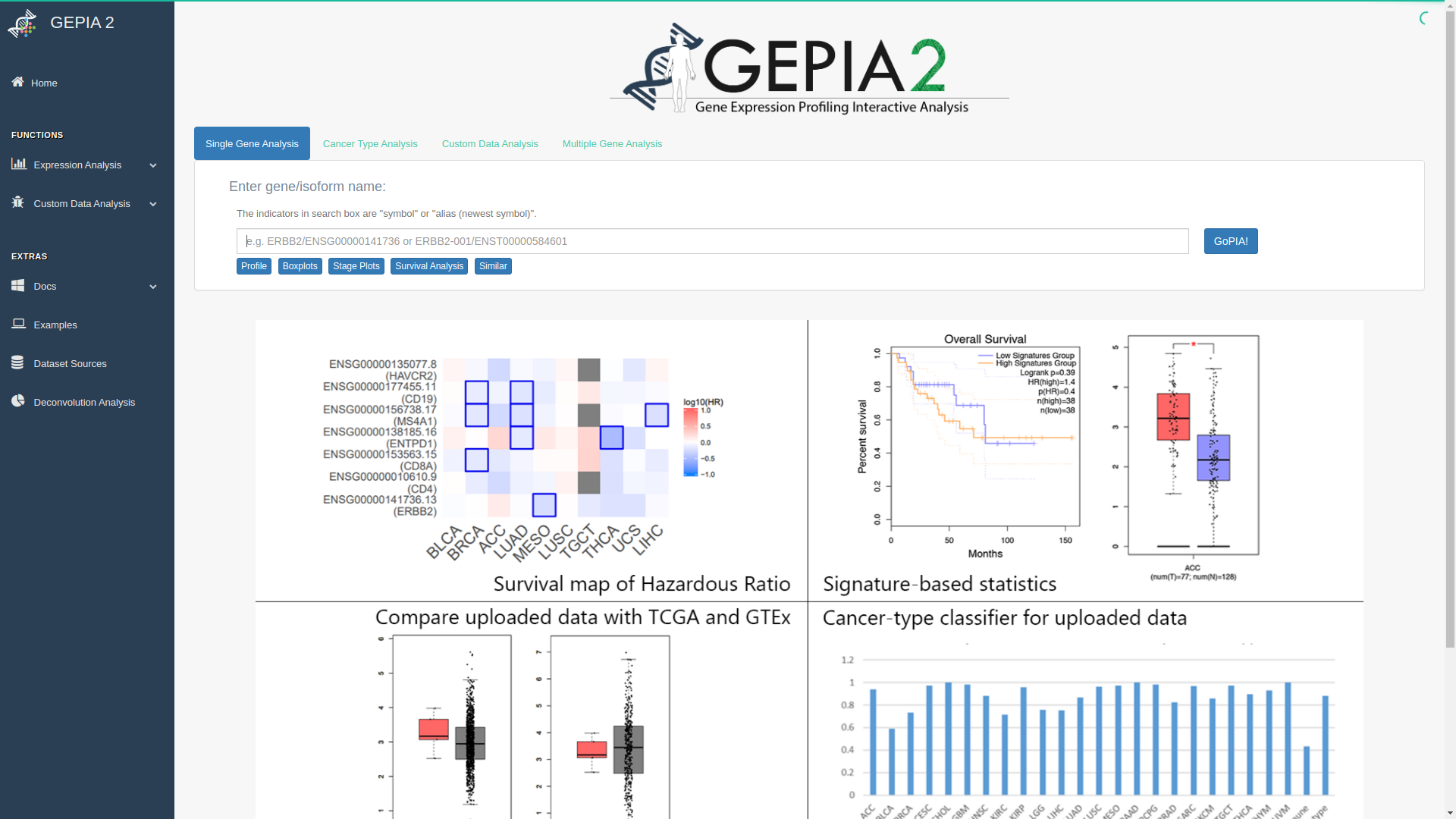
GEPIA 2 is an interactive gene expression dataset and analysis resource built from TCGA cancer data, providing tumor profiles across many cancer types including ACC, BLCA, BRCA, CESC, CHOL, COAD, DLBC, ESCA, GBM, HNSC, KICH, KIRC, KIRP, LAML, LGG, LIHC, LUAD, LUSC, MESO, OV, PAAD, PCPG, PRAD, READ, SARC, SKCM, STAD, TGCT, THCA, THYM, UCEC, UCS, and UVM. It contains gene and isoform expression information linked to clinical outcomes and supports applications such as differential expression, survival and correlation analysis, similar gene detection, dimensionality reduction, expression comparison, deconvolution, and cancer subtype classification.
gepia2.cancer-pku.cn
IP: 118.190.148.166
加载中...
相关论文
34Histone methyltransferase KMT2D promotes castration-resistant prostate cancer progression by reactivating AR through FOXA1
Mayao Luo•Chenwei Wu•Manli Zhou•Rui Liu•Yifan Zhang等 11 人
Oncogene
2026
•2026/5/30
•00 p.1-17
Prostate cancer (PCa) progression, particularly to castration-resistant prostate cancer (CRPC), is driven by androgen receptor (AR) reactivation and epigenetic alterations. Here, we identify lysine methyltransferase 2D (KMT2D) as a critical epigenetic oncogene in PCa. KMT2D expression is elevated in...
Cancer metabolismEpigeneticsProstate cancer
10.1038/S41388-026-03828-3
ISSN:0950-9232
The OGT–c-Myc–PDK2 axis rewires the TCA cycle and promotes colorectal tumor growth
Huijuan Wang•Jie Sun•Haofan Sun•Yifei Wang•Bingyi Lin等 9 人
Cell Death & Differentiation
2024
•2024/5/22
•00 p.1-13
Deregulated glucose metabolism termed the “Warburg effect” is a fundamental feature of cancers, including the colorectal cancer. This is typically characterized with an increased rate of glycolysis, and a concomitant reduced rate of the tricarboxylic acid (TCA) cycle metabolism as compared to the no...
GlycobiologyMetabolic pathways
10.1038/S41418-024-01315-4
ISSN:1350-9047
Long non-coding RNA-derived peptides are immunogenic and drive a potent anti-tumour response
Barczak Wojciech•Carr Simon M.•Liu Geng•Munro Shonagh•Nicastri Annalisa等 12 人
Nature Communications
2023
•2023/2/25
•Vol.14 No.1 p.1-17
Protein arginine methyltransferase (PRMT) 5 is over-expressed in a variety of cancers and the master transcription regulator E2F1 is an important methylation target. We have explored the role of PRMT5 and E2F1 in regulating the non-coding genome and report here a striking effect on long non-coding (...
CD8-positive T cellsNon-coding RNAsTumour immunologyTumour-suppressor proteins
10.1038/S41467-023-36826-0
ISSN:2041-1723
Transcriptional and genetic alterations of cuproptosis-related genes correlated to malignancy and immune-infiltrate of esophageal carcinoma
Jiang Runmin•Huan Yu•Li Yan•Gao Xinyue•Sun Qiang等 7 人
Cell Death Discovery
2022
•2022/8/22
•Vol.8 No.1 p.1-13
Esophageal carcinoma (ESCA) is a common type of cancer with high mortality. Cuproptosis is a new type of cell death and is characterized by the dependence on mitochondrial respiration and protein lipoylation. However, the potential roles of cuproptosis-related genes (CRGs) in ESCA remain elusive. He...
Oesophageal cancerTumour immunology
10.1038/S41420-022-01164-5
ISSN:2058-7716
Proinflammatory polarization of engineered heat-inducible macrophages reprogram the tumor immune microenvironment during cancer immunotherapy
Yanan Xue•Xiaojie Yan•Da Li•Shurong Dong•Yuan Ping
Nature Communications
2024
•2024/3/15
•Vol.15 No.1 p.1-15
The success of macrophage-based adoptive cell therapy is largely constrained by poor polarization from alternatively activated (M2-like) to classically activated (M1-like) phenotype in the immunosuppressive tumor microenvironment (TME). Here, we show that the engineered macrophage (eMac) with a heat...
Cancer immunotherapyCell deliveryMonocytes and macrophagesTranslational research
10.1038/S41467-024-46210-1
ISSN:2041-1723
Loss of Rnf31 and Vps4b sensitizes pancreatic cancer to T cell-mediated killing
Frey Nina•Tortola Luigi•Egli David•Janjuha Sharan•Rothgangl Tanja等 9 人
Nature Communications
2022
•2022/4/4
•Vol.13 No.1 p.1-11
Pancreatic ductal adenocarcinoma (PDA) is an inherently immune cell deprived tumor, characterized by desmoplastic stroma and suppressive immune cells. Here we systematically dissect PDA intrinsic mechanisms of immune evasion by in vitro and in vivo CRISPR screening, and identify Vps4b and Rnf31 as e...
CancerImmune evasionTumour immunology
10.1038/S41467-022-29412-3
ISSN:2041-1723
Global loss of promoter–enhancer connectivity and rebalancing of gene expression during early colorectal cancer carcinogenesis
Yizhou Zhu•Hayan Lee•Shannon White•Annika K. Weimer•Emma Monte等 26 人
Nature Cancer
2024
•2024/10/30
•00 p.1-16
Although three-dimensional (3D) genome architecture is crucial for gene regulation, its role in disease remains elusive. We traced the evolution and malignant transformation of colorectal cancer (CRC) by generating high-resolution chromatin conformation maps of 33 colon samples spanning different st...
CancerCancer genomicsChromatin structureDynamic networksGenome-wide analysis of gene expression
10.1038/S43018-024-00823-Z
ISSN:2662-1347
A glucocorticoid–FAS axis controls immune evasion during metastatic seeding
Monica Cassandras•Xavier Sanchez•Lauren Hsu•Yu Huang•Adam J. Getzler等 22 人
Nature
2026
•2026/3/4
•00 p.1-9
Metastasis is the major cause of death for patients with triple-negative breast cancer and other solid malignancies. Metastases arise from cancer cells that disseminate from the original tumour, survive systemic immune surveillance and colonize new organs1. Little is known about how initial dissemin...
Immune evasionMetastasis
10.1038/S41586-026-10222-2
ISSN:0028-0836
The NUCKS1-SKP2-p21/p27 axis controls S phase entry
Hume Samuel•Grou Claudia P.•Lascaux Pauline•D’Angiolella Vincenzo•Legrand Arnaud J.等 7 人
Nature Communications
2021
•2021/11/29
•Vol.12 No.1 p.1-14
Efficient entry into S phase of the cell cycle is necessary for embryonic development and tissue homoeostasis. However, unscheduled S phase entry triggers DNA damage and promotes oncogenesis, underlining the requirement for strict control. Here, we identify the NUCKS1-SKP2-p21/p27 axis as a checkpoi...
BiochemistryCell-cycle exitCheckpointsGene expression analysisUbiquitin ligases
10.1038/S41467-021-27124-8
ISSN:2041-1723
USP22 regulates lipidome accumulation by stabilizing PPARγ in hepatocellular carcinoma
Ning Zhen•Guo Xin•Liu Xiaolong•Lu Chang•Wang Aman等 23 人
Nature Communications
2022
•2022/4/21
•Vol.13 No.1 p.1-18
Elevated de novo lipogenesis is considered to be a crucial factor in hepatocellular carcinoma (HCC) development. Herein, we identify ubiquitin-specific protease 22 (USP22) as a key regulator for de novo fatty acid synthesis, which directly interacts with deubiquitinates and stabilizes peroxisome pro...
CancerCancer metabolism
10.1038/S41467-022-29846-9
ISSN:2041-1723
METTL16 exerts an m6A-independent function to facilitate translation and tumorigenesis
Su Rui•Dong Lei•Li Yangchan•Gao Min•He P. Cody等 32 人
Nature Cell Biology
2022
•2022/2/10
•Vol.24 No.2 p.205-216
METTL16 has recently been identified as an RNA methyltransferase responsible for the deposition of N6-methyladenosine (m6A) in a few transcripts. Whether METTL16 methylates a large set of transcripts, similar to METTL3 and METTL14, remains unclear. Here we show that METTL16 exerts both methyltransfe...
CancerRNA modificationTranslation
10.1038/S41556-021-00835-2
ISSN:1465-7392
Peroxisome-driven ether-linked phospholipids biosynthesis is essential for ferroptosis
Weiwei Cui•Dong Liu•Wei Gu•Bo Chu
Cell Death & Differentiation
2021
•2021/3/17
•00 p.1-16
It is well established that ferroptosis is primarily induced by peroxidation of long-chain poly-unsaturated fatty acid (PUFA) through nonenzymatic oxidation by free radicals or enzymatic stimulation of lipoxygenase. Although there is emerging evidence that long-chain saturated fatty acid (SFA) might...
Cancer metabolismPhospholipids
10.1038/S41418-021-00769-0
ISSN:1350-9047
NEK2 inhibition triggers anti-pancreatic cancer immunity by targeting PD-L1
Zhang Xiaozhen•Huang Xing•Xu Jian•Li Enliang•Lao Mengyi等 13 人
Nature Communications
2021
•2021/7/27
•Vol.12 No.1 p.1-17
Despite the substantial impact of post-translational modifications on programmed cell death 1 ligand 1 (PD-L1), its importance in therapeutic resistance in pancreatic cancer remains poorly defined. Here, we demonstrate that never in mitosis gene A-related kinase 2 (NEK2) phosphorylates PD-L1 to main...
Cancer immunotherapyPancreatic cancerTumour immunology
10.1038/S41467-021-24769-3
ISSN:2041-1723
Expansion of circulating stem-like CD8+ T cells by adding CD122-directed IL-2 complexes to radiation and anti-PD1 therapies in mice
Onyshchenko Kateryna•Luo Ren•Guffart Elena•Gaedicke Simone•Grosu Anca-Ligia等 7 人
Nature Communications
2023
•2023/4/12
•Vol.14 No.1 p.1-17
Combination of radiation therapy (RT) with immune checkpoint blockade can enhance systemic anti-tumor T cell responses. Here, using two mouse tumor models, we demonstrate that adding long-acting CD122-directed IL-2 complexes (IL-2c) to RT/anti-PD1 further increases tumor-specific CD8+ T cell numbers...
Cancer immunotherapyCytotoxic T cellsInterleukinsRadiotherapyTumour immunology
10.1038/S41467-023-37825-X
ISSN:2041-1723
HER3 targeting augments the efficacy of panobinostat in claudin-low triple-negative breast cancer cells
Hui Lyu•Defu Hou•Hao Liu•Sanbao Ruan•Congcong Tan等 8 人
Npj Precision Oncology
2023
•2023/8/3
•Vol.7 No.1 p.1-14
Patients with triple-negative breast cancer (TNBC) have a poor prognosis and high relapse rate due to limited therapeutic options. This study was conducted to determine the mechanisms of action of panobinostat, a pan-inhibitor of histone deacetylase (HDAC) and FDA-approved medication for multiple my...
Breast cancerTargeted therapies
10.1038/S41698-023-00422-8
ISSN:2397-768X
CD4+ helper T cells endow cDC1 with cancer-impeding functions in the human tumor micro-environment
Lei Xin•Khatri Indu•de Wit Tom•de Rink Iris•Nieuwland Marja等 11 人
Nature Communications
2023
•2023/1/13
•Vol.14 No.1 p.1-14
Despite their low abundance in the tumor microenvironment (TME), classical type 1 dendritic cells (cDC1) play a pivotal role in anti-cancer immunity, and their abundance positively correlates with patient survival. However, their interaction with CD4+ T-cells to potentially enable the cytotoxic T ly...
CD4-positive T cellsConventional dendritic cellsTumour biomarkersTumour immunology
10.1038/S41467-022-35615-5
ISSN:2041-1723
Targeting both death and paracaspase domains of MALT1 with antisense oligonucleotides overcomes resistance to immune-checkpoint inhibitors
Yuwei Tao•Chen Tian•Shaolong Qi•Ziqi Jia•Zheng Xu等 17 人
Nature Cancer
2025
•2025/3/12
•00 p.1-16
Targeting MALT1’s paracaspase activity has been explored for B cell lymphoma and solid tumors. While the role of MALT1 in promoting cancer cell proliferation has been investigated, its involvement in immune evasion is unclear. Here we report that MALT1 promotes immune evasion through its paracaspase...
CancerCancer immunotherapyTumour immunology
10.1038/S43018-025-00930-5
ISSN:2662-1347
Knockdown of TACC3 inhibits tumor cell proliferation and increases chemosensitivity in pancreatic cancer
Saimeng Shi•Duancheng Guo•Longyun Ye•Tianjiao Li•Qinglin Fei等 9 人
Cell Death & Disease
2023
•2023/11/27
•Vol.14 No.11 p.1-18
Pancreatic ductal adenocarcinoma (PDAC) is a highly malignant digestive tract tumor with limited clinical treatments. Transforming acidic coiled-coil-containing protein 3 (TACC3) is a component of the centrosome axis and a member of the TACC family, which affect mitosis and regulate chromosome stabi...
Mitotic spindlePancreatic cancer
10.1038/S41419-023-06313-X
ISSN:2041-4889
Tumor suppressor mediated ubiquitylation of hnRNPK is a barrier to oncogenic translation
Mucha Bartosz•Qie Shuo•Bajpai Sagar•Tarallo Vincenzo•Diehl J. Nathaniel等 24 人
Nature Communications
2022
•2022/11/3
•Vol.13 No.1 p.1-18
Heterogeneous Nuclear Ribonucleoprotein K (hnRNPK) is a multifunctional RNA binding protein (RBP) localized in the nucleus and the cytoplasm. Abnormal cytoplasmic enrichment observed in solid tumors often correlates with poor clinical outcome. The mechanism of cytoplasmic redistribution and ensuing ...
Mechanisms of diseaseMetastasisTranslation
10.1038/S41467-022-34402-6
ISSN:2041-1723
Tumour-targeted interleukin-12 and entinostat combination therapy improves cancer survival by reprogramming the tumour immune cell landscape
Hicks Kristin C.•Chariou Paul L.•Ozawa Yohei•Minnar Christine M.•Knudson Karin M.等 10 人
Nature Communications
2021
•2021/8/26
•Vol.12 No.1 p.1-18
Poorly inflamed carcinomas do not respond well to immune checkpoint blockade. Converting the tumour microenvironment into a functionally inflamed immune hub would extend the clinical benefit of immune therapy to a larger proportion of cancer patients. Here we show, by using comprehensive single-cell...
Cancer microenvironmentImmunoeditingImmunotherapyTumour vaccines
10.1038/S41467-021-25393-X
ISSN:2041-1723
Integrating muti-omics data to identify tissue-specific DNA methylation biomarkers for cancer risk
Yaohua Yang•Yaxin Chen•Shuai Xu•Xingyi Guo•Guochong Jia等 23 人
Nature Communications
2024
•2024/7/18
•Vol.15 No.1 p.1-13
The relationship between tissue-specific DNA methylation and cancer risk remains inadequately elucidated. Leveraging resources from the Genotype-Tissue Expression consortium, here we develop genetic models to predict DNA methylation at CpG sites across the genome for seven tissues and apply these mo...
Cancer epidemiologyDNA methylationPredictive markers
10.1038/S41467-024-50404-Y
ISSN:2041-1723
Glioblastoma-instructed astrocytes suppress tumour-specific T cell immunity
Camilo Faust Akl•Brian M. Andersen•Zhaorong Li•Federico Giovannoni•Martin Diebold等 38 人
Nature
2025
•2025/5/21
•00 p.1-11
Glioblastoma is the most common and aggressive primary brain cancer and shows minimal response to therapies. The immunosuppressive tumour microenvironment in glioblastoma contributes to the limited therapeutic response. Astrocytes are abundant in the central nervous system and have important immunor...
NeuroimmunologyTumour immunology
10.1038/S41586-025-08997-X
ISSN:0028-0836
Targeting SKA3 suppresses the proliferation and chemoresistance of laryngeal squamous cell carcinoma via impairing PLK1–AKT axis-mediated glycolysis
Wei Gao•Yuliang Zhang•Hongjie Luo•Min Niu•Xiwang Zheng等 26 人
Cell Death & Disease
2020
•2020/10/26
•Vol.11 No.10 p.1-19
Spindle and kinetochore-associated complex subunit 3 (SKA3) is a well-known regulator of chromosome separation and cell division, which plays an important role in cell proliferation. However, the mechanism of SKA3 regulating tumor proliferation via reprogramming metabolism is unknown. Here, SKA3 is ...
Cancer metabolismHead and neck cancerTumour biomarkers
10.1038/S41419-020-03104-6
ISSN:2041-4889
Dysregulated ceramides metabolism by fatty acid 2-hydroxylase exposes a metabolic vulnerability to target cancer metastasis
Zhou Xuantong•Huang Furong•Ma Gang•Wei Wenqing•Wu Nan等 6 人
Signal Transduction And Targeted Therapy
2022
•2022/10/24
•Vol.7 No.1 p.1-14
Whereas it is appreciated that cancer cells rewire lipid metabolism to survive and propagate, the roles of lipid metabolism in metastasis remain largely unknown. In this study, using esophageal squamous cell carcinoma (ESCC) as a pulmonary metastasis model, we find that the enzyme fatty acid 2-hydro...
Cancer metabolismDrug developmentGastrointestinal cancerMetastasisOncogenes
10.1038/S41392-022-01199-1
ISSN:2059-3635
HER3 promotes triple-negative breast cancer progression by upregulating PHF8 via miR-34b-5p-dependent mechanism
Hui Lyu•CongCong Tan•Yakun Wu•Margaret E. Larsen•Qingzhao Yu等 9 人
Cell Death & Disease
2025
•2025/11/6
•Vol.16 No.1 p.1-13
Triple-negative breast cancer (TNBC) is one of the most aggressive subtypes of breast cancer, with limited targeted treatment options and poor clinical outcomes. HER3 has recently emerged as a promising therapeutic target, with HER3-directed antibody–drug conjugates advancing to Phase III clinical t...
Breast cancerOncogenesis
10.1038/S41419-025-08115-9
ISSN:2041-4889
Co-delivery of sorafenib and an FSP1 inhibitor triggers dual ferroptosis in tumor cells and immunosuppressive macrophages for enhanced immunotherapy in mouse models of hepatocellular carcinoma
Chuanyu Tang•Cheng He•Decheng Wang•Jie Guo•Xiangyi Yin等 13 人
Nature Communications
2025
•2025/11/18
•Vol.16 No.1 p.100960
The prevalence of immunosuppressive, tumor-associated macrophages (TAM) in the tumor microenvironment of hepatocellular carcinoma (HCC) compromises the efficacy of sorafenib (SF)-based, ferroptosis-inducing systemic therapies. Increasing the susceptibility of tumor cells and TAMs to ferroptosis repr...
Cell death and immune responseDrug deliveryHepatocellular carcinoma
10.1038/S41467-025-65056-9
ISSN:2041-1723
Senescent immune cells accumulation promotes brown adipose tissue dysfunction during aging
Xu Feng•Liwen Wang•Ruoyu Zhou•Rui Zhou•Linyun Chen等 10 人
Nature Communications
2023
•2023/6/2
•Vol.14 No.1 p.1-17
Brown adipose tissue (BAT)-mediated thermogenesis declines with age. However, the underlying mechanism remains unclear. Here we reveal that bone marrow-derived pro-inflammatory and senescent S100A8+ immune cells, mainly T cells and neutrophils, invade the BAT of male rats and mice during aging. Thes...
AgeingMechanisms of diseaseMetabolic syndrome
10.1038/S41467-023-38842-6
ISSN:2041-1723
Gut microbial metabolite facilitates colorectal cancer development via ferroptosis inhibition
Weiwei Cui•Meng Guo•Dong Liu•Peng Xiao•Chuancheng Yang等 23 人
Nature Cell Biology
2024
•2024/1/2
•00 p.1-14
The gut microbiota play a pivotal role in human health. Emerging evidence indicates that gut microbes participate in the progression of tumorigenesis through the generation of carcinogenic metabolites. However, the underlying molecular mechanism is largely unknown. In the present study we show that ...
Cancer metabolismCell death
10.1038/S41556-023-01314-6
ISSN:1465-7392
Cyclic di-GMP suppresses cancer metastasis by targeting proteasome 26S subunit non-ATPase 3 independently of STING
Jieqiong Wang•Alexander Mrozek•Kewen Hu•Hanyu You•Sarah E. Traverse等 10 人
Signal Transduction And Targeted Therapy
2026
•2026/2/4
•Vol.11 No.1 p.440
Cancer metastasis is the primary cause of cancer-related mortality, yet effective treatments remain limited. There is an urgent need to develop novel therapeutic strategies to combat metastasis. In this study, we demonstrate that the bacterial intracellular signaling molecule cyclic di-GMP (c-di-GMP...
Breast cancerTarget identification
10.1038/S41392-025-02553-9
ISSN:2059-3635
SMAD4-armed oncolytic adenovirus therapy potentiates the chemotherapy effects in NSCLC through suppression of the Wnt/β-catenin pathway
Chuanjing Dai•Yaru Zhao•Huili Zhang•Sultan Muhammad Haris•Biao Huang等 10 人
Cancer Gene Therapy
2025
•2025/10/14
•00 p.1-14
Non-small cell lung cancer (NSCLC) represents between 80 and 90% of primary lung cancer cases. Despite progress targeting oncogenic drivers, there are no therapies targeting tumor-suppressor loss. This study confirmed a significant downregulation of SMAD4 expression in both NSCLC tissues and cell li...
Non-small-cell lung cancerTumour virus infections
10.1038/S41417-025-00976-8
ISSN:0929-1903
An in-situ peptide-antibody self-assembly to block CD47 and CD24 signaling enhances macrophage-mediated phagocytosis and anti-tumor immune responses
Weiqi Zhang•Yinghua Zeng•Qiuqun Xiao•Yuanyuan Wu•Jiale Liu等 10 人
Nature Communications
2024
•2024/7/6
•Vol.15 No.1 p.1-19
Targeted immunomodulation for reactivating innate cells, especially macrophages, holds great promise to complement current adaptive immunotherapy. Nevertheless, there is still a lack of high-performance therapeutics for blocking macrophage phagocytosis checkpoint inhibitors in solid tumors. Herein, ...
Biomedical materialsCancer immunotherapyTumour immunology
10.1038/S41467-024-49825-6
ISSN:2041-1723
Transcriptional control of pancreatic cancer immunosuppression by metabolic enzyme CD73 in a tumor-autonomous and -autocrine manner
Tianyu Tang•Xing Huang•Minghao Lu•Gang Zhang•Xu Han等 6 人
Nature Communications
2023
•2023/6/8
•Vol.14 No.1 p.1-18
Cancer cell metabolism contributes to the establishment of an immunosuppressive tumor microenvironment. Aberrant expression of CD73, a critical enzyme in ATP metabolism, on the cell surface results in the extracellular accumulation of adenosine, which exhibits direct inhibitory effects on tumor-infi...
Cancer immunotherapyCancer metabolismPancreatic cancer
10.1038/S41467-023-38578-3
ISSN:2041-1723
Acetylation-dependent regulation of core spliceosome modulates hepatocellular carcinoma cassette exons and sensitivity to PARP inhibitors
Linmao Sun•Yufeng Liu•Xinyu Guo•Tianming Cui•Chenghui Wu等 19 人
Nature Communications
2024
•2024/6/18
•Vol.15 No.1 p.1-17
Despite the importance of spliceosome core components in cellular processes, their roles in cancer development, including hepatocellular carcinoma (HCC), remain poorly understood. In this study, we uncover a critical role for SmD2, a core component of the spliceosome machinery, in modulating DNA dam...
AcetylationHepatocellular carcinomaRNA splicing
10.1038/S41467-024-49573-7
ISSN:2041-1723
METTL5-mediated rRNA modification controls prostate cancer progression through the IRF7/DNA2 axis and mitophagy regulation
Ruifeng Yang•Qintao Ge•Fengyao Wu•Manmei Long•Bingyu Li等 18 人
Oncogene
2026
•2026/7/13
•00 p.1-14
Prostate cancer progression to advanced disease is accompanied by extensive metabolic rewiring, yet the upstream regulatory mechanisms remain incompletely defined. Here, we showed that the rRNA m6A methyltransferase METTL5 was progressively upregulated during prostate cancer progression and was asso...
Cell biologyProstate cancer
10.1038/S41388-026-03867-W
ISSN:0950-9232