MNIST database of handwritten digits
English
United States, New York
The Courant Institute of Mathematical Sciences New York University Corinna Cortes
数据描述
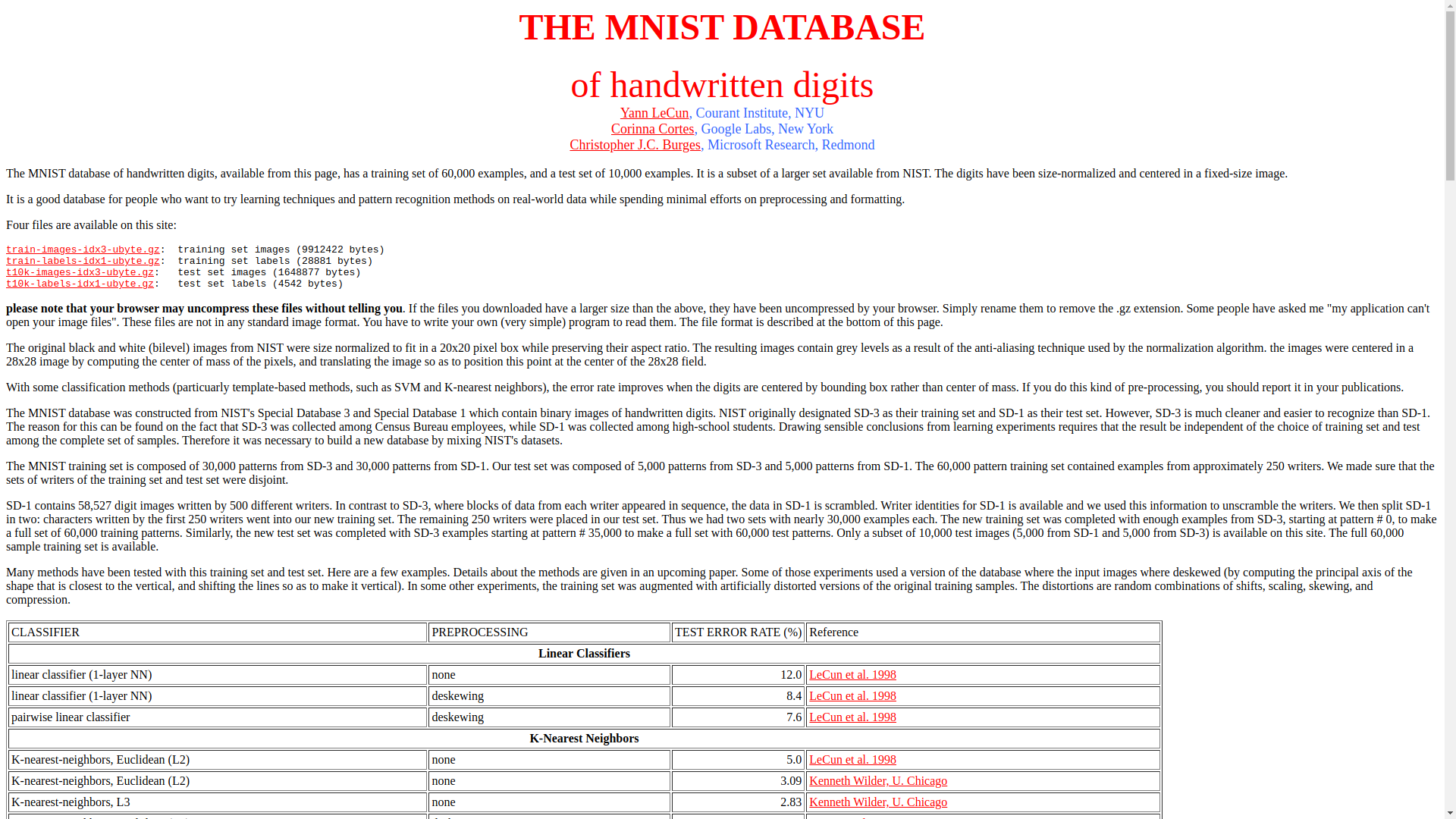
The MNIST database is a benchmark dataset of size-normalized, centered grayscale images of handwritten digits (0–9) derived from NIST Special Database 3 and 1. It contains 60,000 training examples and 10,000 test examples, with 28x28 pixel images produced by fitting original bilevel digits into a 20x20 box (preserving aspect ratio) and centering them using pixel center-of-mass, yielding anti-aliased gray levels. The training set combines 30,000 samples from each NIST source and spans roughly 250 writers, with writer-disjoint training and test splits to support fair evaluation. It is widely used to develop and compare pattern recognition and machine learning methods with minimal preprocessing.
yann.lecun.com
IP: 216.165.22.6
加载中...
相关论文
45Optical neural network via loose neuron array and functional learning
Huo Yuchi•Bao Hujun•Peng Yifan•Gao Chen•Hua Wei等 9 人
Nature Communications
2023
•2023/5/3
•Vol.14 No.1 p.1-12
This research proposes a deep-learning paradigm, termed functional learning (FL), to physically train a loose neuron array, a group of non-handcrafted, non-differentiable, and loosely connected physical neurons whose connections and gradients are beyond explicit expression. The paradigm targets trai...
Computer scienceOptoelectronic devices and componentsSoftware
10.1038/S41467-023-37390-3
ISSN:2041-1723
Selective knowledge sharing for privacy-preserving federated distillation without a good teacher
Jiawei Shao•Fangzhao Wu•Jun Zhang
Nature Communications
2024
•2024/1/8
•Vol.15 No.1 p.1-11
While federated learning (FL) is promising for efficient collaborative learning without revealing local data, it remains vulnerable to white-box privacy attacks, suffers from high communication overhead, and struggles to adapt to heterogeneous models. Federated distillation (FD) emerges as an altern...
Computer scienceElectrical and electronic engineeringTechnology
10.1038/S41467-023-44383-9
ISSN:2041-1723
Sampling-enabled scalable manifold learning unveils the discriminative cluster structure of high-dimensional data
Dehua Peng•Zhipeng Gui•Wenzhang Wei•Fa Li•Jie Gui等 7 人
Nature Machine Intelligence
2025
•2025/9/10
•00 p.1-16
As a pivotal branch of machine learning, manifold learning uncovers the intrinsic low-dimensional structure within complex non-linear manifolds in high-dimensional space for visualization, classification, clustering and gaining key insights. Although existing techniques have achieved remarkable succ...
Classification and taxonomyComputational modelsComputer scienceMachine learning
10.1038/S42256-025-01112-9
ISSN:2522-5839
Detecting shortcut learning for fair medical AI using shortcut testing
Alexander Brown•Nenad Tomasev•Jan Freyberg•Yuan Liu•Alan Karthikesalingam等 6 人
Nature Communications
2023
•2023/7/18
•Vol.14 No.1 p.1-10
Machine learning (ML) holds great promise for improving healthcare, but it is critical to ensure that its use will not propagate or amplify health disparities. An important step is to characterize the (un)fairness of ML models—their tendency to perform differently across subgroups of the population—...
Computer scienceMachine learningMedical imaging
10.1038/S41467-023-39902-7
ISSN:2041-1723
Brain-inspired global-local learning incorporated with neuromorphic computing
Wu Yujie•Zhao Rong•Zhu Jun•Chen Feng•Xu Mingkun等 15 人
Nature Communications
2022
•2022/1/10
•Vol.13 No.1 p.1-14
There are two principle approaches for learning in artificial intelligence: error-driven global learning and neuroscience-oriented local learning. Integrating them into one network may provide complementary learning capabilities for versatile learning scenarios. At the same time, neuromorphic comput...
Computer scienceEngineeringMathematics and computing
10.1038/S41467-021-27653-2
ISSN:2041-1723
Efficient and robust temporal processing with neural oscillations modulated spiking neural networks
Yinsong Yan•Qu Yang•Yujie Wu•Hanwen Liu•Malu Zhang等 8 人
Nature Communications
2025
•2025/9/30
•Vol.16 No.1 p.1-16
The brain exhibits rich dynamical properties that underpin its remarkable temporal processing capabilities. However, spiking neural networks (SNNs) inspired by the brain have not yet matched their biological counterparts in temporal processing and remain vulnerable to noise perturbations. This study...
Computational scienceComputer scienceInformation technology
10.1038/S41467-025-63771-X
ISSN:2041-1723
Different scaling of linear models and deep learning in UKBiobank brain images versus machine-learning datasets
Marc-Andre Schulz•B. T. Thomas Yeo•Joshua T. Vogelstein•Janaina Mourao-Miranada•Jakob N. Kather等 8 人
Nature Communications
2020
•2020/8/25
•Vol.11 No.1 p.1-15
Recently, deep learning has unlocked unprecedented success in various domains, especially using images, text, and speech. However, deep learning is only beneficial if the data have nonlinear relationships and if they are exploitable at available sample sizes. We systematically profiled the performan...
Genetic databasesNeural decoding
10.1038/S41467-020-18037-Z
ISSN:2041-1723
Differentially private knowledge transfer for federated learning
Tao Qi•Fangzhao Wu•Chuhan Wu•Liang He•Yongfeng Huang等 6 人
Nature Communications
2023
•2023/6/24
•Vol.14 No.1 p.1-9
Extracting useful knowledge from big data is important for machine learning. When data is privacy-sensitive and cannot be directly collected, federated learning is a promising option that extracts knowledge from decentralized data by learning and exchanging model parameters, rather than raw data. Ho...
EngineeringEthics
10.1038/S41467-023-38794-X
ISSN:2041-1723
Accurate online training of dynamical spiking neural networks through Forward Propagation Through Time
Bojian Yin•Federico Corradi•Sander M. Bohté
Nature Machine Intelligence
2023
•2023/5/8
•00 p.1-10
With recent advances in learning algorithms, recurrent networks of spiking neurons are achieving performance that is competitive with vanilla recurrent neural networks. However, these algorithms are limited to small networks of simple spiking neurons and modest-length temporal sequences, as they imp...
Computational scienceLearning algorithmsNetwork models
10.1038/S42256-023-00650-4
ISSN:2522-5839
Superior resilience to poisoning and amenability to unlearning in quantum machine learning
Yu-Qin Chen•Shi-Xin Zhang
Nature Communications
2026
•2026/3/9
0The reliability of artificial intelligence hinges on the integrity of its training data, a foundation often compromised by noise and corruption. Here, through a comparative study of classical and quantum neural networks on both classical and quantum data, we reveal a fundamental difference in their ...
Information theory and computationQuantum information
10.1038/S41467-026-70420-4
ISSN:2041-1723
A statistical mechanics framework for Bayesian deep neural networks beyond the infinite-width limit
R. Pacelli•S. Ariosto•M. Pastore•F. Ginelli•M. Gherardi等 6 人
Nature Machine Intelligence
2023
•2023/12/18
•Vol.5 No.12 p.1497-1507
Despite the practical success of deep neural networks, a comprehensive theoretical framework that can predict practically relevant scores, such as the test accuracy, from knowledge of the training data is currently lacking. Huge simplifications arise in the infinite-width limit, in which the number ...
Computer scienceStatistical physics
10.1038/S42256-023-00767-6
ISSN:2522-5839
Layer ensemble averaging for fault tolerance in memristive neural networks
Osama Yousuf•Brian D. Hoskins•Karthick Ramu•Mitchell Fream•William A. Borders等 11 人
Nature Communications
2025
•2025/2/1
•Vol.16 No.1 p.1-14
Artificial neural networks have advanced due to scaling dimensions, but conventional computing struggles with inefficiencies due to memory bottlenecks. In-memory computing architectures using memristor devices offer promise but face challenges due to hardware non-idealities. This work proposes layer...
Computer scienceElectrical and electronic engineeringElectronic devices
10.1038/S41467-025-56319-6
ISSN:2041-1723
Variable selection with false discovery rate control in deep neural networks
Zixuan Song•Jun Li
Nature Machine Intelligence
2021
•2021/3/29
•00 p.1-8
Deep neural networks are famous for their high prediction accuracy, but they are also known for their black-box nature and poor interpretability. We consider the problem of variable selection, that is, selecting the input variables that have significant predictive power on the output, in deep neural...
Computational biology and bioinformaticsMedical research
10.1038/S42256-021-00308-Z
ISSN:2522-5839
Cerebro-cerebellar networks facilitate learning through feedback decoupling
Boven Ellen•Pemberton Joseph•Chadderton Paul•Apps Richard•Costa Rui Ponte
Nature Communications
2023
•2023/1/4
•Vol.14 No.1 p.1-18
Behavioural feedback is critical for learning in the cerebral cortex. However, such feedback is often not readily available. How the cerebral cortex learns efficiently despite the sparse nature of feedback remains unclear. Inspired by recent deep learning algorithms, we introduce a systems-level com...
CerebellumCortexDyslexiaLearning algorithms
10.1038/S41467-022-35658-8
ISSN:2041-1723
Organizing memories for generalization in complementary learning systems
Weinan Sun•Madhu Advani•Nelson Spruston•Andrew Saxe•James E. Fitzgerald
Nature Neuroscience
2023
•2023/7/20
•00 p.1-11
Memorization and generalization are complementary cognitive processes that jointly promote adaptive behavior. For example, animals should memorize safe routes to specific water sources and generalize from these memories to discover environmental features that predict new ones. These functions depend...
ConsolidationLong-term memoryNetwork modelsPsychology
10.1038/S41593-023-01382-9
ISSN:1097-6256
Temporal dendritic heterogeneity incorporated with spiking neural networks for learning multi-timescale dynamics
Hanle Zheng•Zhong Zheng•Rui Hu•Bo Xiao•Yujie Wu等 9 人
Nature Communications
2024
•2024/1/4
•Vol.15 No.1 p.1-20
It is widely believed the brain-inspired spiking neural networks have the capability of processing temporal information owing to their dynamic attributes. However, how to understand what kind of mechanisms contributing to the learning ability and exploit the rich dynamic properties of spiking neural...
EngineeringMathematics and computing
10.1038/S41467-023-44614-Z
ISSN:2041-1723
Revealing the mechanisms of semantic satiation with deep learning models
Xinyu Zhang•Jing Lian•Zhaofei Yu•Huajin Tang•Dong Liang等 7 人
Communications Biology
2024
•2024/4/22
•Vol.7 No.1 p.1-12
The phenomenon of semantic satiation, which refers to the loss of meaning of a word or phrase after being repeated many times, is a well-known psychological phenomenon. However, the microscopic neural computational principles responsible for these mechanisms remain unknown. In this study, we use a d...
Neural encodingPerceptionVisual system
10.1038/S42003-024-06162-0
ISSN:2399-3642
Accurate and efficient time-domain classification with adaptive spiking recurrent neural networks
Yin Bojian•Corradi Federico•Bohté Sander M.
Nature Machine Intelligence
2021
•2021/10/14
•Vol.3 No.10 p.905-913
Inspired by detailed modelling of biological neurons, spiking neural networks (SNNs) are investigated as biologically plausible and high-performance models of neural computation. The sparse and binary communication between spiking neurons potentially enables powerful and energy-efficient neural netw...
Computational scienceNetwork models
10.1038/S42256-021-00397-W
ISSN:2522-5839
A typology for exploring the mitigation of shortcut behaviour
Friedrich Felix•Stammer Wolfgang•Schramowski Patrick•Kersting Kristian
Nature Machine Intelligence
2023
•2023/3/9
•Vol.5 No.3 p.319-330
As machine learning models become larger, and are increasingly trained on large and uncurated datasets in weakly supervised mode, it becomes important to establish mechanisms for inspecting, interacting with and revising models. These are necessary to mitigate shortcut learning effects and to guaran...
Computer scienceMathematics and computing
10.1038/S42256-023-00612-W
ISSN:2522-5839
Photonic neuromorphic accelerator for convolutional neural networks based on an integrated reconfigurable mesh
Aris Tsirigotis•George Sarantoglou•Stavros Deligiannidis•Erica Sánchez•Ana Gutierrez等 8 人
Communications Engineering
2025
•2025/4/28
•Vol.4 No.1 p.1-11
Photonic accelerators have risen as energy efficient, low latency counterparts to computational hungry digital modules for machine learning applications. On the other hand, upscaling integrated photonic circuits to meet the demands of state-of-the-art machine learning schemes such as convolutional l...
Electrical and electronic engineeringIntegrated optics
10.1038/S44172-025-00416-3
ISSN:2731-3395
Towards a topological–geometrical theory of group equivariant non-expansive operators for data analysis and machine learning
Mattia G. Bergomi•Patrizio Frosini•Daniela Giorgi•Nicola Quercioli
Nature Machine Intelligence
2019
•2019/9/2
•Vol.1 No.9 p.423-433
We provide a general mathematical framework for group and set equivariance in machine learning. We define group equivariant non-expansive operators (GENEOs) as maps between function spaces associated with groups of transformations. We study the topological and metric properties of the space of GENEO...
Applied mathematicsComputer scienceLearning algorithmsMathematics and computingNetwork models
10.1038/S42256-019-0087-3
ISSN:2522-5839
Error-aware probabilistic training for memristive neural networks
Jinchang Liu•Jian Lu•Shuangzhu Tang•Ruixi Zhou•Huiqin Ma等 9 人
Nature Communications
2025
•2025/12/12
0Analog computing-in-memory devices leverage fundamental physical laws for computation, greatly enhancing energy efficiency. However, the stochastic characteristics of analog devices conflict with the deterministic weight update of the backpropagation algorithm (BP), limiting training performance. To...
Computer scienceElectrical and electronic engineeringElectronic devices
10.1038/S41467-025-66240-7
ISSN:2041-1723
Multichannel multicentroid motion-compensated single pixel imaging of a 2D arbitrarily moving rigid-body target
Chongwu Shao•Yue Cao•Shijian Li•Xu-Ri Yao•Qing Zhao
Communications Engineering
2026
•2026/2/25
•Vol.5 No.1 p.610
Single-pixel imaging (SPI), distinguished by its cost-efficiency, exceptional spectral adaptability, and robust sub-Nyquist-Shannon sampling reconstruction capabilities, demonstrates transformative potential across imaging applications yet faces critical limitations in capturing arbitrarily moving t...
Applied physicsOptical techniques
10.1038/S44172-026-00619-2
ISSN:2731-3395
Algorithm–hardware co-design of neuromorphic networks with dual memory pathways
Pengfei Sun•Zhe Su•Jascha Achterberg•Giacomo Indiveri•Dan F. M. Goodman等 6 人
Nature Machine Intelligence
2026
•2026/6/16
•00 p.1-12
Spiking neural networks excel at event-driven sensing. Yet, maintaining task-relevant context over long timescales both algorithmically and in hardware, while respecting both tight energy and memory budgets, remains a core challenge in the field. Here we address this challenge through an algorithm–h...
Computational scienceEngineeringNetwork models
10.1038/S42256-026-01255-3
ISSN:2522-5839
Advancing diagnostic performance and clinical usability of neural networks via adversarial training and dual batch normalization
Tianyu Han•Sven Nebelung•Federico Pedersoli•Markus Zimmermann•Maximilian Schulze-Hagen等 11 人
Nature Communications
2021
•2021/7/14
•Vol.12 No.1 p.1-11
Unmasking the decision making process of machine learning models is essential for implementing diagnostic support systems in clinical practice. Here, we demonstrate that adversarially trained models can significantly enhance the usability of pathology detection as compared to their standard counterp...
Machine learningMedical imagingPredictive medicine
10.1038/S41467-021-24464-3
ISSN:2041-1723
Genuage: visualize and analyze multidimensional single-molecule point cloud data in virtual reality
Thomas Blanc•Mohamed El Beheiry•Clément Caporal•Jean-Baptiste Masson•Bassam Hajj
Nature Methods
2020
•2020/9/21
•Vol.17 No.11 p.1100-1102
Experimentally recorded point cloud data, such as those generated by single-molecule localization microscopy, are continuously increasing in size and dimension. Gaining an intuitive understanding and facilitating the analysis of such multidimensional data remains challenging. Here we report a new op...
Computational biophysicsSoftware
10.1038/S41592-020-0946-1
ISSN:1548-7091
Hybrid neural networks for continual learning inspired by corticohippocampal circuits
Qianqian Shi•Faqiang Liu•Hongyi Li•Guangyu Li•Luping Shi等 6 人
Nature Communications
2025
•2025/2/2
•Vol.16 No.1 p.1-14
Current artificial systems suffer from catastrophic forgetting during continual learning, a limitation absent in biological systems. Biological mechanisms leverage the dual representation of specific and generalized memories within corticohippocampal circuits to facilitate lifelong learning. Inspire...
Learning algorithmsMathematics and computing
10.1038/S41467-025-56405-9
ISSN:2041-1723
Learning efficient backprojections across cortical hierarchies in real time
Kevin Max•Laura Kriener•Garibaldi Pineda García•Thomas Nowotny•Ismael Jaras等 7 人
Nature Machine Intelligence
2024
•2024/6/6
•00 p.1-12
Models of sensory processing and learning in the cortex need to efficiently assign credit to synapses in all areas. In deep learning, a known solution is error backpropagation, which requires biologically implausible weight transport from feed-forwards to feedback paths. We introduce phaseless align...
Biophysical modelsLearning algorithmsMachine learningNetwork models
10.1038/S42256-024-00845-3
ISSN:2522-5839
Mode-assisted unsupervised learning of restricted Boltzmann machines
Haik Manukian•Yan Ru Pei•Sean R. B. Bearden•Massimiliano Di Ventra
Communications Physics
2020
•2020/6/5
•Vol.3 No.1 p.1-8
Restricted Boltzmann machines (RBMs) are a powerful class of generative models, but their training requires computing a gradient that, unlike supervised backpropagation on typical loss functions, is notoriously difficult even to approximate. Here, we show that properly combining standard gradient up...
Complex networksStatistics
10.1038/S42005-020-0373-8
ISSN:2399-3650
Time-domain photonic image processor based on speckle projection and reservoir computing
Tomoya Yamaguchi•Kohei Arai•Tomoaki Niiyama•Atsushi Uchida•Satoshi Sunada
Communications Physics
2023
•2023/9/14
•Vol.6 No.1 p.1-10
High-speed image processing is essential for many real-time applications. On-chip photonic neural network processors have the potential to speed up image processing, but their scalability is limited in terms of the number of input/output channels because high-density integration is challenging. Here...
Applied opticsImaging and sensingSilicon photonics
10.1038/S42005-023-01368-W
ISSN:2399-3650
Adaptive spatiotemporal neural networks through complementary hybridization
Yujie Wu•Bizhao Shi•Zhong Zheng•Hanle Zheng•Fangwen Yu等 8 人
Nature Communications
2024
•2024/8/27
•Vol.15 No.1 p.1-15
Processing spatiotemporal data sources with both high spatial dimension and rich temporal information is a ubiquitous need in machine intelligence. Recurrent neural networks in the machine learning domain and bio-inspired spiking neural networks in the neuromorphic computing domain are two promising...
Computational scienceSoftware
10.1038/S41467-024-51641-X
ISSN:2041-1723
Dual adaptive training of photonic neural networks
Ziyang Zheng•Zhengyang Duan•Hang Chen•Rui Yang•Sheng Gao等 8 人
Nature Machine Intelligence
2023
•2023/9/28
•00 p.1-11
Photonic neural networks (PNNs) are remarkable analogue artificial intelligence accelerators that compute using photons instead of electrons at low latency, high energy efficiency and high parallelism; however, the existing training approaches cannot address the extensive accumulation of systematic ...
Applied opticsElectrical and electronic engineeringOptical physics
10.1038/S42256-023-00723-4
ISSN:2522-5839
Deep neural networks using a single neuron: folded-in-time architecture using feedback-modulated delay loops
Stelzer Florian•Röhm André•Vicente Raul•Fischer Ingo•Yanchuk Serhiy
Nature Communications
2021
•2021/8/27
•Vol.12 No.1 p.1-10
Deep neural networks are among the most widely applied machine learning tools showing outstanding performance in a broad range of tasks. We present a method for folding a deep neural network of arbitrary size into a single neuron with multiple time-delayed feedback loops. This single-neuron deep neu...
Complex networksInformation technologyNonlinear phenomena
10.1038/S41467-021-25427-4
ISSN:2041-1723
Assessing single-cell transcriptomic variability through density-preserving data visualization
Ashwin Narayan•Bonnie Berger•Hyunghoon Cho
Nature Biotechnology
2021
•2021/1/18
•00 p.1-10
Nonlinear data visualization methods, such as t-distributed stochastic neighbor embedding (t-SNE) and uniform manifold approximation and projection (UMAP), summarize the complex transcriptomic landscape of single cells in two dimensions or three dimensions, but they neglect the local density of data...
Computational biology and bioinformaticsData miningTranscriptomics
10.1038/S41587-020-00801-7
ISSN:1087-0156
Local kernel renormalization as a mechanism for feature learning in overparametrized convolutional neural networks
R. Aiudi•R. Pacelli•P. Baglioni•A. Vezzani•R. Burioni等 6 人
Nature Communications
2025
•2025/1/10
•Vol.16 No.1 p.1-10
Empirical evidence shows that fully-connected neural networks in the infinite-width limit (lazy training) eventually outperform their finite-width counterparts in most computer vision tasks; on the other hand, modern architectures with convolutional layers often achieve optimal performances in the f...
Complex networksComputer scienceStatistical physics
10.1038/S41467-024-55229-3
ISSN:2041-1723
Clustering by measuring local direction centrality for data with heterogeneous density and weak connectivity
Peng Dehua•Gui Zhipeng•Wang Dehe•Ma Yuncheng•Huang Zichen等 7 人
Nature Communications
2022
•2022/9/16
•Vol.13 No.1 p.1-14
Clustering is a powerful machine learning method for discovering similar patterns according to the proximity of elements in feature space. It is widely used in computer science, bioscience, geoscience, and economics. Although the state-of-the-art partition-based and connectivity-based clustering met...
Biomedical engineeringClassification and taxonomyComputational modelsComputer scienceData mining
10.1038/S41467-022-33136-9
ISSN:2041-1723
Universal structural patterns in sparse recurrent neural networks
Xin-Jie Zhang•Jack Murdoch Moore•Gang Yan•Xiang Li
Communications Physics
2023
•2023/9/8
•Vol.6 No.1 p.1-10
Sparse neural networks can achieve performance comparable to fully connected networks but need less energy and memory, showing great promise for deploying artificial intelligence in resource-limited devices. While significant progress has been made in recent years in developing approaches to sparsif...
Complex networksComputational science
10.1038/S42005-023-01364-0
ISSN:2399-3650
The combination of Hebbian and predictive plasticity learns invariant object representations in deep sensory networks
Manu Srinath Halvagal•Friedemann Zenke
Nature Neuroscience
2023
•2023/10/12
•00 p.1-10
Recognition of objects from sensory stimuli is essential for survival. To that end, sensory networks in the brain must form object representations invariant to stimulus changes, such as size, orientation and context. Although Hebbian plasticity is known to shape sensory networks, it fails to create ...
Learning algorithmsNetwork models
10.1038/S41593-023-01460-Y
ISSN:1097-6256
Continual learning of context-dependent processing in neural networks
Guanxiong Zeng•Yang Chen•Bo Cui•Shan Yu
Nature Machine Intelligence
2019
•2019/8/9
•Vol.1 No.8 p.364-372
Deep neural networks are powerful tools in learning sophisticated but fixed mapping rules between inputs and outputs, thereby limiting their application in more complex and dynamic situations in which the mapping rules are not kept the same but change according to different contexts. To lift such li...
Cognitive controlComputer science
10.1038/S42256-019-0080-X
ISSN:2522-5839
Three types of incremental learning
van de Ven Gido M.•Tuytelaars Tinne•Tolias Andreas S.
Nature Machine Intelligence
2022
•2022/12/5
•Vol.4 No.12 p.1185-1197
Incrementally learning new information from a non-stationary stream of data, referred to as ‘continual learning’, is a key feature of natural intelligence, but a challenging problem for deep neural networks. In recent years, numerous deep learning methods for continual learning have been proposed, b...
Computer scienceLearning algorithmsSoftware
10.1038/S42256-022-00568-3
ISSN:2522-5839
Burst-dependent synaptic plasticity can coordinate learning in hierarchical circuits
Alexandre Payeur•Jordan Guerguiev•Friedemann Zenke•Blake A. Richards•Richard Naud
Nature Neuroscience
2021
•2021/5/13
•00 p.1-10
Synaptic plasticity is believed to be a key physiological mechanism for learning. It is well established that it depends on pre- and postsynaptic activity. However, models that rely solely on pre- and postsynaptic activity for synaptic changes have, so far, not been able to account for learning comp...
Learning algorithmsSensory processingSpike-timing-dependent plasticity
10.1038/S41593-021-00857-X
ISSN:1097-6256
Theoretical error performance analysis for variational quantum circuit based functional regression
Qi Jun•Yang Chao-Han Huck•Chen Pin-Yu•Hsieh Min-Hsiu
Npj Quantum Information
2023
•2023/1/9
•Vol.9 No.1 p.1-10
The noisy intermediate-scale quantum devices enable the implementation of the variational quantum circuit (VQC) for quantum neural networks (QNN). Although the VQC-based QNN has succeeded in many machine learning tasks, the representation and generalization powers of VQC still require further invest...
Computer scienceElectrical and electronic engineeringInformation technology
10.1038/S41534-022-00672-7
ISSN:2056-6387
Random sketch learning for deep neural networks in edge computing
Bin Li•Peijun Chen•Hongfu Liu•Weisi Guo•Xianbin Cao等 8 人
Nature Computational Science
2021
•2021/3/25
•Vol.1 No.3 p.221-228
Despite the great potential of deep neural networks (DNNs), they require massive weights and huge computational resources, creating a vast gap when deploying artificial intelligence at low-cost edge devices. Current lightweight DNNs, achieved by high-dimensional space pre-training and post-compressi...
Computational scienceComputer science
10.1038/S43588-021-00039-6
ISSN:2662-8457
Explaining a series of models by propagating Shapley values
Chen Hugh•Lundberg Scott M.•Lee Su-In
Nature Communications
2022
•2022/8/3
•Vol.13 No.1 p.1-15
Local feature attribution methods are increasingly used to explain complex machine learning models. However, current methods are limited because they are extremely expensive to compute or are not capable of explaining a distributed series of models where each model is owned by a separate institution...
Computational scienceComputer science
10.1038/S41467-022-31384-3
ISSN:2041-1723
Neuromorphic computing paradigms enhance robustness through spiking neural networks
Jianhao Ding•Zhaofei Yu•Jian K. Liu•Tiejun Huang
Nature Communications
2025
•2025/11/19
•Vol.16 No.1 p.101750
The success of deep learning methods over the past decade has been partially shrouded in the shadow of adversarial attacks. Even a tiny undetectable deformation can lead to vicious misleading targeted at safety-critical applications. In contrast, the brain is far more robust when performing complex ...
Computer scienceNetwork models
10.1038/S41467-025-65197-X
ISSN:2041-1723