STScI | Mikulski Archive for Space Telescopes (MAST) Portal
English
Collections
数据描述
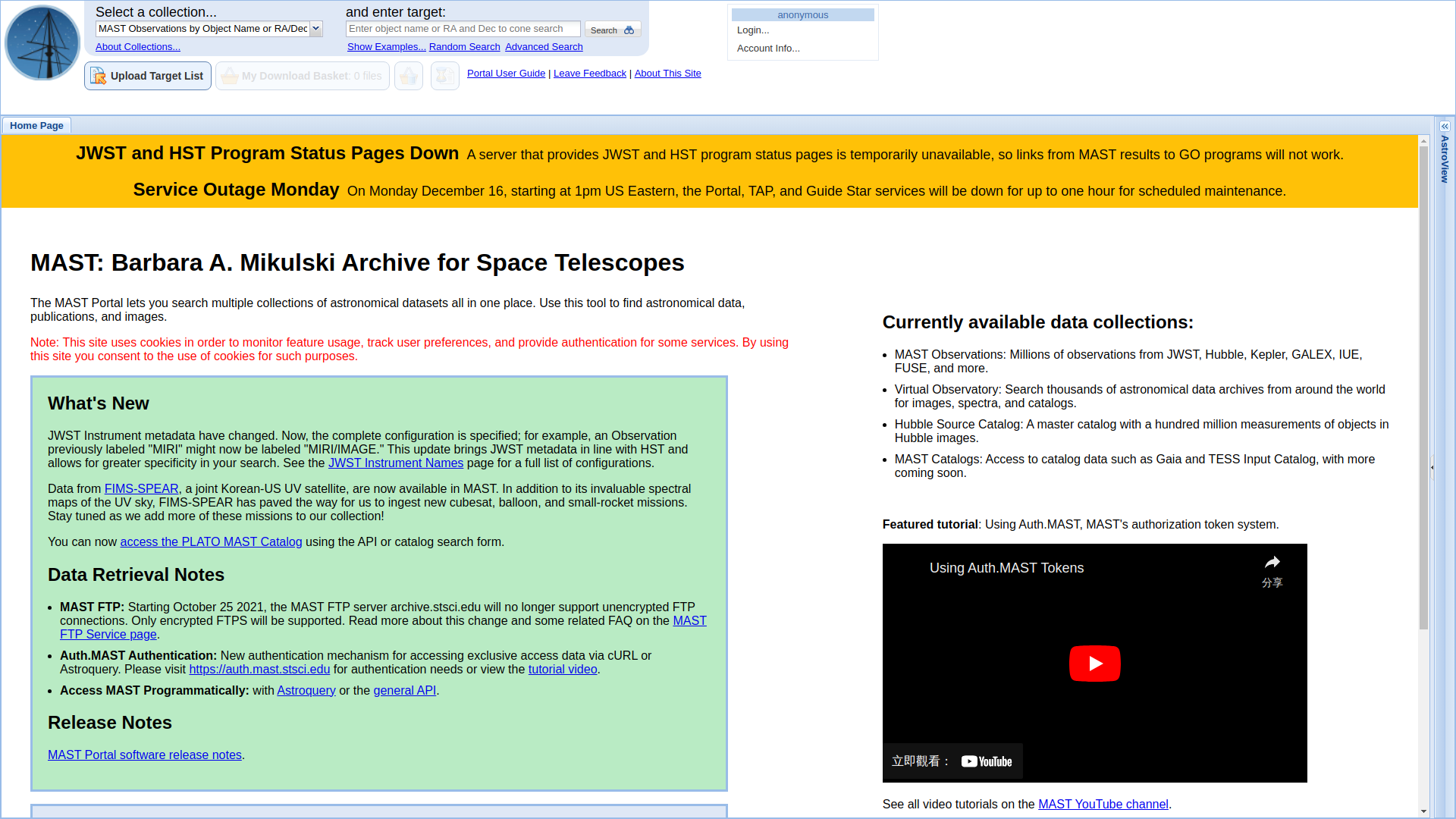
The dataset is part of an online platform designed for accessing and analyzing astronomical data. Users can search, filter, and download observational datasets through features like advanced search, target lists, and bulk downloads. The system supports a collection-based structure, allowing users to select specific datasets or observations efficiently. The interface also includes tools such as AstroView, which likely aids in visualizing or interpreting the data. The dataset's purpose is to facilitate astronomical research by providing accessible and organized observational records for scientific exploration.
mast.stsci.edu
IP: 130.167.220.33
加载中...
相关论文
57Hydrogen sulfide and metal-enriched atmosphere for a Jupiter-mass exoplanet
Guangwei Fu•Luis Welbanks•Drake Deming•Julie Inglis•Michael Zhang等 18 人
Nature
2024
•2024/7/8
•00 p.1-5
As the closest transiting hot Jupiter to Earth, HD 189733b has been the benchmark planet for atmospheric characterization1–3. It has also been the anchor point for much of our theoretical understanding of exoplanet atmospheres from composition4, chemistry5,6, aerosols7 to atmospheric dynamics8, esca...
Atmospheric chemistryExoplanets
10.1038/S41586-024-07760-Y
ISSN:0028-0836
The discovery of two little red dots in transition into quasars
Shuqi Fu•Zijian Zhang•Danyang Jiang•Jie Chen•Linhua Jiang等 12 人
Nature Astronomy
2026
•2026/6/3
•00 p.1-15
JWST has uncovered a population of compact objects that show a unique V-shaped spectral energy distribution in the ultraviolet and optical wavelength range. These so-called little red dots (LRDs) often exhibit broad Balmer emission lines, indicative of the presence of active galactic nuclei (AGNs). ...
Compact astrophysical objectsGalaxies and clusters
10.1038/S41550-026-02885-8
ISSN:2397-3366
JWST/NIRCam detections of dusty subsolar-mass young stellar objects in the Small Magellanic Cloud
Jones Olivia C.•Nally Conor•Habel Nolan•Lenkić Laura•Fahrion Katja等 26 人
Nature Astronomy
2023
•2023/4/24
•00 p.1-8
Low-mass stars are the most numerous stellar objects in the Universe. Before the James Webb Space Telescope (JWST), we had limited knowledge of how planetary systems around low-mass stars could form at subsolar metallicities. Here we present JWST observations of NGC 346, a star-forming region in the...
Astronomy and planetary scienceStars
10.1038/S41550-023-01945-7
ISSN:2397-3366
Continuous helium absorption from both the leading and trailing tails of WASP-107 b
Vigneshwaran Krishnamurthy•Yann Carteret•Caroline Piaulet-Ghorayeb•Jared Splinter•Dhvani Doshi等 24 人
Nature Astronomy
2025
•2025/12/1
•00 p.1-13
The formation and evolution of giant planets remain incompletely understood, with mounting evidence that many close-in giants may have migrated from their birth locations. The detection of helium escaping the atmosphere of exoplanets has provided a powerful new tracer of atmospheric escape and exopl...
Atmospheric chemistryAtmospheric dynamicsExoplanetsGiant planets
10.1038/S41550-025-02710-8
ISSN:2397-3366
Fluorescently excited CO emission in the 49 Ceti debris disk spatially resolved by JWST/NIRSpec
Kadin Worthen•Christine H. Chen•Sean D. Brittain•Joan R. Najita•Chen Xie等 14 人
Nature Astronomy
2025
•2025/9/23
•00 p.1-12
Debris disks are exosystems thought to arise from collisions among planetesimals. Despite being dust dominated, ALMA has detected reservoirs of CO gas in some debris disks. The origin of this gas is debated, as it could be primordial H2-dominated gas from the parent protoplanetary disk, or it could ...
Astrophysical disksExoplanets
10.1038/S41550-025-02664-X
ISSN:2397-3366
A benchmark JWST near-infrared spectrum for the exoplanet WASP-39 b
A. L. Carter•E. M. May•N. Espinoza•L. Welbanks•E. Ahrer等 80 人
Nature Astronomy
2024
•2024/7/10
•00 p.1-12
Observing exoplanets through transmission spectroscopy supplies detailed information about their atmospheric composition, physics and chemistry. Before the James Webb Space Telescope (JWST), these observations were limited to a narrow wavelength range across the near-ultraviolet to near-infrared, al...
Exoplanets
10.1038/S41550-024-02292-X
ISSN:2397-3366
Optical superluminal motion measurement in the neutron-star merger GW170817
Mooley Kunal P.•Anderson Jay•Lu Wenbin
Nature
2022
•2022/10/12
•Vol.610 No.7931 p.273-276
The afterglow of the binary neutron-star merger GW1708171 gave evidence for a structured relativistic jet2–6 and a link3,7,8 between such mergers and short gamma-ray bursts. Superluminal motion, found using radio very long baseline interferometry3 (VLBI), together with the afterglow light curve prov...
General relativity and gravityHigh-energy astrophysicsTime-domain astronomyTransient astrophysical phenomena
10.1038/S41586-022-05145-7
ISSN:0028-0836
Water in the terrestrial planet-forming zone of the PDS 70 disk
G. Perotti•V. Christiaens•Th. Henning•B. Tabone•L. B. F. M. Waters等 45 人
Nature
2023
•2023/7/24
•00 p.1-5
Terrestrial and sub-Neptune planets are expected to form in the inner (less than 10 au) regions of protoplanetary disks1. Water plays a key role in their formation2–4, although it is yet unclear whether water molecules are formed in situ or transported from the outer disk5,6. So far Spitzer Space Te...
Astrophysical disksAstrophysical dustExoplanets
10.1038/S41586-023-06317-9
ISSN:0028-0836
A dense web of neutral gas in a galaxy proto-cluster post-reionization
Kasper E. Heintz•Jake S. Bennett•Pascal A. Oesch•Albert Sneppen•Douglas Rennehan等 25 人
Nature Astronomy
2026
•2026/1/2
•Vol.10 No.3 p.448-456
Galaxy clusters are the most massive, gravitationally bound structures in the Universe. They emerged through hierarchical structure formation of large-scale dark matter and baryon overdensities. Early galaxy ‘proto-clusters’ are believed to have substantially contributed to the cosmic star-formation...
Early universeGalaxies and clusters
10.1038/S41550-025-02745-X
ISSN:2397-3366
A JWST transmission spectrum of the nearby Earth-sized exoplanet LHS 475 b
Jacob Lustig-Yaeger•Guangwei Fu•E. M. May•Kevin N. Ortiz Ceballos•Sarah E. Moran等 23 人
Nature Astronomy
2023
•2023/8/31
•00 p.1-12
The critical first step in the search for life on exoplanets over the next decade is to determine whether rocky planets transiting small M-dwarf stars possess atmospheres and, if so, what processes sculpt them over time. Because of its broad wavelength coverage and improved resolution compared with ...
Exoplanets
10.1038/S41550-023-02064-Z
ISSN:2397-3366
Molecular hydrogen in the extremely metal- and dust-poor galaxy Leo P
O. Grace Telford•Karin M. Sandstrom•Kristen B. W. McQuinn•Simon C. O. Glover•Elizabeth J. Tarantino等 7 人
Nature
2025
•2025/6/11
•00 p.1-5
The James Webb Space Telescope (JWST) has revealed unexpectedly rapid galaxy assembly in the early Universe, in tension with galaxy-formation models1–3. At the low abundances of heavy elements (metals) and dust typical in early galaxies, the formation of molecular hydrogen and its connection to star...
Galaxies and clustersInterstellar medium
10.1038/S41586-025-09115-7
ISSN:0028-0836
Dilution of chemical enrichment in galaxies 600 Myr after the Big Bang
Kasper E. Heintz•Gabriel B. Brammer•Clara Giménez-Arteaga•Victoria B. Strait•Claudia del P. Lagos等 13 人
Nature Astronomy
2023
•2023/9/21
•00 p.1-8
The evolution of galaxies throughout the last 12 Gyr of cosmic time has followed a single, universal relation that connects star-formation rates (SFRs), stellar masses (M⋆) and chemical abundances. Deviation from this fundamental scaling relation would imply a drastic change in the processes that re...
Early universeGalaxies and clustersInterstellar medium
10.1038/S41550-023-02078-7
ISSN:2397-3366
Combined analysis of the 12.8 and 15 μm JWST/MIRI eclipse observations of TRAPPIST-1 b
Elsa Ducrot•Pierre-Olivier Lagage•Michiel Min•Michaël Gillon•Taylor J. Bell等 39 人
Nature Astronomy
2024
•2024/12/16
•00 p.1-12
The first James Webb Space Telescope/MIRI photometric observations of TRAPPIST-1 b allowed for the detection of the thermal emission of the planet at 15 μm, suggesting that the planet could be a bare rock with a zero albedo and no redistribution of heat. These observations at 15 μm were acquired as ...
Atmospheric chemistryExoplanets
10.1038/S41550-024-02428-Z
ISSN:2397-3366
OH as a probe of the warm-water cycle in planet-forming disks
Marion Zannese•Benoît Tabone•Emilie Habart•Javier R. Goicoechea•Alexandre Zanchet等 54 人
Nature Astronomy
2024
•2024/2/23
•00 p.1-10
Water is a key ingredient for the emergence of life as we know it. Yet, its destruction and reformation in space remain unprobed in warm gas (T > 300 K). Here we detect with the James Webb Space Telescope the emission of the hydroxyl radical (OH) from d203-506, a planet-forming disk exposed to ex...
Astrophysical disksAtomic and molecular physicsInterstellar medium
10.1038/S41550-024-02203-0
ISSN:2397-3366
Tidally trapped pulsations in a close binary star system discovered by TESS
G. Handler•D. W. Kurtz•S. A. Rappaport•H. Saio•J. Fuller等 15 人
Nature Astronomy
2020
•2020/3/9
•Vol.4 No.7 p.684-689
It has long been suspected that tidal forces in close binary stars could modify the orientation of the pulsation axis of the constituent stars. Such stars have been searched for, but until now never detected. Here we report the discovery of tidally trapped pulsations in the ellipsoidal variable HD 7...
Astronomy and astrophysicsAstronomy and planetary science
10.1038/S41550-020-1035-1
ISSN:2397-3366
Evidence of triggered star formation in the Pillars of Creation from JWST observations
Jing Wen•Bingqiu Chen•Jian Gao•Jun Li•Ming Yang等 6 人
Nature Astronomy
2025
•2025/10/21
•00 p.1-9
Stars form in molecular clouds under the influence of their local environments, yet the role of massive stellar feedback in either triggering or suppressing star formation remains a fundamental question in astrophysics. The Pillars of Creation in the Eagle Nebula—sculpted by ionizing radiation and s...
Interstellar mediumStarsStellar evolution
10.1038/S41550-025-02683-8
ISSN:2397-3366
A solar C/O ratio in planet-forming gas at 1 au in a highly irradiated disk
Ilane Schroetter•Olivier Berné•Emeric Bron•Felipe Alarcon•Paul Amiot等 21 人
Nature Astronomy
2025
•2025/7/14
•00 p.1-11
The chemical composition of exoplanets is thought to be influenced by the composition of the disks in which they form. JWST observations have unveiled a variety of chemical species in numerous nearby disks, which show substantial variations in the C/O abundance ratio. However, little is known about ...
Astrophysical disksInterstellar medium
10.1038/S41550-025-02596-6
ISSN:2397-3366
Discovery of multi-temperature coronal mass ejection signatures from a young solar analogue
Kosuke Namekata•Kevin France•Jongchul Chae•Vladimir S. Airapetian•Adam Kowalski等 17 人
Nature Astronomy
2025
•2025/10/27
•00 p.1-12
Coronal mass ejections (CMEs) on the early Sun may have profoundly influenced the planetary atmospheres of early Solar System planets. Flaring young solar analogues serve as excellent proxies for probing the plasma environment of the young Sun, yet their CMEs remain poorly understood. Here we report...
Astrophysical magnetic fieldsExoplanetsStarsTime-domain astronomyTransient astrophysical phenomena
10.1038/S41550-025-02691-8
ISSN:2397-3366
A direct black-hole mass measurement in a little red dot at high redshift
Ignas Juodžbalis•Cosimo Marconcini•Francesco D’Eugenio•Roberto Maiolino•Alessandro Marconi等 40 人
Nature
2026
•2026/5/27
•Vol.653 No.8116 p.1017-1021
Recent discoveries of faint active galactic nuclei (AGN) at the redshift frontier have revealed a plethora of broad Hα emitters with optically red continua, named little red dots (LRDs)1, which comprise 15–30% of the high-redshift broad-line AGN population2. Owing to their peculiar properties3–6, mo...
Compact astrophysical objectsGalaxies and clusters
10.1038/S41586-026-10579-4
ISSN:0028-0836
Kilometre-scale Jovian moon characterized for a potential JUICE flyby
Juan Luis Rizos•Jose María Gómez-Limón•Yucel Kilic•Altair R. Gomes-Júnior•Jose Luis Ortiz等 54 人
Nature Astronomy
2026
•2026/7/24
•00 p.1-11
Jupiter’s irregular satellites are thought to be relics of early Solar System planetesimals. However, their small sizes, large distances from Earth and close angular proximity to Jupiter, make them difficult to characterize remotely. Here we report multi-instrument observations of the kilometre-size...
Asteroids, comets and Kuiper beltRings and moons
10.1038/S41550-026-02929-Z
ISSN:2397-3366
JWST interferometric imaging reveals the dusty torus obscuring the supermassive black hole of Circinus galaxy
Enrique Lopez-Rodriguez•Joel Sanchez-Bermudez•Omaira González-Martín•Robert Nikutta•Ryan M. Lau等 9 人
Nature Communications
2026
•2026/1/13
•Vol.17 No.1 p.420
The dusty and molecular torus is an elusive structure surrounding supermassive black holes, yet its importance is unequivocal for understanding feedback and accretion mechanisms. The torus and accretion disk feed the inspiraling gas onto the active nucleus, launching outflows that fundamentally conn...
Astronomical instrumentationAstrophysical dustGalaxies and clusters
10.1038/S41467-025-66010-5
ISSN:2041-1723
A new rotation period and longitude system for Uranus
L. Lamy•R. Prangé•J. Berthier•C. Tao•T. Kim等 12 人
Nature Astronomy
2025
•2025/4/7
•00 p.1-8
The rotation period of Uranus was estimated to be 17.24 ± 0.01 h in 1986 from radio auroral measurements during the brief Voyager 2 flyby. This value is the basis for the Uranian SIII longitude system still in use. However, the poor period uncertainty limited its validity to a few years, after which...
AuroraMagnetospheric physics
10.1038/S41550-025-02492-Z
ISSN:2397-3366
A little red dot at z = 7.3 within a large galaxy overdensity
Jan-Torge Schindler•Joseph F. Hennawi•Frederick B. Davies•Sarah E. I. Bosman•Ryan Endsley等 14 人
Nature Astronomy
2025
•2025/9/17
•00 p.1-13
The nature of ‘little red dots’ and their relation to other forms of accreting supermassive black holes remain an open question. Here we report the discovery of a little red dot at z = 7.3. It is attenuated by moderate amounts of dust, AV = 2.79 mag, and has an intrinsic bolometric luminosity of 104...
Early universeGalaxies and clusters
10.1038/S41550-025-02660-1
ISSN:2397-3366
Probable detection of an eruptive filament from a superflare on a solar-type star
Namekata Kosuke•Maehara Hiroyuki•Honda Satoshi•Notsu Yuta•Okamoto Soshi等 23 人
Nature Astronomy
2021
•2021/12/9
•00 p.1-8
Solar flares are often accompanied by filament/prominence eruptions (~104 K and ~1010−11 cm−3), sometimes leading to coronal mass ejections that directly affect the Earth’s environment1,2. ‘Superflares’ are found on some active solar-type (G-type main-sequence) stars3–5, but the filament eruption–co...
Early solar systemExoplanetsStarsTime-domain astronomyTransient astrophysical phenomena
10.1038/S41550-021-01532-8
ISSN:2397-3366
The atmosphere of Titan in late northern summer from JWST and Keck observations
Conor A. Nixon•Bruno Bézard•Thomas Cornet•Brandon Park Coy•Imke de Pater等 45 人
Nature Astronomy
2025
•2025/5/14
•00 p.1-13
Saturn’s moon Titan undergoes a long annual cycle of 29.45 Earth years. Titan’s northern winter and spring were investigated in detail by the Cassini–Huygens spacecraft (2004–2017), but the northern summer season remains sparsely studied. Here we present new observations from the James Webb Space Te...
Atmospheric dynamicsRings and moons
10.1038/S41550-025-02537-3
ISSN:2397-3366
SiO and a super-stellar C/O ratio in the atmosphere of the giant exoplanet WASP-121 b
Thomas M. Evans-Soma•David K. Sing•Joanna K. Barstow•Anjali A. A. Piette•Jake Taylor等 18 人
Nature Astronomy
2025
•2025/6/2
•Vol.9 No.6 p.845-861
Refractory elements such as iron, magnesium and silicon can be detected in the atmospheres of ultrahot giant planets. This provides an opportunity to quantify the amount of refractory material accreted during formation, along with volatile gases and ices. However, simultaneous detections of refracto...
Atmospheric chemistryAtmospheric dynamicsExoplanetsGiant planets
10.1038/S41550-025-02513-X
ISSN:2397-3366
Heterogeneous outgassing regions identified on active centaur 29P/Schwassmann–Wachmann 1
Sara Faggi•Geronimo L. Villanueva•Adam McKay•Olga Harrington Pinto•Michael S. P. Kelley等 14 人
Nature Astronomy
2024
•2024/7/8
•00 p.1-9
Centaurs are transitional objects between primitive trans-Neptunian objects and Jupiter-family comets. Their compositions and activities provide fundamental clues regarding the processes affecting the evolution of and interplay between these small bodies. Here we report observations of centaur 29P/S...
Asteroids, comets and Kuiper beltAstrobiology
10.1038/S41550-024-02319-3
ISSN:2397-3366
A 5.3-min-period pulsing white dwarf in a binary detected from radio to X-rays
Ingrid Pelisoli•T. R. Marsh•David A. H. Buckley•I. Heywood•Stephen. B. Potter等 22 人
Nature Astronomy
2023
•2023/6/15
•00 p.1-12
White dwarf stars are the most common stellar fossils. When in binaries, they make up the dominant form of compact object binary within the Galaxy and can offer insight into different aspects of binary formation and evolution. One of the most remarkable white dwarf binary systems identified to date ...
Astrophysical magnetic fieldsCompact astrophysical objectsStarsStellar evolutionTime-domain astronomy
10.1038/S41550-023-01995-X
ISSN:2397-3366
Thermal evolution of trans-Neptunian objects through observations of Centaurs with JWST
Javier Licandro•Noemí Pinilla-Alonso•Bryan J. Holler•Mário N. De Prá•Mario Melita等 21 人
Nature Astronomy
2024
•2024/12/19
•00 p.1-7
Centaurs are small bodies orbiting between Jupiter and Neptune and behave as an intermediate population between trans-Neptunian-belt objects and Jupiter-family comets. As such, their surface composition and evolutionary processes are key to understanding the Solar System’s history. However, the mech...
Asteroids, comets and Kuiper beltMineralogy
10.1038/S41550-024-02417-2
ISSN:2397-3366
Sunyaev–Zeldovich detection of hot intracluster gas at redshift 4.3
Dazhi Zhou•Scott C. Chapman•Manuel Aravena•Pablo Araya-Araya•Melanie Archipley等 24 人
Nature
2026
•2026/1/5
•Vol.649 No.8099 p.1130-1133
Most baryons in present-day galaxy clusters exist as hot gas (≳107 K), forming the intracluster medium (ICM)1. Cosmological simulations predict that the mass and temperature of the ICM decline towards earlier times, as intracluster gas in younger clusters is still assembling and being heated2–4. To ...
Early universeGalaxies and clusters
10.1038/S41586-025-09901-3
ISSN:0028-0836
UV-dark polar ovals on Jupiter as tracers of magnetosphere–atmosphere connections
Troy K. Tsubota•Michael H. Wong•Tom Stallard•Xi Zhang•Amy A. Simon
Nature Astronomy
2024
•2024/11/26
•00 p.1-9
Aerosols in Jupiter’s stratosphere form intriguing polar hoods, which have been investigated by ultraviolet cameras on Cassini and the Hubble Space Telescope. Transient, concentrated dark ovals of unknown origin have been noted within both the northern and southern polar hoods. However, a systematic...
Atmospheric dynamicsMagnetospheric physicsPlanetary scienceTime-domain astronomy
10.1038/S41550-024-02419-0
ISSN:2397-3366
An accreting white dwarf displaying fast transitional mode switching
Scaringi S.•de Martino D.•Buckley D. A. H.•Groot P. J.•Knigge C.等 9 人
Nature Astronomy
2021
•2021/10/18
•00 p.1-5
Accreting white dwarfs are often found in close binary systems with orbital periods ranging from tens of minutes to several hours. In most cases, the accretion process is relatively steady, with significant modulations only occurring on timescales of ~days or longer1,2. Here we report the discovery ...
Astrophysical disksAstrophysical magnetic fieldsCompact astrophysical objects
10.1038/S41550-021-01494-X
ISSN:2397-3366
An emission map of the disk–circumgalactic medium transition in starburst IRAS 08339+6517
Nikole M. Nielsen•Deanne B. Fisher•Glenn G. Kacprzak•John Chisholm•D. Christopher Martin等 8 人
Nature Astronomy
2024
•2024/9/6
•00 p.1-8
Most of a galaxy’s mass is located beyond its stellar component, spread out to hundreds of kiloparsecs. This diffuse reservoir of gas, the circumgalactic medium, acts as the interface between a galaxy and the cosmic web that connects galaxies. We present kiloparsec-scale-resolution integral field sp...
Galaxies and clustersInterstellar medium
10.1038/S41550-024-02365-X
ISSN:2397-3366
Evidence of haze control of Pluto’s atmospheric heat balance from JWST/MIRI thermal light curves
Tanguy Bertrand•Emmanuel Lellouch•Bryan Holler•John Stansberry•Ian Wong等 14 人
Nature Astronomy
2025
•2025/6/2
•00 p.1-9
Pluto and its largest moon Charon display a variety of surfaces, whose thermal and energetic properties are largely unknown. Previous thermal measurements of the Pluto–Charon system yield multiple solutions because most of them did not resolve Pluto from Charon. In addition, recent modelling studies...
Asteroids, comets and Kuiper beltAtmospheric chemistry
10.1038/S41550-025-02573-Z
ISSN:2397-3366
No thick atmosphere around TRAPPIST-1 b and c from JWST thermal phase curves
Michaël Gillon•Elsa Ducrot•Taylor J. Bell•Ziyu Huang•Andrew P. Lincowski等 33 人
Nature Astronomy
2026
•2026/4/3
•00 p.1-21
The survival of dense secondary atmospheres around temperate rocky planets orbiting low-mass red dwarfs remains an important open question. Here we show that the thermal phase curves of TRAPPIST-1 b and TRAPPIST-1 c, measured with the James Webb Space Telescope at 15 μm, are consistent with bare roc...
Atmospheric dynamicsExoplanetsInner planets
10.1038/S41550-026-02806-9
ISSN:2397-3366
A lanthanide-rich kilonova in the aftermath of a long gamma-ray burst
Yu-Han Yang•Eleonora Troja•Brendan O’Connor•Chris L. Fryer•Myungshin Im等 27 人
Nature
2024
•2024/2/21
•Vol.626 No.8000 p.742-745
Observationally, kilonovae are astrophysical transients powered by the radioactive decay of nuclei heavier than iron, thought to be synthesized in the merger of two compact objects1–4. Over the first few days, the kilonova evolution is dominated by a large number of radioactive isotopes contrib...
Compact astrophysical objectsHigh-energy astrophysicsTransient astrophysical phenomena
10.1038/S41586-023-06979-5
ISSN:0028-0836
A blue ring nebula from a stellar merger several thousand years ago
Keri Hoadley•D. Christopher Martin•Brian D. Metzger•Mark Seibert•Andrew McWilliam等 10 人
Nature
2020
•2020/11/18
•Vol.587 No.7834 p.387-391
Stellar mergers are a brief but common phase in the evolution of binary star systems1,2. These events have many astrophysical implications; for example, they may lead to the creation of atypical stars (such as magnetic stars3, blue stragglers4 and rapid rotators5), they play an important part in our...
StarsStellar evolution
10.1038/S41586-020-2893-5
ISSN:0028-0836
Photochemically produced SO2 in the atmosphere of WASP-39b
Tsai Shang-Min•Lee Elspeth K. H.•Powell Diana•Gao Peter•Zhang Xi等 85 人
Nature
2023
•2023/4/26
•00 p.1-5
Photochemistry is a fundamental process of planetary atmospheres that regulates the atmospheric composition and stability1. However, no unambiguous photochemical products have been detected in exoplanet atmospheres so far. Recent observations from the JWST Transiting Exoplanet Community Early Releas...
Atmospheric chemistryExoplanetsGiant planets
10.1038/S41586-023-05902-2
ISSN:0028-0836
Detection of carbon dioxide and hydrogen peroxide on the stratified surface of Charon with JWST
Silvia Protopapa•Ujjwal Raut•Ian Wong•John Stansberry•Geronimo L. Villanueva等 17 人
Nature Communications
2024
•2024/10/1
•Vol.15 No.1 p.1-13
Charon, Pluto’s largest moon, has been extensively studied, with research focusing on its primitive composition and changes due to radiation and photolysis. However, spectral data have so far been limited to wavelengths below 2.5 μm, leaving key aspects unresolved. Here we present the detection of c...
Asteroids, comets and Kuiper beltEarly solar system
10.1038/S41467-024-51826-4
ISSN:2041-1723
Discovery of the most compact 3+1-type quadruple star system TIC 120362137
Tamás Borkovits•Saul A. Rappaport•Hai-Liang Chen•Guillermo Torres•Tibor Mitnyan等 21 人
Nature Communications
2026
•2026/3/3
•Vol.17 No.1 p.18590
Hierarchical multiple stellar systems with short outer periods comprise an important subgroup of multiple star systems. In this paper we present the discovery and spectro-photodynamical analysis of the most compact known 3+1 quadruple stellar system, TIC 120362137. Through investigations of the obse...
StarsStellar evolutionTime-domain astronomy
10.1038/S41467-026-69223-4
ISSN:2041-1723
Accretion bursts crystallize silicates in a planet-forming disk
Jeong-Eun Lee•Chul-Hwan Kim•Jaeyeong Kim•Seokho Lee•Young-Jun Kim等 16 人
Nature
2026
•2026/1/21
•Vol.649 No.8098 p.853-858
Crystalline silicates form at high temperatures (>900 K) (refs. 1,2). Their presence in comets3–6 suggests that high-temperature dust processing occurred in the early Solar System and was subsequently transported outwards to comet-forming regions. However, direct evidence for this crystallization...
Astrophysical disksAstrophysical dustTime-domain astronomy
10.1038/S41586-025-09939-3
ISSN:0028-0836
Evidence for a sub-Jovian planet in the young TWA 7 disk
A.-M. Lagrange•C. Wilkinson•M. Mâlin•A. Boccaletti•C. Perrot等 29 人
Nature
2025
•2025/6/25
•Vol.642 No.8069 p.905-908
Planets are thought to form from dust and gas in protoplanetary disks, with debris disks being the remnants of planet formation. Aged a few million up to a few billion years, debris disks have lost their primordial gas, and their dust is produced by steady-state collisions between larger, rocky bodi...
Exoplanets
10.1038/S41586-025-09150-4
ISSN:0028-0836
An ultra-faint, chemically primitive galaxy forming in the reionization era
Kimihiko Nakajima•Masami Ouchi•Yuichi Harikane•Eros Vanzella•Yoshiaki Ono等 12 人
Nature
2026
•2026/5/13
•Vol.653 No.8114 p.363-367
The formation of the first stars and galaxies marked the onset of chemical enrichment, yet direct observations of such primordial systems remain elusive. Here we present James Webb Space Telescope spectroscopic observations of LAP1-B, an ultra-faint galaxy at redshift zspec = 6.625 ±&...
Early universeGalaxies and clusters
10.1038/S41586-026-10374-1
ISSN:0028-0836
Nightside clouds and disequilibrium chemistry on the hot Jupiter WASP-43b
Taylor J. Bell•Nicolas Crouzet•Patricio E. Cubillos•Laura Kreidberg•Anjali A. A. Piette等 83 人
Nature Astronomy
2024
•2024/4/30
•00 p.1-20
Hot Jupiters are among the best-studied exoplanets, but it is still poorly understood how their chemical composition and cloud properties vary with longitude. Theoretical models predict that clouds may condense on the nightside and that molecular abundances can be driven out of equilibrium by zonal ...
Exoplanets
10.1038/S41550-024-02230-X
ISSN:2397-3366
Localized thermonuclear bursts from accreting magnetic white dwarfs
Scaringi S.•Groot P. J.•Knigge C.•Bird A. J.•Breedt E.等 19 人
Nature
2022
•2022/4/20
•Vol.604 No.7906 p.447-450
Nova explosions are caused by global thermonuclear runaways triggered in the surface layers of accreting white dwarfs1–3. It has been predicted4–6 that localized thermonuclear bursts on white dwarfs can also take place, similar to type-I X-ray bursts observed in accreting neutron stars. Unexplained ...
Astrophysical disksCompact astrophysical objectsTransient astrophysical phenomena
10.1038/S41586-022-04495-6
ISSN:0028-0836
JWST molecular mapping and characterization of Enceladus’ water plume feeding its torus
G. L. Villanueva•H. B. Hammel•S. N. Milam•V. Kofman•S. Faggi等 21 人
Nature Astronomy
2023
•2023/6/19
•00 p.1-7
Enceladus is a prime target in the search for life in our Solar System, having an active plume that is likely to be connected to a large liquid water sub-surface ocean. Using the sensitive near-infrared spectograph instrument on board the James Webb Space Telescope, we searched for organic compounds...
AstrobiologyRings and moons
10.1038/S41550-023-02009-6
ISSN:2397-3366
An irradiated-Jupiter analogue hotter than the Sun
Na’ama Hallakoun•Dan Maoz•Alina G. Istrate•Carles Badenes•Elmé Breedt等 13 人
Nature Astronomy
2023
•2023/8/14
•00 p.1-12
Planets orbiting close to hot stars experience intense extreme-ultraviolet radiation, potentially leading to atmosphere evaporation and to thermal dissociation of molecules. However, this extreme regime remains mainly unexplored due to observational challenges. Only a single known ultra-hot giant pl...
Compact astrophysical objectsExoplanetsStellar evolution
10.1038/S41550-023-02048-Z
ISSN:2397-3366
Evidence for morning-to-evening limb asymmetry on the cool low-density exoplanet WASP-107 b
Matthew M. Murphy•Thomas G. Beatty•Everett Schlawin•Taylor J. Bell•Michael R. Line等 11 人
Nature Astronomy
2024
•2024/9/24
•00 p.1-13
The atmospheric properties of hot exoplanets are expected to be different between the morning and the evening limbs due to their global atmospheric circulation. Ground-based observations at high spectral resolution have detected this limb asymmetry in several ultra-hot (>2,000 K) exoplanets, but ...
Exoplanets
10.1038/S41550-024-02367-9
ISSN:2397-3366
Water ice in the debris disk around HD 181327
Chen Xie•Christine H. Chen•Carey M. Lisse•Dean C. Hines•Tracy Beck等 16 人
Nature
2025
•2025/5/14
•Vol.641 No.8063 p.608-611
Debris disks are exoplanetary systems that contain planets, minor bodies (asteroids, Kuiper belt objects, comets and so on) and micrometre-sized debris dust1. Because water ice is the most common frozen volatile, it plays an essential role in the formation of planets2,3 and minor bodies. Although wa...
Astrophysical disksAstrophysical dustEarly solar system
10.1038/S41586-025-08920-4
ISSN:0028-0836
A hot subdwarf–white dwarf super-Chandrasekhar candidate supernova Ia progenitor
Ingrid Pelisoli•P. Neunteufel•S. Geier•T. Kupfer•U. Heber等 11 人
Nature Astronomy
2021
•2021/7/12
•00 p.1-10
Supernovae Ia are bright explosive events that can be used to estimate cosmological distances, allowing us to study the expansion of the Universe. They are understood to result from a thermonuclear detonation in a white dwarf that formed from the exhausted core of a star more massive than the Sun. H...
Compact astrophysical objectsStellar evolution
10.1038/S41550-021-01413-0
ISSN:2397-3366
A gravitationally lensed supernova with an observable two-decade time delay
Rodney Steven A.•Brammer Gabriel B.•Pierel Justin D. R.•Richard Johan•Toft Sune等 8 人
Nature Astronomy
2021
•2021/9/13
•00 p.1-8
When the light from a distant object passes very near to a foreground galaxy or cluster, gravitational lensing can cause it to appear as multiple images on the sky1. If the source is variable, it can be used to constrain the cosmic expansion rate2 and dark energy models3. Achieving these cosmologica...
Astronomy and planetary scienceCosmologyGalaxies and clustersPhysicsTransient astrophysical phenomena
10.1038/S41550-021-01450-9
ISSN:2397-3366
Atmospheric asymmetries in WASP-121 b revealed by rotational transits detected with JWST
Cyril Gapp•Aurélien Falco•Thomas M. Evans-Soma•David K. Sing•Shashank Dholakia等 9 人
Nature Astronomy
2026
•2026/6/10
•00 p.1-11
Close-in exoplanets are tidally locked to their host star and thus exhibit extreme atmospheric temperature gradients. It has been theorized that the fraction of star light absorbed by such planets during transit changes as a function of orbital phase as progressively hotter or colder atmospheric gas...
Exoplanets
10.1038/S41550-026-02887-6
ISSN:2397-3366
Detailed study of a rare hyperluminous rotating disk in an Einstein ring 10 billion years ago
Daizhong Liu•Natascha M. Förster Schreiber•Kevin C. Harrington•Lilian L. Lee•Patrick S. Kamieneski等 86 人
Nature Astronomy
2024
•2024/7/15
•00 p.1-14
Hyperluminous infrared galaxies (HyLIRGs) are the rarest and most extreme starbursts and found only in the distant Universe (z ≳ 1). They have intrinsic infrared (IR) luminosities LIR ≥ 1013 L⊙ and are commonly found to be major mergers. Recently, the Planck All-Sky Survey to Analyze Gravitationally...
Astrophysical disksEarly universeGalaxies and clusters
10.1038/S41550-024-02296-7
ISSN:2397-3366
Persistence of flare-driven atmospheric chemistry on rocky habitable zone worlds
Howard Chen•Zhuchang Zhan•Allison Youngblood•Eric T. Wolf•Adina D. Feinstein等 6 人
Nature Astronomy
2020
•2020/12/21
•Vol.5 No.3 p.298-310
Low-mass stars show evidence of vigorous magnetic activity in the form of large flares and coronal mass ejections. Such space weather events may have important ramifications for the habitability and observational fingerprints of exoplanetary atmospheres. Here, using a suite of three-dimensional coup...
AstrobiologyAstronomy and astrophysicsAtmospheric chemistryExoplanetsPlanetary science
10.1038/S41550-020-01264-1
ISSN:2397-3366
The metal-poor atmosphere of a potential sub-Neptune progenitor
Saugata Barat•Jean-Michel Désert•Allona Vazan•Robin Baeyens•Michael R. Line等 15 人
Nature Astronomy
2024
•2024/5/9
•00 p.1-10
Young transiting exoplanets offer a unique opportunity to characterize the atmospheres of freshly formed and evolving planets. We present the transmission spectrum of V1298 Tau b, a 23-Myr-old warm Jupiter-sized (0.91 ± 0.05 RJ, where RJ is the radius of Jupiter) planet orbiting a pre-main-sequence ...
Exoplanets
10.1038/S41550-024-02257-0
ISSN:2397-3366
Methane throughout the atmosphere of the warm exoplanet WASP-80b
Taylor J. Bell•Luis Welbanks•Everett Schlawin•Michael R. Line•Jonathan J. Fortney等 15 人
Nature
2023
•2023/11/22
•Vol.623 No.7988 p.709-712
The abundances of main carbon- and oxygen-bearing gases in the atmospheres of giant exoplanets provide insights into atmospheric chemistry and planet formation processes1,2. Thermochemistry suggests that methane (CH4) should be the dominant carbon-bearing species below about 1,000 K over a range of ...
Exoplanets
10.1038/S41586-023-06687-0
ISSN:0028-0836
Identification of carbon dioxide in an exoplanet atmosphere
Nature
2022
•2022/9/2
•00 p.1-4
Carbon dioxide (CO2) is a key chemical species that is found in a wide range of planetary atmospheres. In the context of exoplanets, CO2 is an indicator of the metal enrichment (that is, elements heavier than helium, also called ‘metallicity’)1–3, and thus the formation processes of the primary atmo...
Exoplanets
10.1038/S41586-022-05269-W
ISSN:0028-0836