Bulk RNA sequencing analysis of a iPSC-derived neurons, microglia and astrocytes models of mitochondrial unfolded protein response (UPRmt) activation.
Michela Deleidi
2026
2026/3/9
United States, Cabin John
Institut Imagine, INSERM UMR1163
数据描述
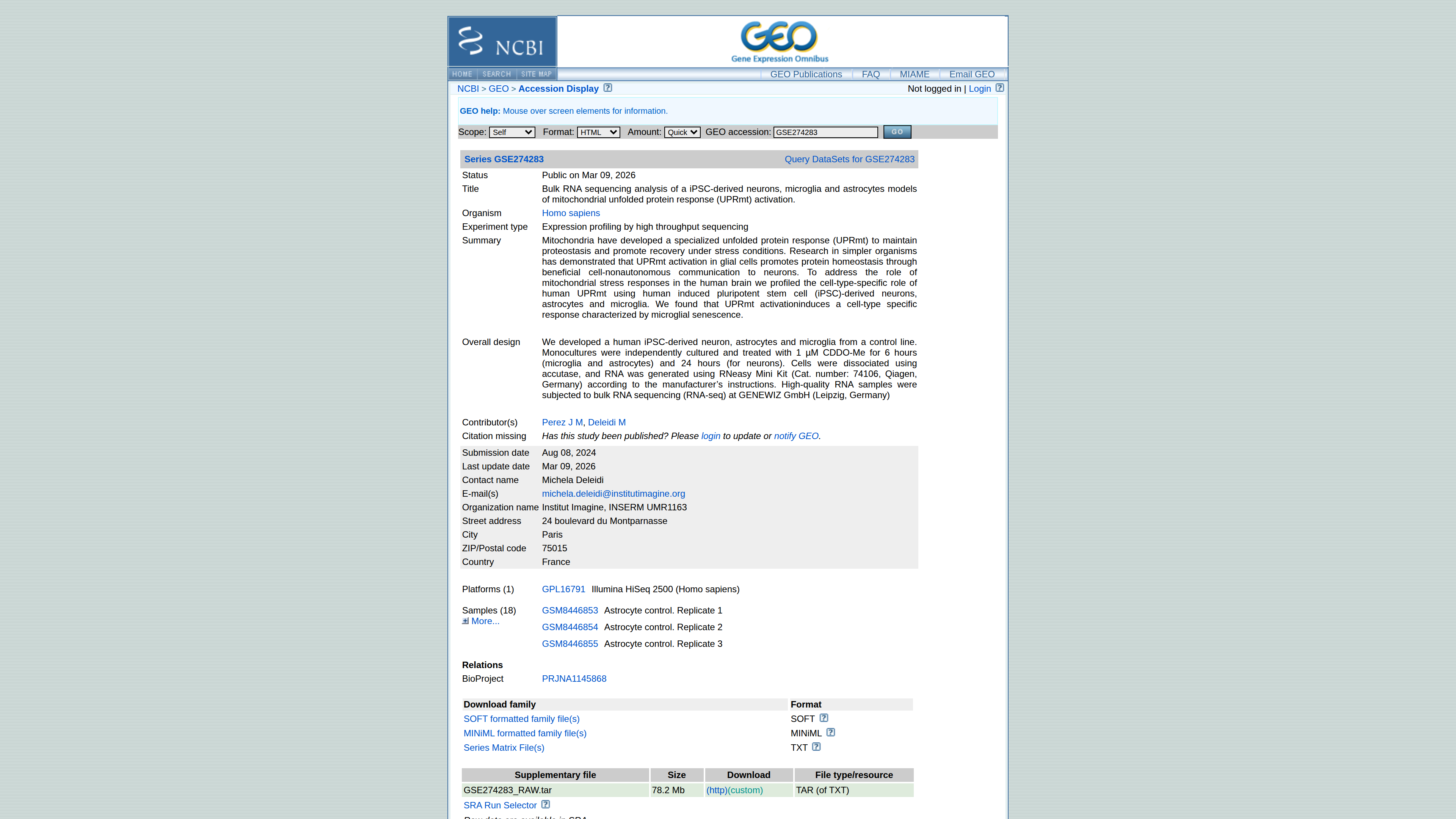
Mitochondria have developed a specialized unfolded protein response (UPRmt) to maintain proteostasis and promote recovery under stress conditions. Research in simpler organisms has demonstrated that UPRmt activation in glial cells promotes protein homeostasis through beneficial cell-nonautonomous communication to neurons. To address the role of mitochondrial stress responses in the human brain we profiled the cell-type-specific role of human UPRmt using human induced pluripotent stem cell (iPSC)-derived neurons, astrocytes and microglia. We found that UPRmt activationinduces a cell-type specific response characterized by microglial senescence.
关键词
1Homo sapiens
www.ncbi.nlm.nih.gov
IP: 130.14.29.110
加载中...
相关论文
1The mitochondrial unfolded protein response in human microglia disrupts neuronal–glial communication and promotes senescence
Maria Jose Perez J•Alicia Lam•Christin Weissleder•Federico Bertoli•Hariam Raji等 14 人
Nature Neuroscience
2026
•2026/6/26
•00 p.1-15
Mitochondria have evolved a specialized mitochondrial unfolded protein response (UPRmt) to maintain proteostasis and promote recovery under stress. Studies in simple organisms have shown that UPRmt activation in glial cells supports proteostasis through beneficial non-cell-autonomous communication w...
MicrogliaMitochondriaMolecular neuroscienceNeuroimmunology
10.1038/S41593-026-02320-1
ISSN:1097-6256