TriTrypDB 70 Release
English
United States, Athens
Apollo
数据描述
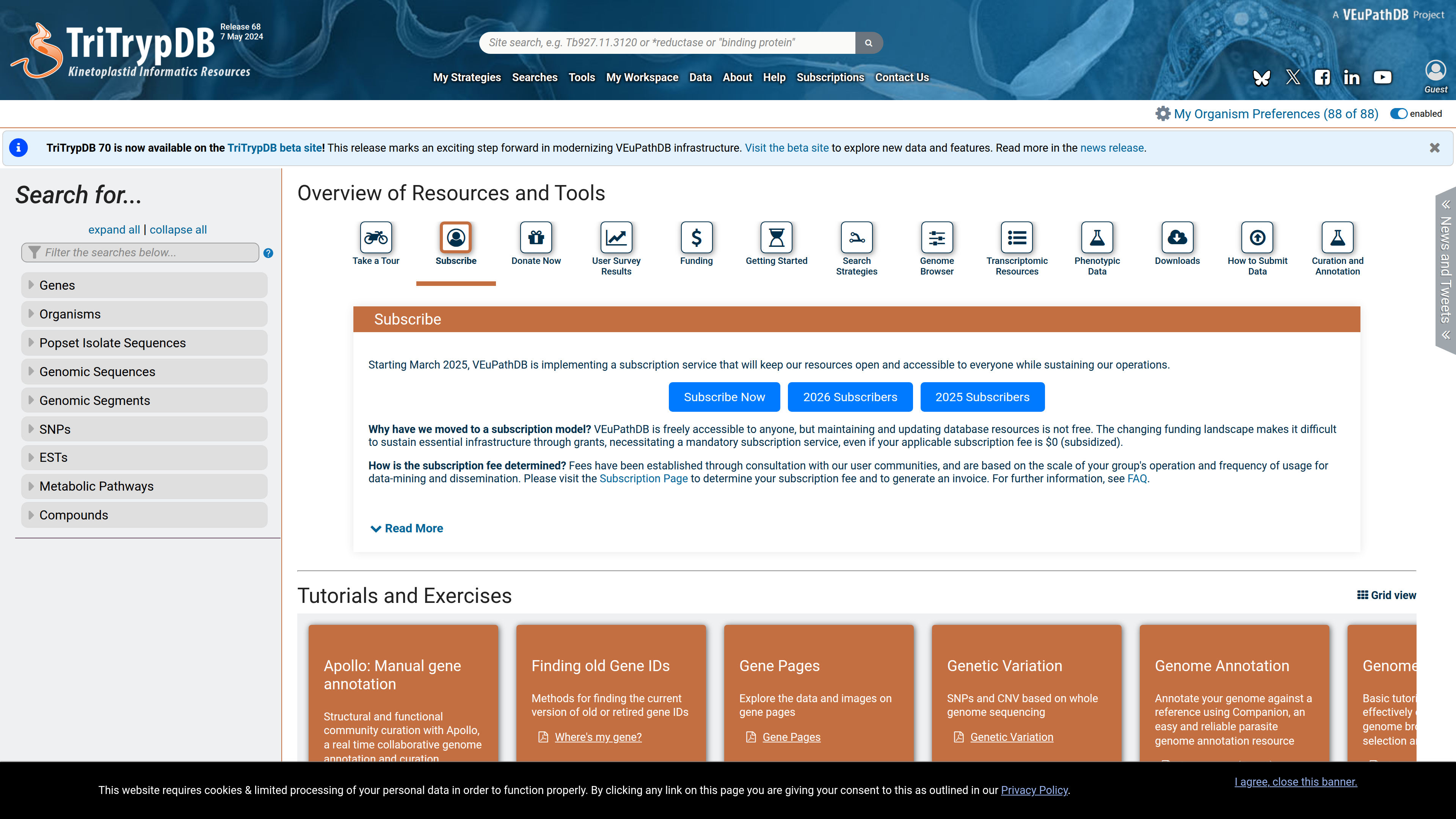
VEuPathDB is a data platform that provides access to genomic, phenotypic, and population-centric data for the scientific community, with TriTrypDB offering support for specific organisms. The dataset includes genes, organisms, genomic sequences, SNPs, ESTs, metabolic pathways, transcriptomics and proteomics data, as well as tools for genome browsing, annotation, and search strategies. Its purpose is to support research in areas such as host response, genetic variation, and metabolic pathway analysis while keeping resources open through a mandatory subscription model.
tritrypdb.org
IP: 128.192.21.13
加载中...
相关论文
16Characterization of a new Leishmania major strain for use in a controlled human infection model
Helen Ashwin•Jovana Sadlova•Barbora Vojtkova•Tomas Becvar•Patrick Lypaczewski等 17 人
Nature Communications
2021
•2021/1/11
•Vol.12 No.1 p.1-12
Leishmaniasis is widely regarded as a vaccine-preventable disease, but the costs required to reach pivotal Phase 3 studies and uncertainty about which candidate vaccines should be progressed into human studies significantly limits progress in vaccine development for this neglected tropical disease. ...
Live attenuated vaccinesParasite biology
10.1038/S41467-020-20569-3
ISSN:2041-1723
An invariant Trypanosoma vivax vaccine antigen induces protective immunity
Delphine Autheman•Cécile Crosnier•Simon Clare•David A. Goulding•Cordelia Brandt等 14 人
Nature
2021
•2021/5/26
•00 p.1-5
Trypanosomes are protozoan parasites that cause infectious diseases, including African trypanosomiasis (sleeping sickness) in humans and nagana in economically important livestock1,2. An effective vaccine against trypanosomes would be an important control tool, but the parasite has evolved sophistic...
ParasitologyProtein vaccines
10.1038/S41586-021-03597-X
ISSN:0028-0836
Genetic diversity and comparative genomics across Leishmania (Viannia) species
Laura Natalia Gonzalez-Garcia•Maria Paula Rodriguez•Marcela Parra-Muñoz•Ana M. Clavijo•Laura Levy等 16 人
Communications Biology
2025
•2025/6/14
•Vol.8 No.1 p.1-14
Leishmaniasis is an important public health problem worldwide, with a broad spectrum of clinical and epidemiological features partly associated with the diversity and complex life cycle of the Leishmania parasites. This study analyzes genomic data from 205 Leishmania (Viannia) samples, including 65 ...
Genetic variationPathogens
10.1038/S42003-025-08331-1
ISSN:2399-3642
Nucleoside analogue activators of cyclic AMP-independent protein kinase A of Trypanosoma
Sabine Bachmaier•Yuri Volpato Santos•Susanne Kramer•George Boniface Githure•Thomas Klöckner等 16 人
Nature Communications
2019
•2019/3/29
•Vol.10 No.1 p.1-14
Protein kinase A (PKA), the main effector of cAMP in eukaryotes, is a paradigm for the mechanisms of ligand-dependent and allosteric regulation in signalling. Here we report the orthologous but cAMP-independent PKA of the protozoan Trypanosoma and identify 7-deaza-nucleosides as potent activators (E...
KinasesParasite biologySmall moleculesX-ray crystallography
10.1038/S41467-019-09338-Z
ISSN:2041-1723
Genome-wide chromatin interaction map for Trypanosoma cruzi
Florencia Díaz-Viraqué•María Laura Chiribao•María Gabriela Libisch•Carlos Robello
Nature Microbiology
2023
•2023/10/12
•00 p.1-12
Trypanosomes are eukaryotic, unicellular parasites, such as Trypanosoma brucei, which causes sleeping sickness, and Trypanosoma cruzi, which causes Chagas disease. Genomes of these parasites comprise core regions and species-specific disruptive regions that encode multigene families of surface glyco...
Molecular medicineParasite biology
10.1038/S41564-023-01483-Y
ISSN:2058-5276
Structural basis of the RNA-editing cascade in trypanosome mitochondria
Yun-Tao Liu•Andres F. Vacas•Jonathan Jih•Xiaojing Zhao•Clinton Yu等 15 人
Nature
2026
•2026/7/22
•00 p.1-12
The molecular mechanism of uridine insertion-and-deletion mRNA editing in trypanosome mitochondria1–4 has remained unclear because of the highly dynamic nature of the underlying multi-enzyme machinery5. Here, we define editosomes as supramolecular assemblies formed by the RNA-editing substrate-bindi...
Cryoelectron microscopyRNA editing
10.1038/S41586-026-10831-X
ISSN:0028-0836
Mistargeting of aggregation prone mitochondrial proteins activates a nucleus-mediated posttranscriptional quality control pathway in trypanosomes
Dewar Caroline E.•Oeljeklaus Silke•Mani Jan•Mühlhäuser Wignand W. D.•von Känel Corinne等 9 人
Nature Communications
2022
•2022/6/2
•Vol.13 No.1 p.1-17
Mitochondrial protein import in the parasitic protozoan Trypanosoma brucei is mediated by the atypical outer membrane translocase, ATOM. It consists of seven subunits including ATOM69, the import receptor for hydrophobic proteins. Ablation of ATOM69, but not of any other subunit, triggers a unique q...
Parasite biologyProteomics
10.1038/S41467-022-30748-Z
ISSN:2041-1723
Bromodomain factor 5 is an essential regulator of transcription in Leishmania
Jones Nathaniel G.•Geoghegan Vincent•Moore Gareth•Carnielli Juliana B. T.•Newling Katherine等 12 人
Nature Communications
2022
•2022/7/13
•Vol.13 No.1 p.1-18
Leishmania are unicellular parasites that cause human and animal diseases. Like other kinetoplastids, they possess large transcriptional start regions (TSRs) which are defined by histone variants and histone lysine acetylation. Cellular interpretation of these chromatin marks is not well understood....
ChromatinGene expressionParasite biologyTranscription
10.1038/S41467-022-31742-1
ISSN:2041-1723
Combining tubercidin and cordycepin scaffolds results in highly active candidates to treat late-stage sleeping sickness
Fabian Hulpia•Dorien Mabille•Gustavo D. Campagnaro•Gabriela Schumann•Louis Maes等 10 人
Nature Communications
2019
•2019/12/5
•Vol.10 No.1 p.1-11
African trypanosomiasis is a disease caused by Trypanosoma brucei parasites with limited treatment options. Trypanosoma is unable to synthesize purines de novo and relies solely on their uptake and interconversion from the host, constituting purine nucleoside analogues a potential source of antitryp...
Drug deliveryDrug screeningMedicinal chemistryParasitologyTarget identification
10.1038/S41467-019-13522-6
ISSN:2041-1723
Discovery of an orally active benzoxaborole prodrug effective in the treatment of Chagas disease in non-human primates
Padilla Angel M.•Wang Wei•Akama Tsutomu•Carter David S.•Easom Eric等 20 人
Nature Microbiology
2022
•2022/9/5
•Vol.7 No.10 p.1536-1546
Trypanosoma cruzi, the agent of Chagas disease, probably infects tens of millions of people, primarily in Latin America, causing morbidity and mortality. The options for treatment and prevention of Chagas disease are limited and underutilized. Here we describe the discovery of a series of benzoxabor...
Drug developmentParasite biologyParasitic infectionTarget identification
10.1038/S41564-022-01211-Y
ISSN:2058-5276
Genome-wide subcellular protein map for the flagellate parasite Trypanosoma brucei
Billington Karen•Halliday Clare•Madden Ross•Dyer Philip•Barker Amy Rachel等 13 人
Nature Microbiology
2023
•2023/2/20
•Vol.8 No.3 p.533-547
Trypanosoma brucei is a model trypanosomatid, an important group of human, animal and plant unicellular parasites. Understanding their complex cell architecture and life cycle is challenging because, as with most eukaryotic microbes, ~50% of genome-encoded proteins have completely unknown functions....
High-throughput screeningMolecular biologyOrganellesParasitologyPathogens
10.1038/S41564-022-01295-6
ISSN:2058-5276
A multi-adenylate cyclase regulator at the flagellar tip controls African trypanosome transmission
Bachmaier Sabine•Giacomelli Giacomo•Calvo-Alvarez Estefanía•Vieira Larissa Rezende•Van Den Abbeele Jan等 16 人
Nature Communications
2022
•2022/9/16
•Vol.13 No.1 p.1-17
Signaling from ciliary microdomains controls developmental processes in metazoans. Trypanosome transmission requires development and migration in the tsetse vector alimentary tract. Flagellar cAMP signaling has been linked to parasite social motility (SoMo) in vitro, yet uncovering control of direct...
Cell signallingMolecular modellingParasite biologyProtein–protein interaction networksSuper-resolution microscopy
10.1038/S41467-022-33108-Z
ISSN:2041-1723
Mapping diversity in African trypanosomes using high resolution spatial proteomics
Nicola M. Moloney•Konstantin Barylyuk•Eelco Tromer•Oliver M. Crook•Lisa M. Breckels等 8 人
Nature Communications
2023
•2023/7/21
•Vol.14 No.1 p.1-16
African trypanosomes are dixenous eukaryotic parasites that impose a significant human and veterinary disease burden on sub-Saharan Africa. Diversity between species and life-cycle stages is concomitant with distinct host and tissue tropisms within this group. Here, the spatial proteomes of two Afri...
OrganellesParasitologyProteomics
10.1038/S41467-023-40125-Z
ISSN:2041-1723
N6-methyladenosine in poly(A) tails stabilize VSG transcripts
Viegas Idálio J.•de Macedo Juan Pereira•Serra Lúcia•De Niz Mariana•Temporão Adriana等 12 人
Nature
2022
•2022/3/30
•00 p.1-9
RNA modifications are important regulators of gene expression1. In Trypanosoma brucei, transcription is polycistronic and thus most regulation happens post-transcriptionally2. N6-methyladenosine (m6A) has been detected in this parasite, but its function remains unknown3. Here we found that m6A is en...
Parasite immune evasionRNA modification
10.1038/S41586-022-04544-0
ISSN:0028-0836
FAP106 is an interaction hub for assembling microtubule inner proteins at the cilium inner junction
Michelle M. Shimogawa•Angeline S. Wijono•Hui Wang•Jiayan Zhang•Jihui Sha等 12 人
Nature Communications
2023
•2023/8/26
•Vol.14 No.1 p.1-12
Motility of pathogenic protozoa depends on flagella (synonymous with cilia) with axonemes containing nine doublet microtubules (DMTs) and two singlet microtubules. Microtubule inner proteins (MIPs) within DMTs influence axoneme stability and motility and provide lineage-specific adaptations, but ind...
Cellular motilityCiliaCryoelectron tomographyMicrotubulesParasite biology
10.1038/S41467-023-40230-Z
ISSN:2041-1723
Identification of a small-molecule inhibitor that selectively blocks DNA-binding by Trypanosoma brucei replication protein A1
Aditi Mukherjee•Zakir Hossain•Esteban Erben•Shuai Ma•Jun Yong Choi等 6 人
Nature Communications
2023
•2023/7/20
•Vol.14 No.1 p.1-19
Replication Protein A (RPA) is a broadly conserved complex comprised of the RPA1, 2 and 3 subunits. RPA protects the exposed single-stranded DNA (ssDNA) during DNA replication and repair. Using structural modeling, we discover an inhibitor, JC-229, that targets RPA1 in Trypanosoma brucei, the causat...
DNA-binding proteinsTarget identification
10.1038/S41467-023-39839-X
ISSN:2041-1723