Shared and distinct transcriptomic cell types across neocortical areas
Allen Institute
2018
2018/10/31
United States, Cabin John
The Allen Institute for Brain Science

数据描述

Shared and distinct transcriptomic cell types across neocortical areas

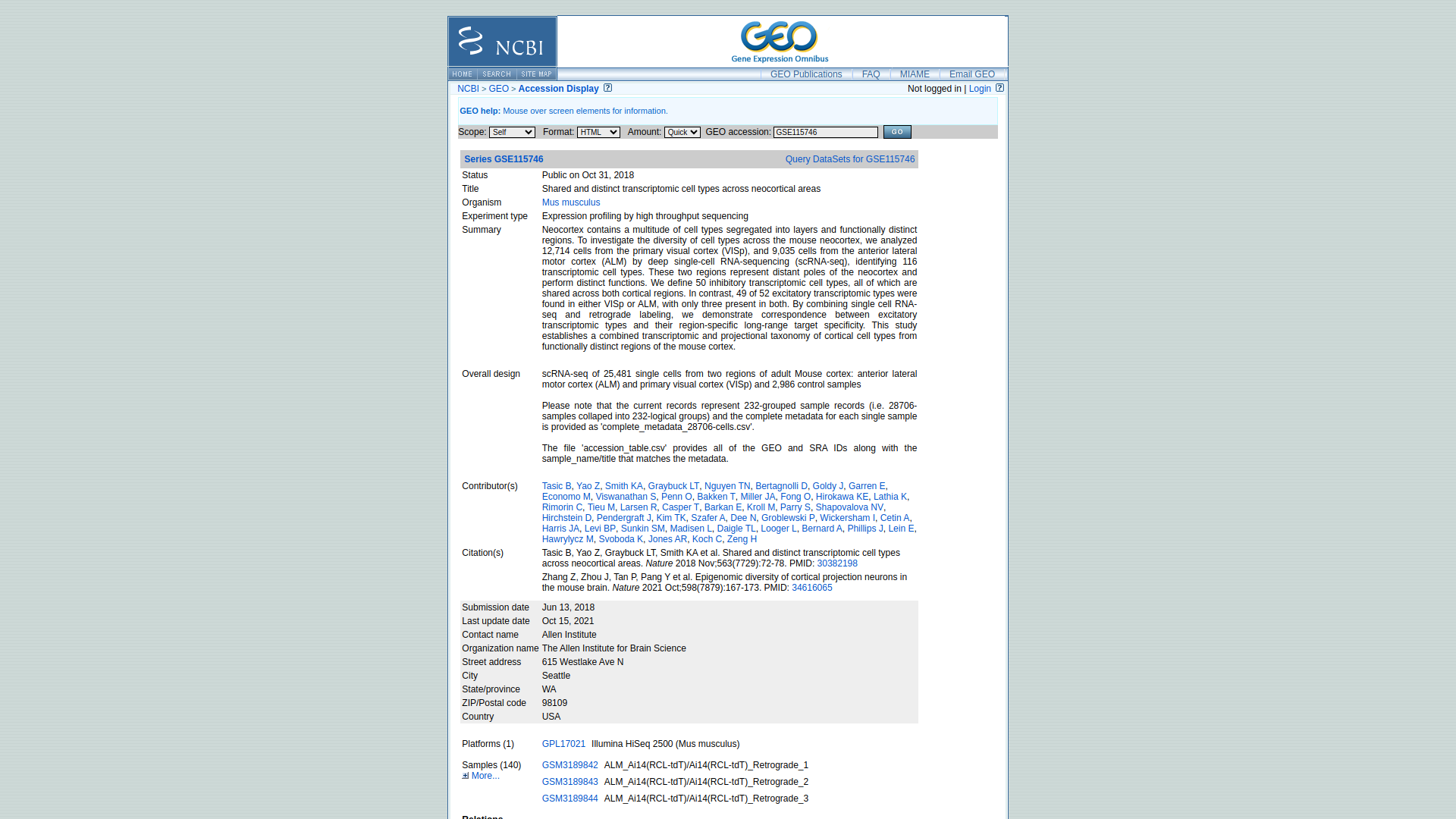
Neocortex contains a multitude of cell types segregated into layers and functionally distinct regions. To investigate the diversity of cell types across the mouse neocortex, we analyzed 12,714 cells from the primary visual cortex (VISp), and 9,035 cells from the anterior lateral motor cortex (ALM) by deep single-cell RNA-sequencing (scRNA-seq), identifying 116 transcriptomic cell types. These two regions represent distant poles of the neocortex and perform distinct functions. We define 50 inhibitory transcriptomic cell types, all of which are shared across both cortical regions. In contrast, 49 of 52 excitatory transcriptomic types were found in either VISp or ALM, with only three present in both. By combining single cell RNA-seq and retrograde labeling, we demonstrate correspondence between excitatory transcriptomic types and their region-specific long-range target specificity. This study establishes a combined transcriptomic and projectional taxonomy of cortical cell types from functionally distinct regions of the mouse cortex.

关键词

1
Mus musculus

数据列表

9

SOFT formatted family file(s)

格式SOFT
下载

MINiML formatted family file(s)

格式MINiML
下载

Series Matrix File(s)

格式TXT
下载

GSE115746_accession_table.csv.gz

格式CSV
大小173.6 Kb
下载

GSE115746_cells_exon_counts.csv.gz

格式CSV
大小319.2 Mb
下载

GSE115746_cells_intron_counts.csv.gz

格式CSV
大小155.0 Mb
下载

GSE115746_complete_metadata_28706-cells.csv.gz

格式CSV
大小489.9 Kb
下载

GSE115746_controls_exon_counts.csv.gz

格式CSV
大小21.5 Mb
下载

GSE115746_controls_intron_counts.csv.gz

格式CSV
大小14.0 Mb
下载
www.ncbi.nlm.nih.gov
IP: 130.14.29.110
访问数据源
加载中...

相关论文

22

Putative cell type discovery from single-cell gene expression data

Zhichao MiaoPablo MorenoNi HuangIrene PapatheodorouAlvis Brazma6
Nature Methods
2020
2020/5/18
Vol.17 No.6 p.621-628
We present the Single-Cell Clustering Assessment Framework, a method for the automated identification of putative cell types from single-cell RNA sequencing (scRNA-seq) data. By iteratively applying a machine learning approach to a given set of cells, we simultaneously identify distinct cell groups ...
Computational biology and bioinformaticsComputational modelsFunctional clusteringGene expressionSoftware
10.1038/S41592-020-0825-9
ISSN:1548-7091

Modeling gene regulatory networks using neural network architectures

Hantao ShuJingtian ZhouQiuyu LianHan LiDan Zhao7
Nature Computational Science
2021
2021/7/22
Vol.1 No.7 p.491-501
Gene regulatory networks (GRNs) encode the complex molecular interactions that govern cell identity. Here we propose DeepSEM, a deep generative model that can jointly infer GRNs and biologically meaningful representation of single-cell RNA sequencing (scRNA-seq) data. In particular, we developed a n...
Computational biology and bioinformaticsGene regulatory networksMachine learning
10.1038/S43588-021-00099-8
ISSN:2662-8457

Harnessing the power of single-cell large language models with parameter-efficient fine-tuning using scPEFT

Fei HeRuixin FeiJordan E. KrullYang YuXinyu Zhang16
Nature Machine Intelligence
2025
2025/12/31
Vol.8 No.1 p.118-133
Single-cell large language models (scLLMs) capture essential biological insights from vast single-cell atlases but struggle in out-of-context applications, where zero-shot predictions can be unreliable. To address this, here we introduce a single-cell parameter-efficient fine-tuning (scPEFT) framewo...
Computational modelsMachine learning
10.1038/S42256-025-01170-Z
ISSN:2522-5839

Alternative splicing of latrophilin-3 controls synapse formation

Shuai WangChelsea DeLeonWenfei SunStephen R. QuakeBryan L. Roth6
Nature
2024
2024/1/17
00 p.1-8
The assembly and specification of synapses in the brain is incompletely understood1–3. Latrophilin-3 (encoded by Adgrl3, also known as Lphn3)—a postsynaptic adhesion G-protein-coupled receptor—mediates synapse formation in the hippocampus4 but the mechanisms involved remain unclear. Here we show in ...
G protein-coupled receptorsMolecular neuroscienceNext-generation sequencingRNA splicingSynaptic development
10.1038/S41586-023-06913-9
ISSN:0028-0836

Joint inference of discrete cell types and continuous type-specific variability in single-cell datasets with MMIDAS

Yeganeh MarghiRohan GalaFahimeh BaftizadehUygar Sümbül
Nature Computational Science
2024
2024/9/23
Vol.4 No.9 p.706-722
Reproducible definition and identification of cell types is essential to enable investigations into their biological function and to understand their relevance in the context of development, disease and evolution. Current approaches model variability in data as continuous latent factors, followed by...
Cellular neuroscienceComputational biology and bioinformaticsComputational neuroscienceMachine learning
10.1038/S43588-024-00683-8
ISSN:2662-8457

MARS: discovering novel cell types across heterogeneous single-cell experiments

Maria BrbićMarinka ZitnikSheng WangAngela O. PiscoRuss B. Altman7
Nature Methods
2020
2020/10/19
Vol.17 No.12 p.1200-1206
Although tremendous effort has been put into cell-type annotation, identification of previously uncharacterized cell types in heterogeneous single-cell RNA-seq data remains a challenge. Here we present MARS, a meta-learning approach for identifying and annotating known as well as new cell types. MAR...
GenomicsMachine learningStatistical methodsTranscriptomics
10.1038/S41592-020-00979-3
ISSN:1548-7091

Transcriptional and morphological profiling of parvalbumin interneuron subpopulations in the mouse hippocampus

Lin QueDavid LukacsovichWenshu LuoCsaba Földy
Nature Communications
2021
2021/1/4
Vol.12 No.1 p.1-15
The diversity reflected by >100 different neural cell types fundamentally contributes to brain function and a central idea is that neuronal identity can be inferred from genetic information. Recent large-scale transcriptomic assays seem to confirm this hypothesis, but a lack of morphological informa...
Cellular neuroscienceMolecular neuroscienceTranscriptomics
10.1038/S41467-020-20328-4
ISSN:2041-1723

Hierarchical progressive learning of cell identities in single-cell data

Lieke MichielsenMarcel J. T. ReindersAhmed Mahfouz
Nature Communications
2021
2021/5/14
Vol.12 No.1 p.1-12
Supervised methods are increasingly used to identify cell populations in single-cell data. Yet, current methods are limited in their ability to learn from multiple datasets simultaneously, are hampered by the annotation of datasets at different resolutions, and do not preserve annotations when retra...
Data processingGene expressionMachine learning
10.1038/S41467-021-23196-8
ISSN:2041-1723

acorde unravels functionally interpretable networks of isoform co-usage from single cell data

Arzalluz-Luque AngelesSalguero PedroTarazona SoniaConesa Ana
Nature Communications
2022
2022/4/5
Vol.13 No.1 p.1-18
Alternative splicing (AS) is a highly-regulated post-transcriptional mechanism known to modulate isoform expression within genes and contribute to cell-type identity. However, the extent to which alternative isoforms establish co-expression networks that may be relevant in cellular function has not ...
Computational biology and bioinformaticsSystems biology
10.1038/S41467-022-29497-W
ISSN:2041-1723

SpiceMix enables integrative single-cell spatial modeling of cell identity

Chidester BenjaminZhou TianmingAlam ShahulMa Jian
Nature Genetics
2023
2023/1/9
Vol.55 No.1 p.78-88
Spatial transcriptomics can reveal spatially resolved gene expression of diverse cells in complex tissues. However, the development of computational methods that can use the unique properties of spatial transcriptome data to unveil cell identities remains a challenge. Here we introduce SpiceMix, an ...
Computational biology and bioinformaticsGenomics
10.1038/S41588-022-01256-Z
ISSN:1061-4036

An atlas of primate insular cortex reveals a signal-processing strategy in von Economo neurons

Rui-Feng LiuMengyao HuangYuhui ShenMingting ShaoJunzhan Jing13
Nature Cell Biology
2026
2026/7/2
00 p.1-16
The anterior insular cortex (AIC) is a critical hub integrating exteroceptive and interoceptive information into high-order cognition, yet its neural basis remains incompletely understood. Here, by combining whole-cell-based single-cell transcriptomics with Patch-seq recordings, we resolved and char...
Computer modellingGene expressionRNA sequencingTranscriptomics
10.1038/S41556-026-02009-4
ISSN:1465-7392

Pianno: a probabilistic framework automating semantic annotation for spatial transcriptomics

Yuqiu ZhouWei HeWeizhen HouYing Zhu
Nature Communications
2024
2024/4/2
Vol.15 No.1 p.1-15
Spatial transcriptomics has revolutionized the study of gene expression within tissues, while preserving spatial context. However, annotating spatial spots’ biological identity remains a challenge. To tackle this, we introduce Pianno, a Bayesian framework automating structural semantics annotation b...
Computational modelsData processingRNA sequencingSoftwareStatistical methods
10.1038/S41467-024-47152-4
ISSN:2041-1723

A unified model for interpretable latent embedding of multi-sample, multi-condition single-cell data

Ariel MadrigalTianyuan LuLarisa M. SotoHamed S. Najafabadi
Nature Communications
2024
2024/8/3
Vol.15 No.1 p.1-15
Single-cell analysis across multiple samples and conditions requires quantitative modeling of the interplay between the continuum of cell states and the technical and biological sources of sample-to-sample variability. We introduce GEDI, a generative model that identifies latent space variations in ...
Bayesian inferenceBioinformaticsData integrationData processingGene regulatory networks
10.1038/S41467-024-50963-0
ISSN:2041-1723

A brain cell atlas integrating single-cell transcriptomes across human brain regions

Xinyue ChenYin HuangLiangfeng HuangZiliang HuangZhao-Zhe Hao14
Nature Medicine
2024
2024/8/2
00 p.1-13
While single-cell technologies have greatly advanced our comprehension of human brain cell types and functions, studies including large numbers of donors and multiple brain regions are needed to extend our understanding of brain cell heterogeneity. Integrating atlas-level single-cell data presents a...
Genetic databasesRNA sequencing
10.1038/S41591-024-03150-Z
ISSN:1078-8956

Shared and distinct transcriptomic cell types across neocortical areas

Bosiljka TasicZizhen YaoLucas T. GraybuckKimberly A. SmithThuc Nghi Nguyen48
Nature
2018
2018/10/31
Vol.563 No.7729 p.72-78
The neocortex contains a multitude of cell types that are segregated into layers and functionally distinct areas. To investigate the diversity of cell types across the mouse neocortex, here we analysed 23,822 cells from two areas at distant poles of the mouse neocortex: the primary visual cortex and...
Gene expressionNeuroscienceTranscriptomicsVisual system
10.1038/S41586-018-0654-5
ISSN:0028-0836

Reconstructing single-cell resolution from spatial transcriptomics with CellRefiner

Eric Bourgain-ChangXiangyu KuangZixuan CangQing Nie
Nature Communications
2026
2026/2/27
Vol.17 No.1 p.33040
Single-cell RNA sequencing technologies profile the transcriptome of individual cells but lack the spatial context necessary for dissecting cellular interactions like cell-cell communications. On the other hand, most current spatial transcriptomic technologies lack cellular resolution, limiting thei...
Computational modelsData integrationTranscriptomics
10.1038/S41467-026-70090-2
ISSN:2041-1723

High-resolution mapping of single cells in spatial context

Jincan KeJian XuJia LiuYumeng YangChenkai Guo9
Nature Communications
2025
2025/7/15
Vol.16 No.1 p.1-21
Spatially resolved transcriptomic technologies have emerged as pivotal tools for elucidating molecular regulation and cellular interplay within the intricate tissue microenvironment, but hampered by insufficient gene recovery or challenges in achieving intact single-cell resolution. Here, we develop...
Computational modelsData integration
10.1038/S41467-025-61667-4
ISSN:2041-1723

DIALOGUE maps multicellular programs in tissue from single-cell or spatial transcriptomics data

Jerby-Arnon LivnatRegev Aviv
Nature Biotechnology
2022
2022/5/5
00 p.1-11
Deciphering the functional interactions of cells in tissues remains a major challenge. Here we describe DIALOGUE, a method to systematically uncover multicellular programs (MCPs)—combinations of coordinated cellular programs in different cell types that form higher-order functional units at the tiss...
Computational biology and bioinformaticsSystems biology
10.1038/S41587-022-01288-0
ISSN:1087-0156

Highly sensitive spatial transcriptomics using FISHnCHIPs of multiple co-expressed genes

Xinrui ZhouWan Yi SeowNorbert HaTeh How ChengLingfan Jiang10
Nature Communications
2024
2024/3/15
Vol.15 No.1 p.1-14
High-dimensional, spatially resolved analysis of intact tissue samples promises to transform biomedical research and diagnostics, but existing spatial omics technologies are costly and labor-intensive. We present Fluorescence In Situ Hybridization of Cellular HeterogeneIty and gene expression Progra...
Fluorescence in situ hybridizationGene expression profilingTranscriptomics
10.1038/S41467-024-46669-Y
ISSN:2041-1723

Deciphering cell–cell communication at single-cell resolution for spatial transcriptomics with subgraph-based graph attention network

Wenyi YangPingping WangShouping XuTao WangMeng Luo19
Nature Communications
2024
2024/8/18
Vol.15 No.1 p.1-18
The inference of cell–cell communication (CCC) is crucial for a better understanding of complex cellular dynamics and regulatory mechanisms in biological systems. However, accurately inferring spatial CCCs at single-cell resolution remains a significant challenge. To address this issue, we present a...
BioinformaticsCellular signalling networksComputational modelsMachine learningRNA sequencing
10.1038/S41467-024-51329-2
ISSN:2041-1723

scGCN is a graph convolutional networks algorithm for knowledge transfer in single cell omics

Qianqian SongJing SuWei Zhang
Nature Communications
2021
2021/6/22
Vol.12 No.1 p.1-11
Single-cell omics is the fastest-growing type of genomics data in the literature and public genomics repositories. Leveraging the growing repository of labeled datasets and transferring labels from existing datasets to newly generated datasets will empower the exploration of single-cell omics data. ...
Computational modelsSequencingSoftwareTranscriptomics
10.1038/S41467-021-24172-Y
ISSN:2041-1723

Inferring neuron-neuron communications from single-cell transcriptomics through NeuronChat

Zhao WeiJohnston Kevin G.Ren HongleiXu XiangminNie Qing
Nature Communications
2023
2023/2/28
Vol.14 No.1 p.1-16
Neural communication networks form the fundamental basis for brain function. These communication networks are enabled by emitted ligands such as neurotransmitters, which activate receptor complexes to facilitate communication. Thus, neural communication is fundamentally dependent on the transcriptom...
Computational neuroscienceNeural circuits
10.1038/S41467-023-36800-W
ISSN:2041-1723