Population, total | Data
English
CloseBrowse byCountryorIndicatorDataBankMicrodataData

数据描述

Population, total | Data

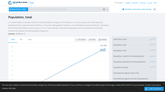
The dataset is the World Bank World Development Indicators series “Population, total,” providing annual estimates of the total number of people living in each country, economy, and selected regional or income aggregates, reported in thousands, with coverage from 1960 through the most recent year (e.g., 2023). It contains time-series values for entities ranging from individual countries to the world total and development groupings, enabling comparison of population levels across places and over time. Estimates are compiled from the United Nations Population Division’s World Population Prospects (2022 Revision) and supplemented by national statistical offices, Eurostat demographic statistics, and UN Statistics Division population and vital statistics publications, supporting demographic analysis and development planning.

data.worldbank.org
IP: 104.130.169.209
访问数据源
加载中...

相关论文

6

Global patterns of student mobility align with national climate adaptation

Hengyu GuHaoyu HuJianfa ShenYuting ZhangTiyan Shen
Communications Sustainability
2026
2026/5/9
Vol.1 No.1 p.750
Global talent flows substantially shape national and regional competitiveness. Yet, the effects of climate adaptation on these flows are not fully understood. Here we analyse its impact on international student flows by utilising a panel dataset covering 1.15 million international student flows betw...
Climate-change adaptationGeography
10.1038/S44458-026-00061-7
ISSN:3059-4308

Biological invasions facilitate zoonotic disease emergences

Zhang LinRohr JasonCui RuinaXin YusiHan Lixia13
Nature Communications
2022
2022/4/1
Vol.13 No.1 p.1-11
Outbreaks of zoonotic diseases are accelerating at an unprecedented rate in the current era of globalization, with substantial impacts on the global economy, public health, and sustainability. Alien species invasions have been hypothesized to be important to zoonotic diseases by introducing both exi...
Ecological epidemiologyInvasive speciesMacroecology
10.1038/S41467-022-29378-2
ISSN:2041-1723

Global invasion patterns and dynamics of disease vector mosquitoes

Rebecca PabstCarla A. SousaFranz EsslAdrián García-RodríguezDaijun Liu9
Nature Communications
2025
2025/10/22
Vol.16 No.1 p.1-13
Mosquitoes are major vectors of human diseases, and their geographic expansion is primarily driven by the unintentional, human mediated introduction beyond their native ranges. Despite the substantial public health implications and rising numbers of disease outbreaks, a global picture of the introdu...
BiogeographyEntomologyInvasive species
10.1038/S41467-025-64446-3
ISSN:2041-1723

Reframing air pollution as a cognitive and socioeconomic risk

Thomas FahertyLaura-Jayne A. Ellis-BradfordHelen OnyeakaRoy M. HarrisonFrancis D. Pope
Npj Clean Air
2026
2026/3/9
Vol.2 No.1 p.180
Air pollution is a major environmental health risk, yet its cognitive impact remains under-recognised. Evidence links short- and long-term fine particulate matter (PM2.5) exposure to reduced cognitive performance and intelligence quotient (IQ). We estimate global PM2.5-related IQ losses of 65 billio...
Environmental sciencesEnvironmental social sciences
10.1038/S44407-026-00059-4
ISSN:3059-2240

Global particulate pollution research reflects economic capacity more than pollution burden

Jiani YangAntong ZhangXun JianKairui QiuVijay Natraj9
Communications Sustainability
2026
2026/7/27
Vol.1 No.1 p.1210
Air pollution from fine airborne particles remains one of the leading environmental threats to human health, yet it is unclear whether scientific research is concentrated where pollution burdens are greatest. Here we show that global research activity is distributed primarily according to economic c...
Developing worldSustainability
10.1038/S44458-026-00126-7
ISSN:3059-4308

An open-access web application to visualise countries’ and regions’ carbon footprints using Sankey diagrams

Baptiste AndrieuHugo Le BoulzecLouis DelannoyFrançois VerzierGuillaume Winter7
Communications Earth & Environment
2024
2024/5/7
Vol.5 No.1 p.1-9
Consumption-based carbon assessments are essential for evaluating climate change responsibility. However, the results vary greatly depending on the boundary chosen, making them hard to understand for non-expert readers and hindering their uptake by policy makers. Sankey diagrams are a type of flow d...
AttributionEnvironmental impact
10.1038/S43247-024-01378-8
ISSN:2662-4435