Autism and autism-related research data and biospecimens
English
United States, Los Angeles
the Simons Foundation Autism Research Initiative
数据描述
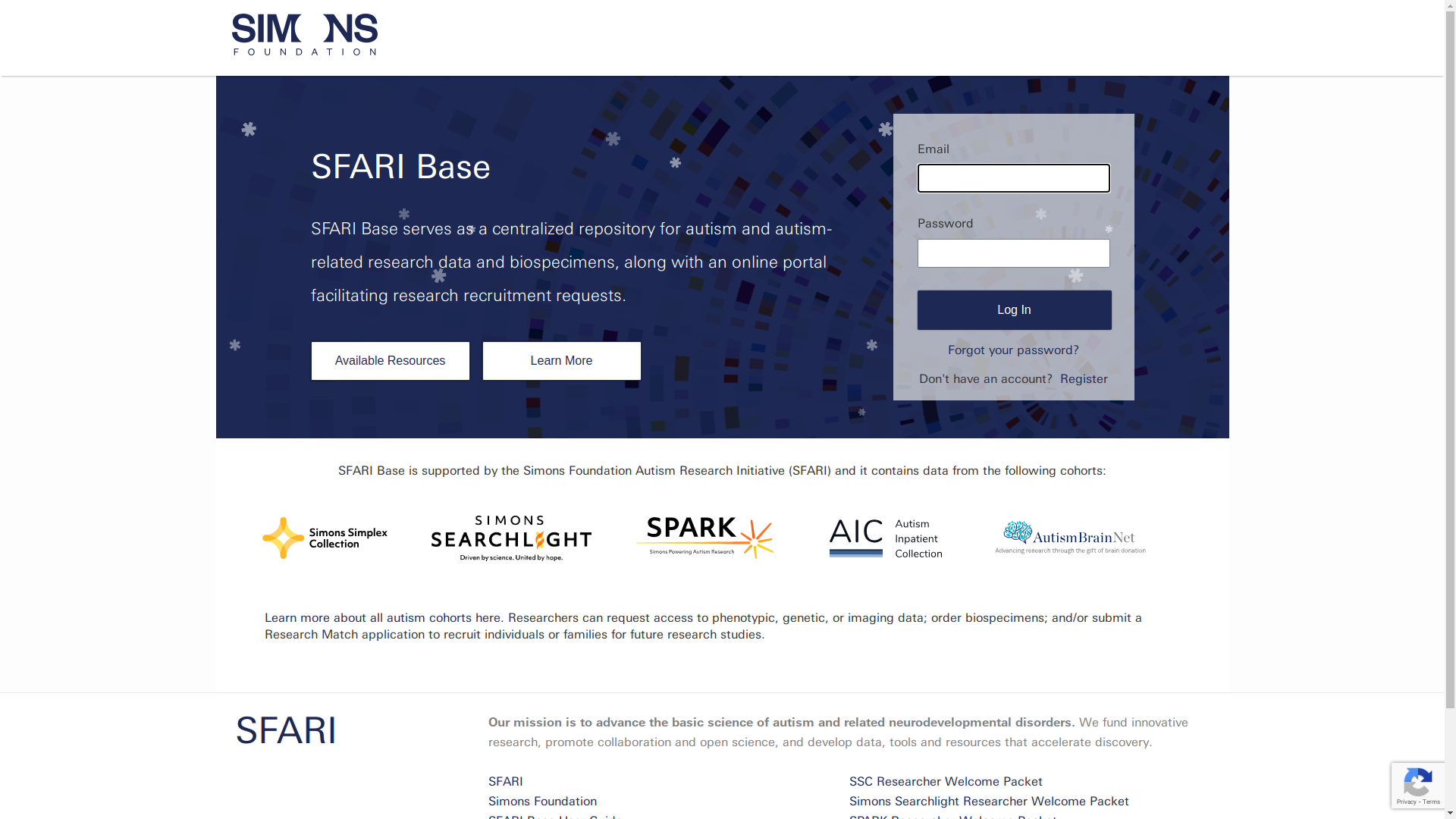
SFARI Base is a centralized repository supported by the Simons Foundation Autism Research Initiative (SFARI) designed to store autism research data, including phenotypic, genetic, and imaging information, along with biospecimens from various cohorts. It provides researchers access to these resources through an online portal for conducting studies on autism and related neurodevelopmental disorders. Researchers can request datasets or biospecimens, submit recruitment applications via Research Match, and utilize the platform's tools to advance scientific discovery in this field.
base.sfari.org
IP: 3.167.212.61
加载中...
相关论文
26Human and bacterial genetic variation shape oral microbiomes and health
Nolan Kamitaki•Robert E. Handsaker•Margaux L. A. Hujoel•Ronen E. Mukamel•Christina L. Usher等 7 人
Nature
2026
•2026/1/28
•Vol.651 No.8105 p.429-439
Human genetic variation influences all aspects of our biology, including the oral cavity1–3, through which nutrients and microbes enter the body. Yet it is largely unknown which human genetic variants shape a person’s oral microbiome and potentially promote its dysbiosis3–5. We characterized the ora...
Bacterial geneticsDental cariesGenome-wide association studies
10.1038/S41586-025-10037-7
ISSN:0028-0836
Genomic landscape of rare variants in a Chinese autism cohort and discovery of novel risk genes
Senwei Tan•Yongqing Lyu•Xiaoyue Sun•Ruolan Guo•Xiaolei Zhang等 31 人
Molecular Psychiatry
2026
•2026/7/16
•00 p.1-18
Autism spectrum disorder (ASD) is a genetically complex neurodevelopmental condition with a high heritability. However, genomic studies of ASD have been underrepresented in East Asian populations, and the molecular yield in ASD cohorts remains modest. Here, we present a whole-genome sequencing analy...
Autism spectrum disordersGenetics
10.1038/S41380-026-03754-6
ISSN:1359-4184
Monoallelic loss-of-function variants in GSK3B lead to autism and developmental delay
Senwei Tan•Qiumeng Zhang•Rui Zhan•Si Luo•Yaoling Han等 37 人
Molecular Psychiatry
2024
•2024/10/29
•00 p.1-14
De novo variants adjacent to the canonical splicing sites or in the well-defined splicing-related regions are more likely to impair splicing but remain under-investigated in autism spectrum disorder (ASD). By analyzing large, recent ASD genome sequencing cohorts, we find a significant burden of de n...
Autism spectrum disordersGenetics
10.1038/S41380-024-02806-Z
ISSN:1359-4184
A genome-wide scan statistic framework for whole-genome sequence data analysis
Zihuai He•Bin Xu•Joseph Buxbaum•Iuliana Ionita-Laza
Nature Communications
2019
•2019/7/9
•Vol.10 No.1 p.1-11
The analysis of whole-genome sequencing studies is challenging due to the large number of noncoding rare variants, our limited understanding of their functional effects, and the lack of natural units for testing. Here we propose a scan statistic framework, WGScan, to simultaneously detect the existe...
Autism spectrum disordersNext-generation sequencingStatistics
10.1038/S41467-019-11023-0
ISSN:2041-1723
Using the linear references from the pangenome to discover missing autism variants
Yang Sui•Jiadong Lin•Michelle D. Noyes•Youngjun Kwon•Isaac Wong等 28 人
Nature Communications
2026
•2026/1/23
•Vol.17 No.1 p.16810
To better understand large-effect pathogenic variation associated with autism, we generated long-read sequencing (LRS) data to construct phased and near-complete genome assemblies (average contig N50 = 43 Mbp, QV = 56) for 189 individuals from 51 families with unsolved cases. We applied read- and as...
Autism spectrum disordersGenetic variation
10.1038/S41467-026-68378-4
ISSN:2041-1723
Mutation of key signaling regulators of cerebrovascular development in vein of Galen malformations
Shujuan Zhao•Kedous Y. Mekbib•Martijn A. van der Ent•Garrett Allington•Andrew Prendergast等 66 人
Nature Communications
2023
•2023/11/17
•Vol.14 No.1 p.1-23
To elucidate the pathogenesis of vein of Galen malformations (VOGMs), the most common and most severe of congenital brain arteriovenous malformations, we performed an integrated analysis of 310 VOGM proband-family exomes and 336,326 human cerebrovasculature single-cell transcriptomes. We found the R...
Genetics researchMedical geneticsVascular diseases
10.1038/S41467-023-43062-Z
ISSN:2041-1723
Phenotypic effects of genetic variants associated with autism
Thomas Rolland•Freddy Cliquet•Richard J. L. Anney•Clara Moreau•Nicolas Traut等 25 人
Nature Medicine
2023
•2023/6/26
•00 p.1-10
While over 100 genes have been associated with autism, little is known about the prevalence of variants affecting them in individuals without a diagnosis of autism. Nor do we fully appreciate the phenotypic diversity beyond the formal autism diagnosis. Based on data from more than 13,000 individuals...
Autism spectrum disordersGenetics research
10.1038/S41591-023-02408-2
ISSN:1078-8956
A reference haplotype panel for genome-wide imputation of short tandem repeats
Shubham Saini•Ileena Mitra•Nima Mousavi•Stephanie Feupe Fotsing•Melissa Gymrek
Nature Communications
2018
•2018/10/23
•Vol.9 No.1 p.1-11
Short tandem repeats (STRs) are involved in dozens of Mendelian disorders and have been implicated in complex traits. However, genotyping arrays used in genome-wide association studies focus on single nucleotide polymorphisms (SNPs) and do not readily allow identification of STR associations. We lev...
Genetic databasesGenome informaticsGenomicsStructural variation
10.1038/S41467-018-06694-0
ISSN:2041-1723
A probabilistic graphical model for estimating selection coefficients of nonsynonymous variants from human population sequence data
Yige Zhao•Tian Lan•Guojie Zhong•Jake Hagen•Hongbing Pan等 7 人
Nature Communications
2025
•2025/5/20
•Vol.16 No.1 p.1-12
Accurately predicting the effect of missense variants is important in discovering disease risk genes and clinical genetic diagnostics. Commonly used computational methods predict pathogenicity, which does not capture the quantitative impact on fitness in humans. We develop a method, MisFit, to estim...
Machine learningRare variantsSequence annotation
10.1038/S41467-025-59937-2
ISSN:2041-1723
Decomposition of phenotypic heterogeneity in autism reveals underlying genetic programs
Aviya Litman•Natalie Sauerwald•LeeAnne Green Snyder•Jennifer Foss-Feig•Christopher Y. Park等 9 人
Nature Genetics
2025
•2025/7/9
•00 p.1-9
Unraveling the phenotypic and genetic complexity of autism is extremely challenging yet critical for understanding the biology, inheritance, trajectory and clinical manifestations of the many forms of the condition. Using a generative mixture modeling approach, we leverage broad phenotypic data from...
Autism spectrum disordersGenetics research
10.1038/S41588-025-02224-Z
ISSN:1061-4036
Estimation of direct and indirect polygenic effects and gene–environment interactions using polygenic scores in case–parent trio studies
Ziqiao Wang•Luke Grosvenor•Debashree Ray•Tianyuan Cheng•Ingo Ruczinski等 9 人
Nature Genetics
2026
•2026/6/2
•00 p.1-11
We have proposed PGS-TRI, a framework for analyzing polygenic scores (PGSs) in case–parent trio studies that estimate the risk of an index condition associated with direct PGS effects, gene–environment interactions and asymmetrical maternal and paternal indirect effects. Simulations confirm its robu...
Autism spectrum disordersGenetic association study
10.1038/S41588-026-02601-2
ISSN:1061-4036
An open science resource for accelerating scalable digital health research in autism and other neurodevelopmental conditions
Micha Hacohen•Adam Levy•Hadas Kaiser•LeeAnne Green Snyder•Alpha Amatya等 8 人
Nature Neuroscience
2025
•2025/12/30
•00 p.1-12
The Simons Sleep Project (SSP) is an open-science resource designed to accelerate digital health research into sleep and daily behaviors of autistic children. The SSP contains data from Dreem3 EEG headbands, multi-sensor EmbracePlus smartwatches and Withings’ sleep mats, as well as parent questionna...
Autism spectrum disordersDiagnostic markersPsychologySleep
10.1038/S41593-025-02146-3
ISSN:1097-6256
Pervasive alterations of intra-axonal volume and network organization in young children with a 16p11.2 deletion
Anne M. Maillard•David Romascano•Julio E. Villalón-Reina•Clara A. Moreau•Joana M. Almeida Osório等 15 人
Translational Psychiatry
2024
•2024/2/14
•Vol.14 No.1 p.1-11
Reciprocal Copy Number Variants (CNVs) at the 16p11.2 locus confer high risk for autism spectrum disorder (ASD) and other neurodevelopmental disorders (NDDs). Morphometric MRI studies have revealed large and pervasive volumetric alterations in carriers of a 16p11.2 deletion. However, the specific ne...
Autism spectrum disordersClinical geneticsNeuroscience
10.1038/S41398-024-02810-5
ISSN:2158-3188
Rare X-linked variants carry predominantly male risk in autism, Tourette syndrome, and ADHD
Sheng Wang•Belinda Wang•Vanessa Drury•Sam Drake•Nawei Sun等 22 人
Nature Communications
2023
•2023/12/6
•Vol.14 No.1 p.1-18
Autism spectrum disorder (ASD), Tourette syndrome (TS), and attention-deficit/hyperactivity disorder (ADHD) display strong male sex bias, due to a combination of genetic and biological factors, as well as selective ascertainment. While the hemizygous nature of chromosome X (Chr X) in males has long ...
Autism spectrum disordersNeurodevelopmental disorders
10.1038/S41467-023-43776-0
ISSN:2041-1723
Large mosaic copy number variations confer autism risk
Maxwell A. Sherman•Rachel E. Rodin•Giulio Genovese•Caroline Dias•Alison R. Barton等 10 人
Nature Neuroscience
2021
•2021/1/11
•Vol.24 No.2 p.197-203
Although germline de novo copy number variants (CNVs) are known causes of autism spectrum disorder (ASD), the contribution of mosaic (early-developmental) copy number variants (mCNVs) has not been explored. In this study, we assessed the contribution of mCNVs to ASD by ascertaining mCNVs in genotype...
Autism spectrum disordersGenetics of the nervous systemStatistical methodsStructural variation
10.1038/S41593-020-00766-5
ISSN:1097-6256
Long-read sequencing of families reveals increased germline and postzygotic mutation rates in repetitive DNA
Michelle D. Noyes•Yang Sui•Youngjun Kwon•Nidhi Koundinya•Isaac Wong等 12 人
Nature Communications
2026
•2026/3/9
0Long-read sequencing improves sensitivity to discover variation in complex repetitive regions, assign parent-of-origin, and distinguish germline from postzygotic mutations. We applied Illumina, Oxford Nanopore Technologies, and PacBio sequencing to discover and validate de novo mutations in 73 child...
Autism spectrum disordersDNA sequencingGenomicsPopulation genetics
10.1038/S41467-026-70342-1
ISSN:2041-1723
Clinical autism subscales have common genetic liabilities that are heritable, pleiotropic, and generalizable to the general population
Thomas Taylor R.•Koomar Tanner•Casten Lucas G.•Tener Ashton J.•Bahl Ethan等 6 人
Translational Psychiatry
2022
•2022/6/13
•Vol.12 No.1 p.1-14
The complexity of autism’s phenotypic spectra is well-known, yet most genetic research uses case-control status as the target trait. It is undetermined if autistic symptom domain severity underlying this heterogeneity is heritable and pleiotropic with other psychiatric and behavior traits in the sam...
Autism spectrum disordersGenomics
10.1038/S41398-022-01982-2
ISSN:2158-3188
A genome-first study of sex chromosome aneuploidies provides evidence of Y chromosome dosage effects on autism risk
Alexander S. F. Berry•Brenda M. Finucane•Scott M. Myers•Lauren K. Walsh•John M. Seibert等 8 人
Nature Communications
2024
•2024/10/15
•Vol.15 No.1 p.1-11
A female protective effect has long been postulated as the primary explanation for the four-fold increase of autism spectrum disorder (ASD) diagnoses in males versus females. However, genetic and epidemiological investigations of this hypothesis have so far failed to explain the large difference in ...
Autism spectrum disordersMedical genomicsRisk factors
10.1038/S41467-024-53211-7
ISSN:2041-1723
Transgenerational transmission of post-zygotic mutations suggests symmetric contribution of first two blastomeres to human germline
Yeongjun Jang•Livia Tomasini•Taejeong Bae•Anna Szekely•Flora M. Vaccarino等 6 人
Nature Communications
2024
•2024/10/23
•Vol.15 No.1 p.1-8
Little is known about the origin of germ cells in humans. We previously leveraged post-zygotic mutations to reconstruct zygote-rooted cell lineage ancestry trees in a phenotypically normal woman, termed NC0. Here, by sequencing the genome of her children and their father, we analyze the transmission...
EmbryogenesisGenomicsGermline developmentMutation
10.1038/S41467-024-53485-X
ISSN:2041-1723
Association of mitochondrial DNA content, heteroplasmies and inter-generational transmission with autism
Wang Yiqin•Guo Xiaoxian•Hong Xiumei•Wang Guoying•Pearson Colleen等 10 人
Nature Communications
2022
•2022/7/1
•Vol.13 No.1 p.1-14
Mitochondria are essential for brain development. While previous studies linked dysfunctional mitochondria with autism spectrum disorder (ASD), the role of the mitochondrial genome (mtDNA) in ASD risk is largely unexplored. This study investigates the association of mtDNA heteroplasmies (co-existenc...
Autism spectrum disordersDNA sequencingMitochondrial genome
10.1038/S41467-022-30805-7
ISSN:2041-1723
Genetic correlates of phenotypic heterogeneity in autism
Warrier Varun•Zhang Xinhe•Reed Patrick•Havdahl Alexandra•Moore Tyler M.等 18 人
Nature Genetics
2022
•2022/6/2
•00 p.1-12
The substantial phenotypic heterogeneity in autism limits our understanding of its genetic etiology. To address this gap, here we investigated genetic differences between autistic individuals (nmax = 12,893) based on core and associated features of autism, co-occurring developmental disabilities and...
Autism spectrum disordersBehavioural genetics
10.1038/S41588-022-01072-5
ISSN:1061-4036
Autism gene variants disrupt enteric neuron migration and cause gastrointestinal dysmotility
Kate E. McCluskey•Katherine M. Stovell•Karen Law•Elina Kostyanovskaya•James D. Schmidt等 11 人
Nature Communications
2025
•2025/3/6
•Vol.16 No.1 p.1-11
The co-occurrence of autism and gastrointestinal distress is well-established, yet the molecular underpinnings remain unknown. The identification of high-confidence, large-effect autism genes offers the opportunity to identify convergent, underlying biology by studying these genes in the context of ...
Autism spectrum disordersConstipation
10.1038/S41467-025-57342-3
ISSN:2041-1723
Large-scale metagenomic analysis of oral microbiomes reveals markers for autism spectrum disorders
Paolo Manghi•Michele Filosi•Moreno Zolfo•Lucas G. Casten•Albert Garcia-Valiente等 23 人
Nature Communications
2024
•2024/11/11
•Vol.15 No.1 p.1-18
The link between the oral microbiome and neurodevelopmental disorders remains a compelling hypothesis, still requiring confirmation in large-scale datasets. Leveraging over 7000 whole-genome sequenced salivary samples from 2025 US families with children diagnosed with autism spectrum disorders (ASD)...
Autism spectrum disordersMetagenomics
10.1038/S41467-024-53934-7
ISSN:2041-1723
Evidence supporting the role of GIGYF2 in synapse development and autism
Bin Yu•Shimeng Zhu•Linhu Xiao•Guodong Chen•Suixin Deng等 41 人
Molecular Psychiatry
2026
•2026/6/15
•00 p.1-15
Autism spectrum disorder (ASD) is a heterogeneous condition in which genetically defined subtypes offered insights into underlying biological mechanisms and potential targeted treatments. Here, we investigate the clinical and pathogenic significance of GIGYF2 variants in ASD through an integrated ap...
Autism spectrum disordersGeneticsNeuroscience
10.1038/S41380-026-03681-6
ISSN:1359-4184
Integrating de novo and inherited variants in 42,607 autism cases identifies mutations in new moderate-risk genes
Zhou Xueya•Feliciano Pamela•Shu Chang•Wang Tianyun•Astrovskaya Irina等 28 人
Nature Genetics
2022
•2022/8/18
•Vol.54 No.9 p.1305-1319
To capture the full spectrum of genetic risk for autism, we performed a two-stage analysis of rare de novo and inherited coding variants in 42,607 autism cases, including 35,130 new cases recruited online by SPARK. We identified 60 genes with exome-wide significance (P < 2.5 × 10⁻⁶), including fi...
Autism spectrum disordersNeuroscienceSequencing
10.1038/S41588-022-01148-2
ISSN:1061-4036
Structural models of genome-wide covariance identify multiple common dimensions in autism
Lucía de Hoyos•Maria T. Barendse•Fenja Schlag•Marjolein M. J. van Donkelaar•Ellen Verhoef等 12 人
Nature Communications
2024
•2024/2/27
•Vol.15 No.1 p.1-15
Common genetic variation has been associated with multiple phenotypic features in Autism Spectrum Disorder (ASD). However, our knowledge of shared genetic factor structures contributing to this highly heterogeneous phenotypic spectrum is limited. Here, we developed and implemented a structural equat...
Autism spectrum disordersBehavioural genetics
10.1038/S41467-024-46128-8
ISSN:2041-1723